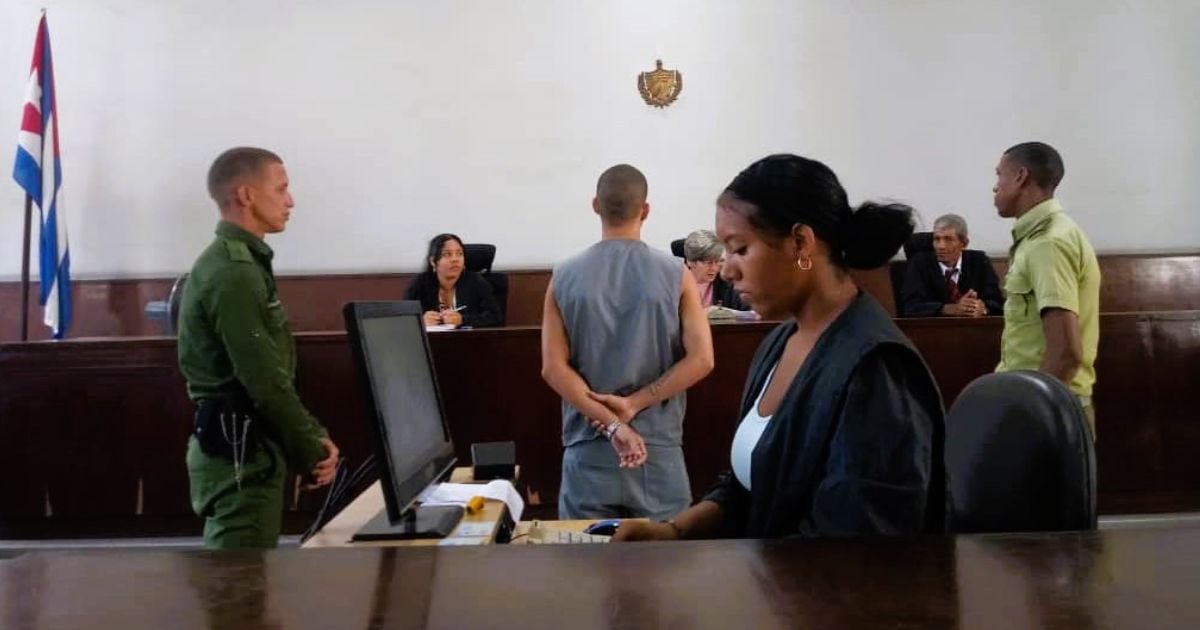
The family of a Cuban citizen, sentenced to 13 years in prison in Santiago de Cuba for international drug trafficking, has alleged significant violations of fundamental rights and procedural safeguards during the trial. According to a provincial court’s Facebook announcement, the accused, a resident in Suriname since 2022, was apprehended at Antonio Maceo International Airport. Authorities discovered 300 grams of high-purity cocaine concealed within a bicycle saddle in his luggage.
The prosecution acknowledged, "The 33-year-old defendant received items in his luggage from someone in Suriname," adding that "he was paid $84 for these actions and was supposed to deliver the items to an unidentified person upon his arrival in Cuba." The statement clarified, "Anyone who agrees to carry packages and inadvertently transports drugs is accountable, thus the court deemed him the perpetrator per Article 20.1.2(a) of the Penal Code." However, the note emphasized an "exemplary" trial, which seemed contradictory given that "the court recognized he had no prior drug involvement, maintained a good social standing, and had no criminal record."
Family members of the convicted man have called for the case to be reopened, claiming that evidence and witnesses proving his unawareness of the drug’s presence were ignored. His sister, Yaidarys Rodríguez Avilés, described the court’s version as "incomplete and biased," noting that her brother returned to Cuba amid financial hardship. "He lacked the funds for his ticket and had to sell part of his luggage. It was his first time leaving the country with no malicious intent," she stated.
According to her, the accused carefully checked each item, including the saddle, and witnesses confirmed his ignorance about the drugs. Rodríguez pointed out that during the trial, neither witnesses nor evidence demonstrating her brother’s diligence were allowed. She added that even customs officials testified that the drugs were so well-hidden that not even experts could detect them with a superficial inspection. "My brother fell victim to a setup and the desire for an exemplary trial," she concluded.
Another sister, Yaliannis Reyes, called the process a "total injustice." "We demand the full trial be made public, as it showed he had no intention to traffic drugs. They overlooked a mother’s pain, a daughter’s heartbreak. We demand justice and adherence to laws and rights," she urged.
The mother, Eneida Avilés Castillo, expressed profound grief, "My heart aches to witness the injustices against my son, who was sentenced to 13 years despite being deceived. He entered Cuba just days before losing his migration status, not wanting to become an emigrant. I agree that real drug criminals should be punished, but not at the cost of innocent families."
The stepfather, Juan Rafael Rodríguez Diéguez, a teacher, defended the accused. "Essential evidence was dismissed, breaching the principle of equality before the law and violating the presumption of innocence. He was convicted without evidence of intent or knowledge of a crime," he noted.
Rodríguez cited Articles 54 and 55 of the Constitution and Article 95 of the Penal Code, arguing the trial lacked fundamental due process guarantees. In a subsequent statement, Yaidarys Rodríguez Avilés questioned the court’s interpretation of the Penal Code. "To convict someone as the perpetrator, direct and conscious action must be proven. This case lacked evidence of intent or knowledge of trafficking. The sentence is disproportionate and unfounded," she asserted.
Yaliannis Reyes stressed the emotional toll of the sentence, "You cannot imagine the psychological and moral damage this injustice has caused my brother and our family. How do I explain to my children their uncle was sentenced to 13 years without basis? We seek justice for the accused in case 90 of 2025."
The family collectively called for a review of the trial, the inclusion of all excluded evidence and testimonies, and full public disclosure of the proceedings to ensure "society sees the full truth, not just an official narrative."
Recently, Cuba's Supreme People's Court issued a stern warning regarding the rising use and trafficking of synthetic drugs on the island, particularly in Havana. Additionally, it approved a ruling that increases penalties for those possessing or distributing these highly toxic substances.
The Supreme Court clarified that it will no longer require an accused to possess a pound (460 grams) of drugs to be prosecuted under the "relatively large quantities" clause of the Penal Code. In cases of synthetic cannabinoids, it will suffice to demonstrate, via toxicological and forensic analysis, the substance's high toxicity, potential dosage yield, and public health risks. Unlawful possession will be classified under Article 236(a), with penalties ranging from one to three years in prison or fines up to one thousand quotas, similar to substances as potent as cocaine.
Questions on Cuban Legal Proceedings and Drug Trafficking
What were the main violations claimed by the family during the trial?
The family alleged violations of fundamental rights, including the denial of evidence and witnesses, breach of equality before the law, and the presumption of innocence not being upheld.
How did the prosecution justify the conviction of the accused?
The prosecution argued that the accused was responsible for the drugs since he agreed to transport packages, in line with Article 20.1.2(a) of the Penal Code, despite the accused's lack of prior drug involvement.
What changes has the Cuban Supreme Court made regarding drug trafficking offenses?
The court has tightened penalties, no longer requiring possession of a pound of drugs for prosecution. For synthetic drugs, toxicology and forensic evidence will suffice to prove high toxicity and potential public health risks.