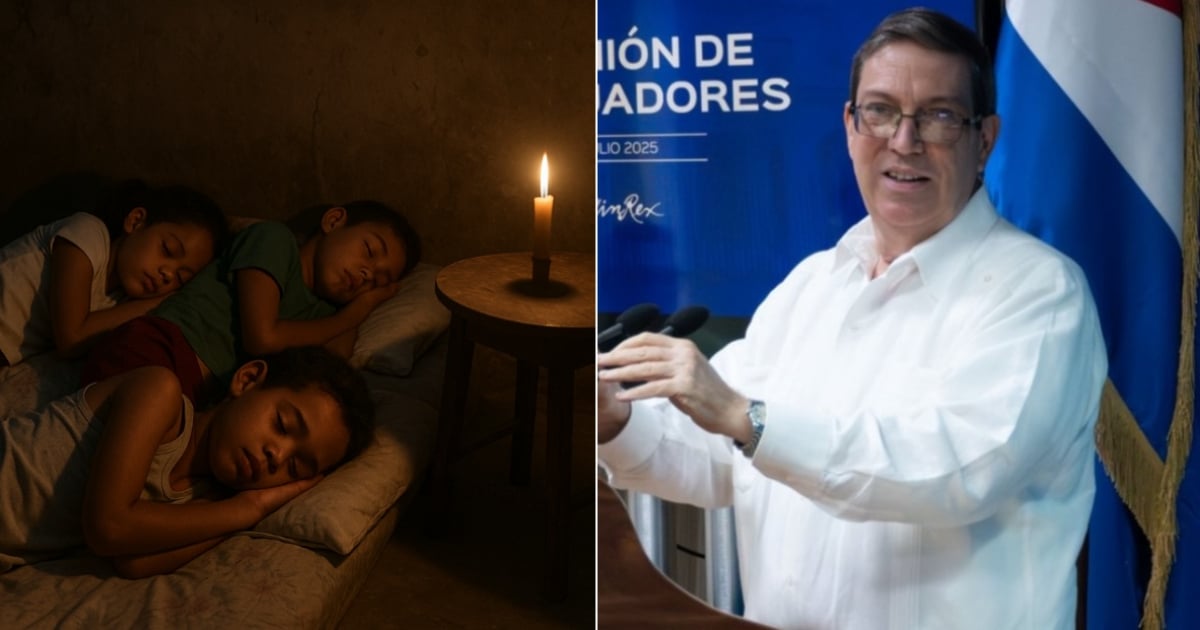
The remarks made by Cuban Foreign Minister Bruno Rodríguez Parrilla, who claimed that "joy once again fills Cuban schools" at the start of the school year, have sparked a wave of backlash on social media. Hundreds of Cuban families have taken to these platforms to dismantle what they view as a mockery of their daily struggles. Rodríguez posted his message on his official account on September 1st, aligning with the return of over 1.5 million students to classrooms. However, rather than excitement, his comment has been seen as an act of cynicism, out of touch with the harsh realities faced by thousands of Cuban households as they confront a school year fraught with shortages.
A user responded, “You really have no shame. Joy is something that very few Cubans feel today, much less the children, who spent their vacations amid blackouts and were unable to enjoy anything due to the high prices of everything.” Another commenter was more direct: “Do you think our children are happy? With barely any food, no milk, nowhere to entertain themselves, no toys, unable to sleep due to the massive blackouts, no water, no freedom, no, no, no.”
The frustration and anger expressed on social media are not isolated incidents. Numerous parents, grandparents, and teachers have shared images, testimonies, and experiences that contradict the supposed atmosphere of joy depicted in the official narrative. One commentator, outraged by what he perceived as “another attempt to impose a triumphant narrative amidst disaster,” wrote, “Another impious mockery of the people's suffering. Even more cruel, knowing what the children endure... Down with communism! Homeland and Life and Freedom!”
Structural Challenges and Government Narratives
Reports from various provinces echo similar grievances: prolonged blackouts, classrooms lacking basic conditions, a shortage of teachers, and a complete lack of school supplies. In a school in Florida, Camagüey, “there were no guides, the desks were falling apart, and some children had no chairs. Now they are asking parents to repair them and buy paint for the classrooms that don’t even have teachers. That’s a great achievement of the revolution, and the president is living the good life with his ‘machi’.”
“I don’t know what country you live in, but here the children didn’t even get their eight hours of sleep. Many went without breakfast. Our children have even lost their innocence. They didn’t even have a vacation,” lamented another mother.
In Bahía, Habana del Este, a 5th-grade classroom was described as follows: “It leaks, has no electricity, and the termite-infested door cannot be closed. That gave us tremendous joy.”
Rather than joy, what has been witnessed is extreme sacrifice by families. One mother wrote: “Joy… what joy? I’ve seen mothers struggling to provide a backpack, shoes, school supplies, and money for snacks and extra lunch. What joy, please? Families are being bled dry.”
Many others shared scenes that reflect a national pattern: “Since morning, all I’ve seen are posts from mothers saying: ‘What an abuse, first day of school and my child couldn’t sleep because there’s been no electricity since yesterday…’ or ‘I had to get them ready by candlelight because there was no power.’ Is that the joy you are celebrating?”
“What a lack of shame” is one of the most repeated sentiments. A grandmother added: “It would have been better if they stayed silent, but they insist on making a fool of themselves every time they say or do something.” In one classroom, parents reportedly have to bring even the lamps because no lights are installed. And the children “are suffocating from the heat. Such happiness, damn,” raged a user who couldn’t hold back her anger.
In stark contrast to the government-imposed optimism, the reality reveals a country where the start of the school year is not a cause for celebration, but another episode of resilience. While officials publish self-congratulatory messages, parents improvise desks, split notebooks in half, and go into debt to provide the bare minimum for their children. Instead of joy, what fills Cuban schools is exhaustion, sacrifice, scarcity, and frustration.
Education System Under Strain
The issues highlighted by families are supported by official figures. The government admitted to producing only 2.2 million of the 3.6 million uniforms planned for this school year, with only 20% of students receiving new clothes. The rest depend on hand-me-downs or the black market, where a uniform costs over 5,000 pesos. Furthermore, an “adjusted norm” was implemented, reducing the distribution of notebooks: three per primary school child to cover six subjects. In secondary school, they must be divided in half. Those unable to afford the 200 CUP for a notebook in the informal market simply cannot take notes in class.
The problems also extend to teaching staff. In Matanzas, there is a shortage of more than 2,000 teachers, and the solution has been to fill classrooms with university students, hourly contracts, and unqualified personnel. The deficit is similar in provinces like Camagüey or Sancti Spíritus, severely impacting educational quality.
Education Minister Naima Trujillo emphasized that the school opening was possible thanks to “collective effort,” but even she acknowledged that many schools only opened after emergency repairs led by parents, cooperatives, and local businesses. Leaky roofs, insufficient furniture, out-of-service bathrooms, and dark classrooms remain part of the school landscape.
Meanwhile, blackouts affected much of the country just before the school year started. Many students arrived without sleep or the ability to warm their breakfast. The return to school, far from a celebration, has been another chapter of weariness.
As the government attempts to sell the beginning of the school year as a “victory,” Cuban families continue to question what exactly there is to celebrate.
Frequently Asked Questions about Cuba's School Year Challenges
What was the reaction of Cuban families to Bruno Rodríguez's statements?
Cuban families reacted with anger and disbelief to Bruno Rodríguez's statements, viewing them as a disconnect from their harsh realities and a mockery of their struggles.
What issues are Cuban schools facing at the start of the school year?
Cuban schools are struggling with prolonged blackouts, lack of basic classroom conditions, severe teacher shortages, and a complete lack of school supplies.
How is the Cuban government addressing the shortage of school uniforms and supplies?
The Cuban government has admitted to producing fewer uniforms than needed and has implemented an “adjusted norm” that drastically reduces the distribution of notebooks, leaving many families to rely on the black market.
What solutions are being implemented to address the teacher shortages?
To cope with teacher shortages, the government has resorted to using university students, hourly contracts, and unqualified personnel to fill the gaps in the teaching staff.