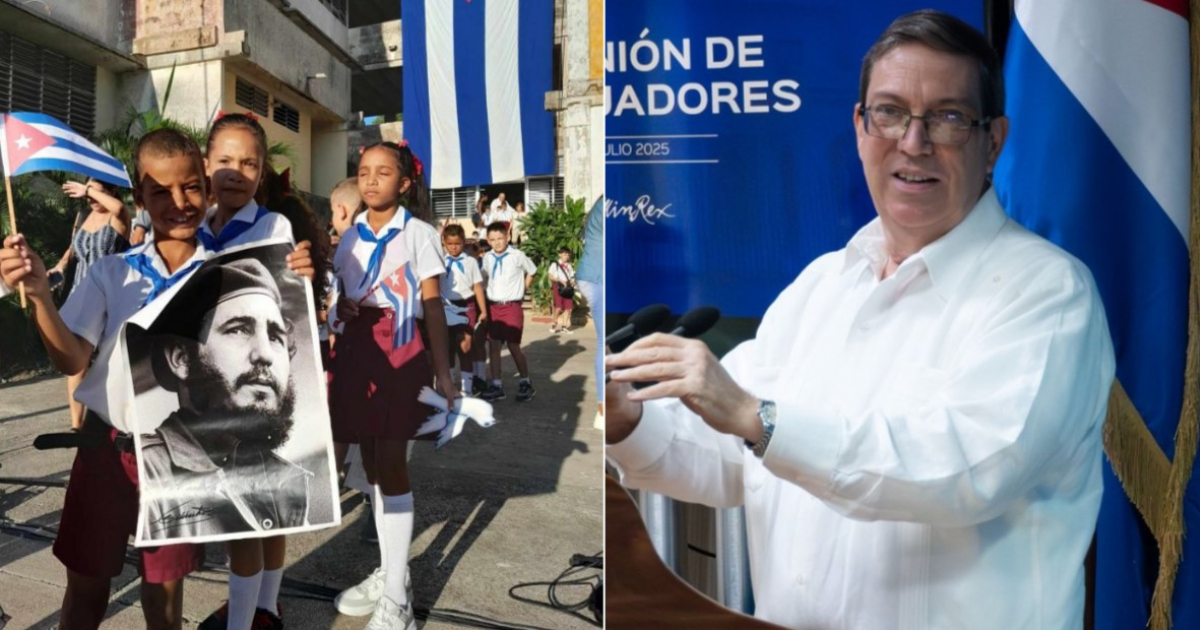
Bruno Rodríguez Parilla, Cuba's Minister of Foreign Affairs, claimed that joy fills Cuban schools as the new academic year kicks off this Monday on the island. "Today, joy once again fills Cuban schools as the new school year begins, with over 1,530,000 students from various levels of general education joining the system," he stated on his X account. "We extend a special welcome to the ISRI students, wishing them success," he added, referencing the Higher Institute of International Relations, which trains the regime's diplomats.
While the Cuban regime insists on portraying each new school year as a "Revolutionary achievement," families on the island face a starkly different reality, characterized by material shortages and uncertainty. What should be a time of excitement and anticipation for returning to school has, for many parents, become an arduous journey through the shortcomings of the educational system.
Struggles Faced by Cuban Families
In secondary classrooms, a single notebook is expected to suffice for two subjects. This practice, officially termed a "tightened standard," forces students to split notebooks in half or divide their pages, a tactic aimed at masking the lack of supplies that ultimately hampers students' learning. Those unable to afford the nearly 200 pesos a notebook costs on the black market must settle for this makeshift solution.
The issue of uniforms is also significant. The state managed to produce only 2.3 million of the 3.6 million pieces needed, meaning only 20 percent of students will have new clothes for this school year. The rest must reuse inherited, patched, or exorbitantly priced uniforms; in the informal market, a set can exceed 5,000 pesos, an amount beyond the reach of most families.
Educational Infrastructure and Staffing Challenges
School infrastructure is also in a dire state. Thousands of schools opened in deplorable conditions, with leaking roofs, broken windows, and insufficient furniture. There are common scenes of students sitting on the floor due to a lack of desks or classes being disrupted by power outages, forcing teachers and students to continue lessons in the dark or wait for a generator.
The shortage of teachers further exacerbates the situation. For instance, Matanzas began the school year with over 2,000 vacant positions, and nationally, around 24,000 teaching positions remain unfilled, leaving one in eight positions without a teacher. Low salaries, professional burnout, and migration to other sectors have left classrooms with inadequate staffing, often lacking the necessary training.
Financial Burden on Families
The so-called "free education" has become a significant financial burden for families. A primary school notebook can cost up to 1,400 pesos in a private business, an unaffordable sum for most. This is in addition to backpacks, shoes, snacks, and other expenses, turning each new school year into a financial nightmare.
Behind the regime's triumphalist rhetoric and the state media's manufactured epic tales of "rivers of innocence" and "silent deeds" lies the true story of September: parents battling inflation and shortages so their children can attend school with the bare essentials. This is the other side of the start of the school year in Cuba, the one propaganda never shows.
Understanding Cuba's Educational Crisis
What challenges do Cuban families face with the start of the school year?
Cuban families contend with material shortages, high costs for school supplies, and inadequate access to new uniforms, making the start of the school year a financial and logistical struggle.
How does the teacher shortage affect Cuba's educational system?
The teacher shortage in Cuba leads to many classes being taught by underqualified staff or not at all, which significantly impacts the quality of education and student learning outcomes.
What is the "tightened standard" practice in Cuban schools?
The "tightened standard" is a practice where students must use one notebook for two subjects, splitting it in half or dividing pages, due to a lack of sufficient school supplies.