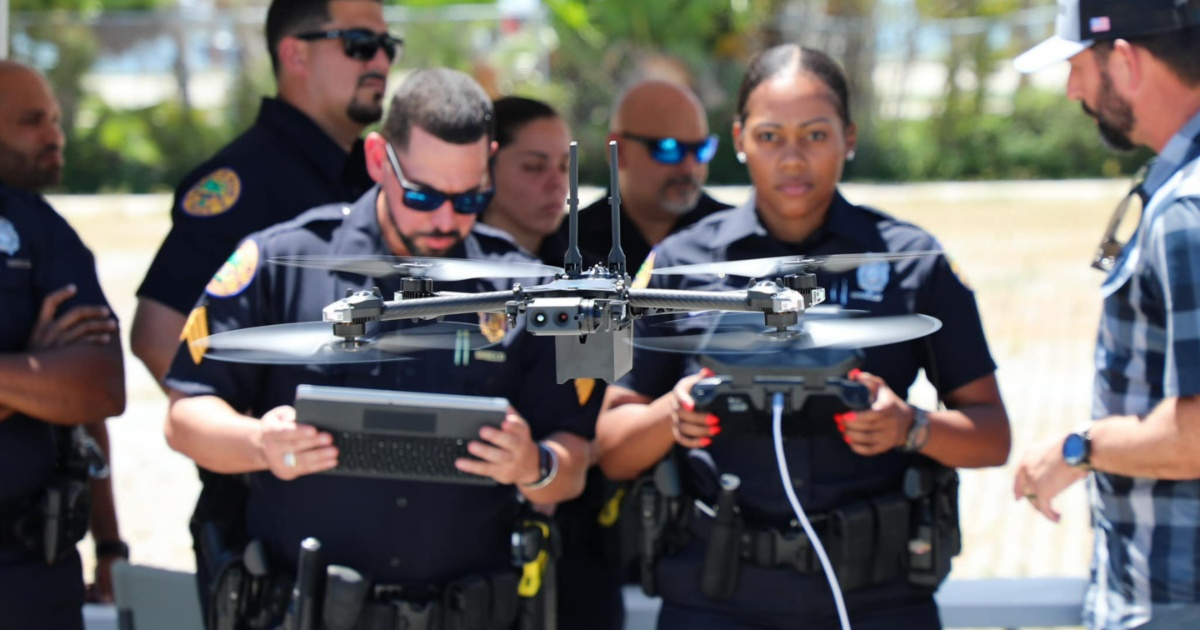
The Miami Police Department has officially launched its First Response Drone (DFR) program. According to reports from El Nuevo Herald, this innovative initiative involves remotely trained pilots operating high-tech drones from the central headquarters. These drones will swiftly respond to emergency scenes following a 911 call, offering a real-time aerial perspective that aids in the early detection of threats, dangers, or evolving situations.
Arriving on the scene before ground patrols, the drones help in making quicker and more precise assessments, thereby enhancing the decision-making process for officers responding to incidents. The program also plays a crucial role in traffic management, incident location, and operational coordination in complex terrains.
The Miami police emphasize that these first response drones significantly enhance the safety of officers and improve citizen protection. The drone pilots are tasked with alerting officers about imminent threats, identifying crime scenes and vehicular accidents, conducting perimeter searches, and assisting in locating missing persons and performing water rescues, even utilizing specialized floatation devices.
Drone Regulations in Florida
Starting October 1, a new law signed by Governor Ron DeSantis will impose stricter restrictions on drone use in sensitive areas such as prisons, military facilities, airports, dams, and other critical infrastructures. The goal is to mitigate risks to public safety and national security threats.
This legislation is part of HB 1121, introduced by Republican Representative Jennifer Canady from Lakeland County. The law aims to curb dangerous and illegal activities such as smuggling contraband into prisons, spying on strategic sites, or potentially deploying drones with chemical payloads.
“These changes bolster the state’s ability to prevent illicit activities with unmanned aircraft,” Canady stated during a discussion in the House Criminal Justice Committee. The law expands the definition of critical infrastructure to include airports, military bases, dams, telecommunications facilities, and correctional centers, and bans drones from interfering with their operation unless expressly authorized by the Federal Aviation Administration (FAA).
Additionally, the legislation prohibits drones modified to evade remote identification requirements, as well as those equipped with weapons, explosives, or destructive devices. Unauthorized surveillance or the dissemination of illegally captured images will also incur criminal penalties. However, the law permits law enforcement agencies to use drones under specific conditions for crowd control or other security tasks.
During the legislative discussion, Republican Representative Danny Alvarez, chair of the committee, supported the measure by emphasizing the need for timely action regarding new technologies. “We are often criticized for not reacting in time and allowing technology to overtake us,” Alvarez noted.
Understanding Miami’s Drone Program and Florida Regulations
What is the main purpose of Miami's First Response Drone program?
The program is designed to provide a real-time aerial view of emergency scenes, aiding in early detection of threats and enhancing decision-making for responding officers.
How will the new drone law in Florida affect drone usage?
The law will impose stricter restrictions on drone usage in sensitive areas to enhance public safety and prevent illegal activities, with specific provisions for law enforcement use under certain conditions.
Who introduced the new drone legislation in Florida?
The legislation was introduced by Republican Representative Jennifer Canady from Lakeland County as part of the HB 1121 project.