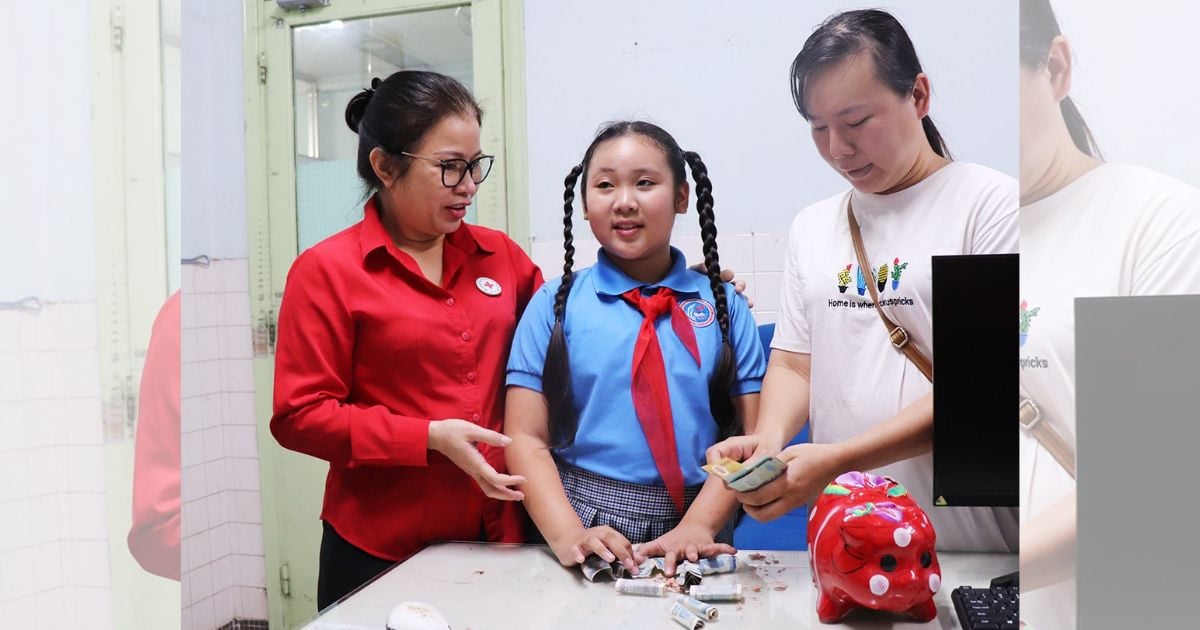
The Cuban regime once again showcased an act of "international solidarity," this time sharing the story of a Vietnamese child who donated her personal savings to Cuba, turning it into a near-epic narrative. The story was shared on Facebook by Rogelio Polanco Fuentes, Cuba's ambassador in Vietnam, who highlighted the actions of Ho Thao Nhi, a fifth-grade student at Dinh Tien Hoang Primary School in Ho Chi Minh City.
Ho Thao Nhi asked her parents to break open her piggy bank and donated 5,100,000 Vietnamese dongs—equivalent to about 200 U.S. dollars—which she had saved from her daily allowance and a school bonus. The young student expressed her wish to send her contribution "to the children of Cuba," believing that "small donations can also bring them joy and affection."
This act was applauded by the Vietnam Red Cross, whose vice president in Ho Chi Minh City congratulated her and bestowed upon her the symbolic title of "Good Granddaughter of Uncle Ho." Polanco expressed gratitude "on behalf of the Cuban people" for Ho Thao Nhi's gesture, emphasizing: "Her solidarity moves us and demonstrates the purest human sentiments that we admire in the Vietnamese people."
The narrative, hailed as an example of brotherhood, underscores the Cuban regime's ability to capitalize on even the savings of a foreign child, while the island's children continue to face unresolved basic issues such as the lack of milk or medicines. Additionally, it highlights the Cuban regime's talent for leveraging virtually any event for its political propaganda.
While the Cuban regime celebrates the donation of a Vietnamese child who broke her piggy bank to send $200 to the island, children in Cuba begin the school year with notebooks for only two subjects, hand-me-down uniforms, and without essential supplies. The start of the new school year is marred by power outages that halt production and hinder learning, in an environment where the energy crisis directly impacts schools and homes. Furthermore, the shortage of over two thousand teachers in provinces like Camagüey forces improvisation with unqualified staff, leaving thousands of students without proper educational attention.
In households, the situation is no better: mothers struggle daily with shortages, like the difficulty in obtaining milk, and many families are forced to sleep in doorways or on rooftops due to endless blackouts. This is the true reality for Cuban children, in stark contrast to the propagandistic tales of foreign solidarity that the regime elevates to legendary status.
Cuban Children's Struggles Amid Propaganda
What was the donation made by the Vietnamese child?
The Vietnamese child, Ho Thao Nhi, donated 5,100,000 Vietnamese dongs, approximately 200 U.S. dollars, from her savings.
How does the Cuban regime use such donations?
The Cuban regime uses donations like these to fuel its political propaganda, portraying them as acts of international solidarity while domestic issues remain unaddressed.
What challenges do Cuban children face as the school year begins?
Cuban children face challenges such as starting the school year with limited supplies, power outages disrupting education, and a severe shortage of qualified teachers.
What are some of the daily struggles Cuban families face?
Cuban families struggle with shortages of basic necessities like milk and frequent power outages, forcing some to sleep in uncomfortable conditions like doorways or rooftops.