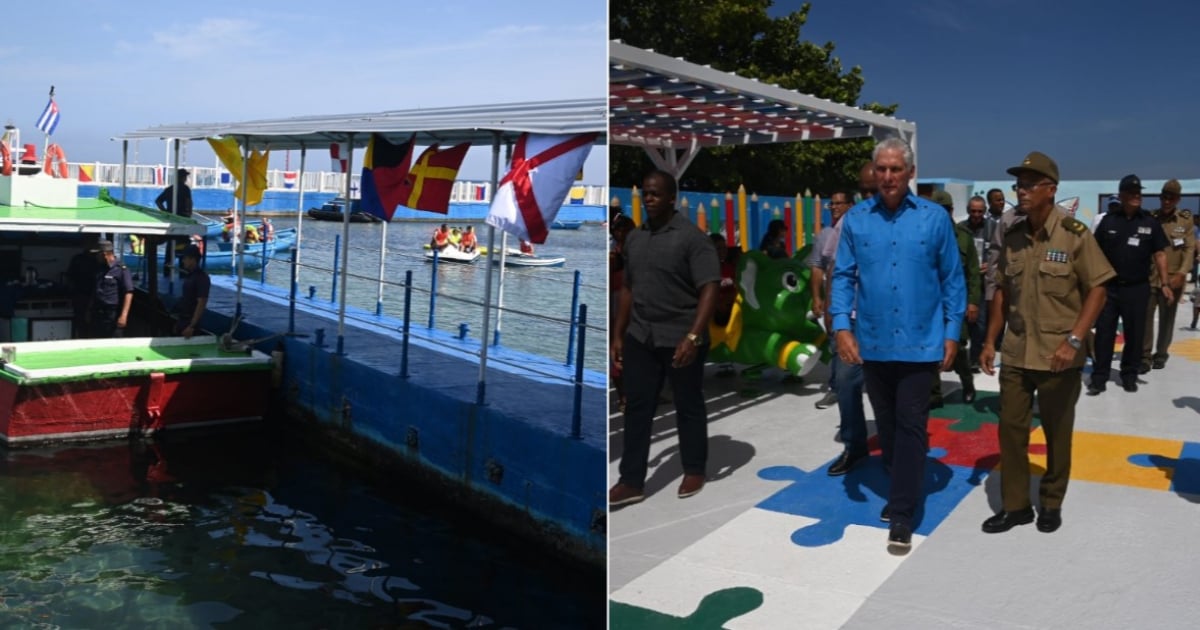
This past Wednesday, Cuban leader Miguel Díaz-Canel toured the recently renovated Central House of the Revolutionary Armed Forces (FAR), formerly the Miramar Yacht Club, showcasing a facility that starkly contrasts with those restored for public use. Accompanied by Prime Minister Manuel Marrero Cruz and FAR Minister Álvaro López Miera, he explored the site located in the Playa municipality, which has undergone investment since 2020 and has already welcomed nearly 100,000 visitors in 2025.
The government praised the refurbishment of beach areas, sports courts, cultural spaces, and restaurants, highlighting "the contribution of FAR companies" and the utilization of national resources, as noted in a "Presidencia de Cuba" post on X. Díaz-Canel lauded the club’s "beauty and order," asserting it as a model of "intelligence and systematic conservation."
Nevertheless, the restoration of this recreational center starkly contrasts with the severe housing crisis plaguing the nation. Thousands of families remain homeless following natural disasters and the degradation of the housing stock, with entire neighborhoods crumbling.
The renovation of FAR's Central House had already sparked controversy in 2023, when plans for new swimming pools, a nightclub, and structural expansions were announced. “Is this the right time for such projects?” questioned professor Eunice Lores Roque, who criticized the squandering of resources for the benefit of the military elite while the majority of the population endures hardship.
For instance, recreational centers like the once-famous Comodoro nightclub, Lenin Park, and the former Balneario del Casino Español de La Habana, now the "José Ramón Rodríguez Workers' Social Circle" in Playa, lie in ruins.
The historic Miramar Yacht Club, inaugurated in 1926 as a nautical and recreational space for Havana's high society, was transferred to the Armed Forces following the Revolution. It was transformed into a leisure area for officers and their families. Today, amidst Cuba's dire economic and social crises, the club stands restored and exclusive, a symbol of FAR's power and the regime's priorities: luxury and leisure for the military elite, decay and scarcity for the people.
Understanding Cuba's Prioritization of Military Facilities
What is the significance of the Central House of FAR renovation?
The renovation signifies the Cuban government's focus on military priorities, highlighting the stark contrast between the resources allocated to military facilities and the neglect of public infrastructure.
How does this renovation affect the Cuban population?
While military facilities receive upgrades, many Cubans face housing crises and live in deteriorating conditions, underscoring the disparity between government spending on military versus civilian needs.
What criticisms have been raised about the renovation project?
Critics argue that the project wastes resources that could address pressing public needs, benefiting the military elite while the general population suffers from inadequate living conditions.