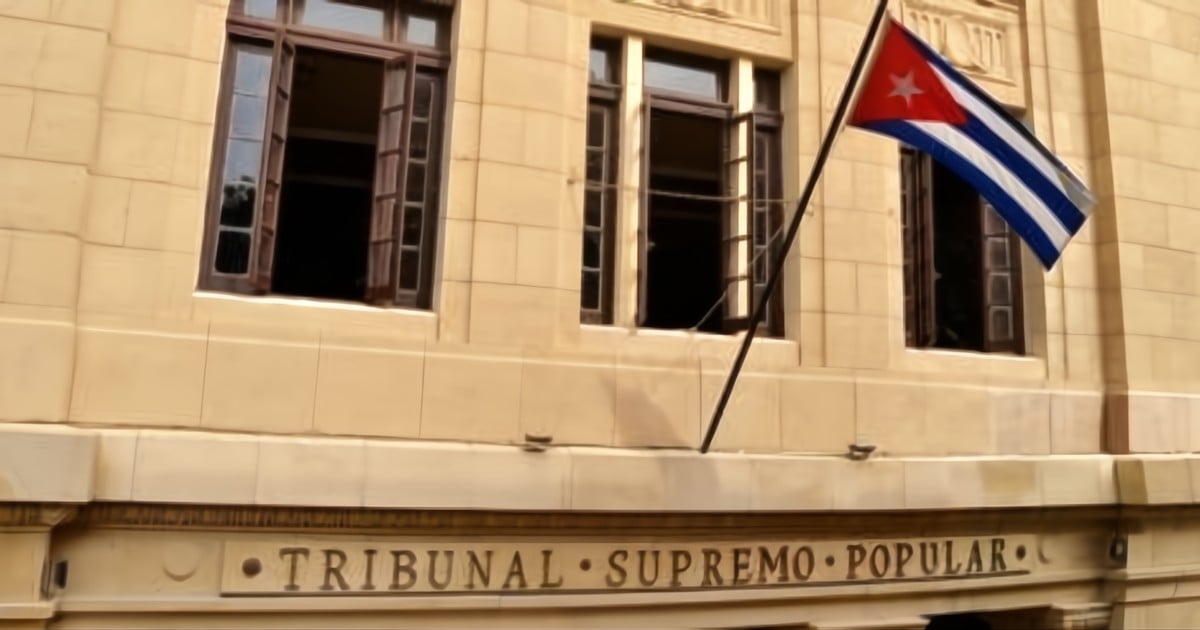
The Cuban Supreme Court has issued a stern warning regarding the increasing consumption and trafficking of synthetic drugs on the island, particularly in Havana. In response, the court has sanctioned a directive to intensify penalties for those who possess or distribute these highly toxic substances, as outlined in the extraordinary issue number 52 of the Official Gazette released this Thursday.
Synthetic cannabinoids, commonly referred to as "the chemical" or "little papers," mimic marijuana but are up to a hundred times more potent and have severe health consequences. Experts cited in the Official Gazette note that even minimal amounts can trigger convulsions, heart attacks, psychosis, and multiple organ failure.
Legal Reforms Targeting Synthetic Drug Possession
The Supreme Court clarified that it is no longer necessary for an accused individual to possess a pound (460 grams) of drugs to be prosecuted under the "relatively large quantities" category of the Penal Code. For synthetic cannabinoids, it will suffice to prove, through toxicology and forensic analysis, that the substance is highly toxic, how many doses could be derived from the seized material, and its potential harm to public health.
Possession of these drugs will be classified under Article 236 section a), with punishments ranging from one to three years of imprisonment or fines up to a thousand units, similar to those for substances as potent as cocaine. This legal tightening aims to address a problem that overwhelms institutions and positions synthetic drugs as both a public health and national security issue.
The Devastating Impact of Synthetic Drugs on Communities
Beyond the legal framework, the true tragedy unfolds on the streets. A young Cuban woman shocked social media by revealing her face scarred by the use of "the chemical," highlighting how these drugs shatter not only mental and physical health but also the everyday lives of entire families. Another case that captured public attention involved a Cuban model addicted to these substances, whose fight for survival sparked a wave of public solidarity that contrasted with the institutional indifference.
In Havana neighborhoods such as Centro Habana, Playa, and La Habana Vieja, police operations have resulted in numerous arrests, including entire families involved in the trade. The "chemical" is sold in tiny pieces of paper sprayed with the drug, making it cheap and easily accessible, and thus the drug of choice for many young people amid the economic crisis.
Narcotics Trafficking: A Sophisticated Threat
Meanwhile, drug traffickers are using increasingly sophisticated methods to smuggle drugs into Cuba. In recent weeks, Customs has seized cocaine concealed in wet wipes, tuna cans, water pumps, Eleguá dolls, gummies, and cigarette packs. Despite this, authorities maintain a "zero tolerance" policy on the island.
Despite official rhetoric and severe punishments—up to 20 years in prison for drug trafficking—the spread of these substances demonstrates that the government's strategy is insufficient. On the streets, drugs move faster than the state's responses. On social media, victims openly display the ravages of "the chemical." In the courts, there is an attempt to curtail a phenomenon that is more social than legal, in a Cuba battered by crisis, where drugs find a fertile ground among despair and lack of hope for the future.
FAQs on Cuba's Synthetic Drug Crisis
What are synthetic cannabinoids?
Synthetic cannabinoids are man-made chemicals that mimic the effects of marijuana but are much more potent and can have severe health risks.
How is Cuba addressing the synthetic drug issue?
Cuba is intensifying penalties for possession and distribution of synthetic drugs and is using toxicology and forensic analysis to identify high toxicity substances.
What are the health risks associated with synthetic drugs?
Synthetic drugs can cause convulsions, heart attacks, psychosis, and multiple organ failure, even in small quantities.