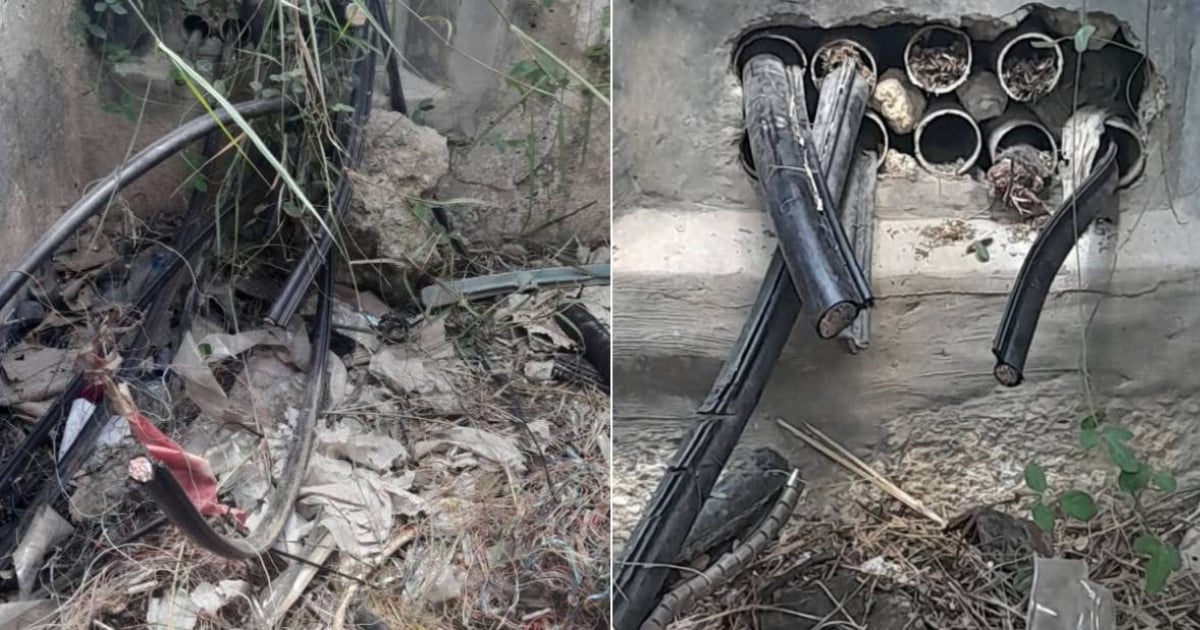
In a recent act of vandalism, the telecommunications infrastructure of ETECSA has been compromised, leaving hundreds without phone service in Marianao, a district in Havana. The Western Territorial Directorate of ETECSA announced via their official Facebook page that over 200 residential landline services were disrupted, impacting even the Medical Equipment Company in the neighborhoods of Cai and Los Ángeles.
This marks the third such occurrence in 2025 in this particular area. The cable thefts not only sever user connectivity but also stall the restoration process due to the state-run company's ongoing shortage of materials. "The damage inflicted doubly impacts the public, who suffer both the loss of service and delays in its restoration because of limited resources," ETECSA acknowledged in their statement.
Increasing Trend of Metal Theft
Cable theft is not a new issue in Cuba. According to Tribuna de La Habana, 39 acts of vandalism had been reported in the capital by the end of 2024, nearly double the incidents reported in 2023. In the first few months of 2025 alone, the city has confirmed seven thefts. The thieves primarily target the copper within the cables, a metal highly sought after in the black market. Areas like Arroyo Naranjo, Cotorro, and Boyeros are hotspots for these crimes.
In Boyeros, the theft of over 600 meters of cable left about 600 customers in the El Chico neighborhood without service. At least four thefts have occurred along the same cable route since February 2023. "It's a sensitive service that the community loses, and the economic damage is significant," explained Armando Marchán Bárcena, head of the Boyeros Telephone Center.
Impact on Mobile Networks
Beyond landlines, mobile networks have also been targeted. Last week, ETECSA reported an attack on a radiobase in San Vicente, Santiago de Cuba, which cut off mobile and internet service to more than 2,500 users. The perpetrators stole batteries and destroyed rectifiers, cabling, and other high-value equipment, resulting in millions in losses. These parts are often repurposed for home use in autonomous electrical systems.
The remote locations of these radiobases and lack of surveillance have facilitated such attacks, which ETECSA describes as "sabotage."
No Resolution in Sight
Authorities claim that these acts will be punished as sabotage, with penalties reaching up to 15 years in prison. Despite these assertions, the frequency of thefts continues to rise. In 2025 alone, Santiago de Cuba has seen at least 17 vandalized radiobases, many of which were newly installed. Although ETECSA has increased remote monitoring, criminals have adapted to evade security measures.
This surge in thefts highlights not only the vulnerability of telecommunications infrastructure but also the economic crisis driving individuals to engage in illegal activities to procure metals and valuable parts for the black market. In the meantime, thousands of Cubans remain isolated, trapped in a cycle of structural decay with no immediate solution in sight.
Understanding the Impact of Cable Theft in Cuba
Why is copper theft so prevalent in Cuba?
Copper is in high demand in the informal market due to its value, making it a prime target for theft. The economic crisis in Cuba pushes individuals to resort to such illegal activities to earn quick money.
How does ETECSA plan to combat these thefts?
ETECSA has attempted to strengthen remote surveillance and is working with authorities to classify these acts as sabotage, which carries severe legal penalties. However, the effectiveness of these measures remains uncertain.
What is the impact of these thefts on Cuban citizens?
The thefts leave many Cubans without essential telephone services, isolating them from communication networks and causing significant inconvenience and economic loss.