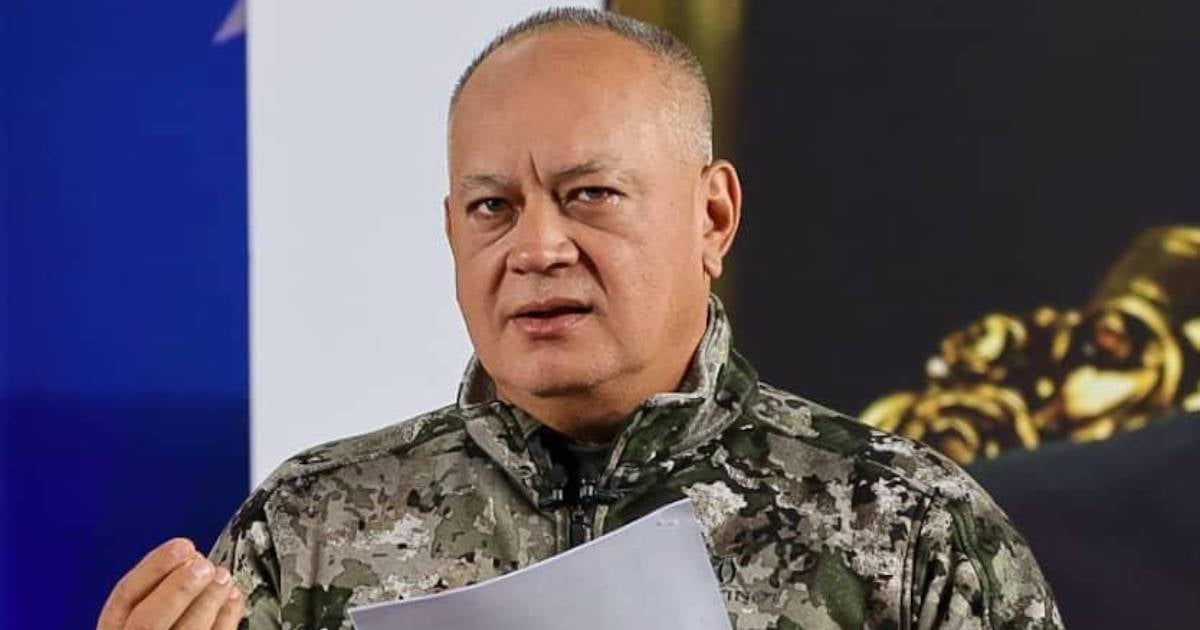
On Wednesday morning, Caracas awoke to a sobering warning that sounded like an ultimatum. Diosdado Cabello, the influential Interior Minister and a key figure in the Chavista regime, declared, "We are preparing for the worst," in reference to the increased military presence of the United States off the Venezuelan coast.
During his weekly broadcast, "Con el mazo dando," aired on the state-run channel VTV, Cabello asserted that Venezuela stands ready to face "whatever comes, no matter how tough it may be." This statement directly addressed the presence of U.S. ships, submarines, and marines, which have encircled the Caribbean under the guise of an anti-drug campaign.
Cabello emphasized, "We do not underestimate any threat. Nor do we overestimate or disregard them," highlighting the mobilization of thousands of civilian militiamen nationwide. This strong message follows the Nicolás Maduro government's complaint to the United Nations, warning of the Pentagon's plan to dispatch a "missile cruiser" and a "fast-attack nuclear submarine" to the Caribbean, which Caracas views as a direct provocation and a "grave threat to regional peace and security," as reported by EFE.
Escalating Military Presence in the Region
The situation rapidly intensified. Venezuela's "response" manifested in a deployment of warships, drones, helicopters, and surveillance points across the Caribbean Sea and the Colombian border as part of the "Relámpago del Catatumbo" operation. Defense Minister Vladimir Padrino López confirmed the mobilization of over 15,000 troops.
Meanwhile, Washington has been transparent with its intentions. According to international media, the Trump administration has dispatched the missile cruiser USS Lake Erie, the submarine USS Newport News, three destroyers, and approximately 4,500 marines, along with spy planes to the Caribbean, ostensibly to combat drug trafficking.
However, the Chavista regime dismisses this narrative as a mere pretext, asserting that Venezuela has no illicit crops and accusing the U.S. of leveraging geopolitical pressure to extract concessions from Maduro's government. "This has no technical justification; it is tactical pressure," warned Phil Gunson, an analyst at the International Crisis Group.
Global Reactions to Rising Tensions
As tensions mount, Cuba has rallied behind its Venezuelan ally. Miguel Díaz-Canel pledged "unconditional support" to Maduro and condemned the "imperialist threats" from the United States, strengthening the historic alliance between Havana and Caracas.
France has also signaled its stance. President Emmanuel Macron's government has deployed military personnel, radars, and drones to Guadeloupe as part of its own anti-drug initiative, effectively aligning with the U.S. strategy.
Even more surprising was the position of Trinidad and Tobago. Prime Minister Kamla Persad-Bissessar offered the U.S. unrestricted access to her territory should Venezuela attack Guyana, with whom it has a territorial dispute over the Esequibo. "We will not hesitate to defend the Guyanese people," she stated.
Rhetoric on the Brink of Conflict
As the United Nations receives complaints and warnings, Venezuela is accelerating the enlistment of its militiamen. According to Minister Padrino, more than 1,000 points will be activated this weekend to recruit volunteers for the "defense of the homeland against any aggression."
This scenario is reminiscent of the most tense years of the 20th century. However, this time, militarization unfolds in the Caribbean, involving nuclear powers, unresolved territorial conflicts, and an underlying ideological backdrop.
Cabello reiterated, "What is certain is that our people, our women, our youth have stepped forward to defend the homeland," in a message seemingly aimed more at Washington than the Venezuelan audience.
Key Questions Surrounding the U.S.-Venezuela Tensions
What is the main reason for the U.S. naval presence near Venezuela?
The U.S. claims its military presence is part of an anti-drug operation aimed at curbing narcotics trafficking in the Caribbean.
How has Venezuela responded to the U.S. military deployment?
Venezuela has mobilized warships, drones, helicopters, and surveillance points in the Caribbean, and has prepared thousands of troops as part of its defensive measures.
What role do international allies play in the Venezuela-U.S. tensions?
Countries like Cuba and France have shown support for Venezuela, while Trinidad and Tobago have aligned with the U.S., offering strategic access if Venezuela acts aggressively towards Guyana.