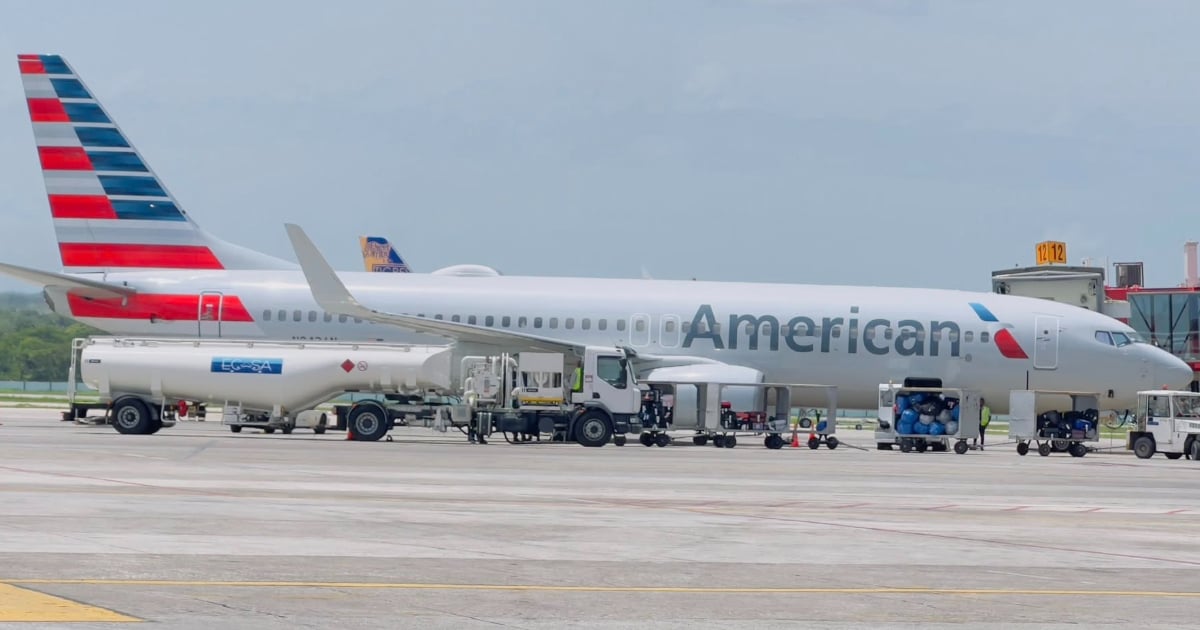
The air connectivity between the United States and Cuba is set to experience a significant decline starting in September, driven by decreased demand following the end of summer vacation and the return to school activities. According to data from aviation specialist publication Aviacionline, compared to August 2025, the air service will see a 20% reduction, leaving it at 91 weekly flights with a total capacity of 13,965 seats between the two countries.
This decline is also evident in the year-over-year analysis, showing a 21% drop in flight frequencies and a 16.1% decrease in seat availability from September 2024 to September 2025. Currently, only three American airlines continue operations to the island, all based in Florida. American Airlines leads with 70 weekly flights and 10,500 seats, representing 77% of the flights and 75% of the market capacity.
Delta Air Lines maintains 14 flights with 2,240 seats. Meanwhile, Southwest Airlines offers seven flights and 1,225 seats, focusing primarily on the Tampa to Havana route. The flight schedules are concentrated on routes from Miami and Tampa, with American Airlines covering destinations such as Havana, Camagüey, Holguín, Santa Clara, Santiago de Cuba, and Varadero. Delta continues its flights to Havana from Miami, while Southwest operates exclusively on the Tampa–Havana route.
The drop in demand has already triggered changes within the industry. United Airlines announced the suspension of its Houston to Havana route starting September 1, while Southwest Airlines will cut back one daily flight from its Tampa–Havana service beginning September 4. Additionally, American Airlines has requested a temporary waiver of inactivity from the U.S. Department of Transportation for the winter season, which would mean suspending several frequencies from Miami to Havana, Santiago de Cuba, and Santa Clara until March 2026.
Analysts cite two primary factors for this downturn: restrictive immigration policies that limit travel for U.S. citizens under the 12 authorized categories, including family visits, and a growing preference for alternative destinations like the Dominican Republic. Many Cuban-Americans choose to meet their relatives there, avoiding the costs and restrictions of direct travel to Cuba.
This reduction solidifies a downward trend in air connectivity between Cuba and the U.S., which seems to be deepening into the fall and winter. The regime admitted in July that tourism saw a significant drop in visitors in June, particularly from Russian tourists. By June, Cuba had received 1,306,650 travelers, 319,654 fewer than in the same period in 2024, according to official data from the National Office of Statistics and Information (ONEI). Furthermore, 981,856 international visitors arrived, 327,799 fewer than in 2024, marking a 25% decline in the total number of visitors to Cuba.
Impact of Airline Reductions on Cuba Travel
Why are flights from the U.S. to Cuba being reduced?
The reduction is due to a decline in demand following the end of summer and the start of school activities, alongside restrictive immigration policies and a preference for other destinations.
Which airlines are still operating flights to Cuba?
As of now, American Airlines, Delta Air Lines, and Southwest Airlines continue to operate flights to Cuba, primarily from Florida.
What impact does the reduction have on Cuba's tourism?
The reduction exacerbates a downward trend in tourism, with significant drops in visitor numbers, especially from international tourists, impacting Cuba's economy.