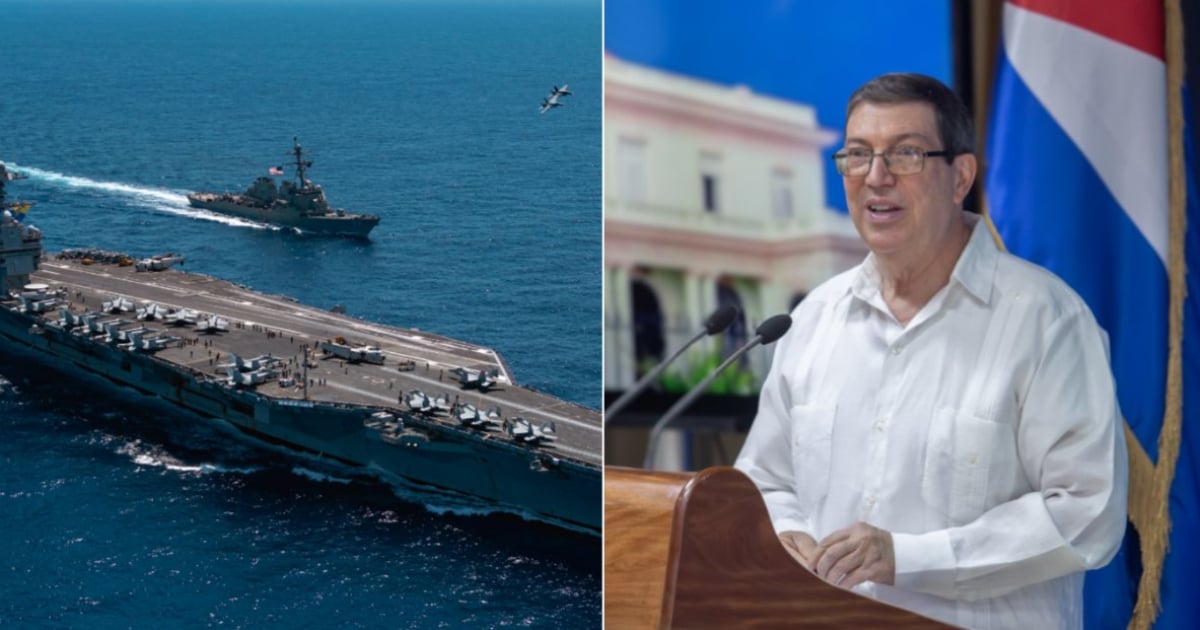
The Cuban regime has raised alarms over the presence of U.S. military ships in Caribbean waters, describing it as a direct threat to regional peace. In a series of statements on social media this Tuesday, high-ranking officials accused Washington of escalating military tensions with interventionist intentions, specifically calling out Secretary of State Marco Rubio as a key figure behind this strategy.
Bruno Rodríguez Highlights "Severe Threat" to the Region
Cuba's Foreign Minister, Bruno Rodríguez Parrilla, took to his social media account to express that the deployment of American vessels in the Caribbean poses a "severe threat to regional peace" and is part of a broader agenda to reassert control over Latin America. "The dispatch of additional U.S. military ships to the Caribbean creates a severe risk to peace in the region and is aimed at reinstating its dominance over Our America under the flimsy guise of combating drug trafficking," Rodríguez asserted, criticizing American political figures supporting this military operation.
"This aligns with the agenda of corrupt politicians like the Secretary of State," he added, indirectly referencing Marco Rubio, a vocal supporter of the naval deployment.
Morales Ojeda Reiterates Support for Maduro, Condemns "Yankee Threats"
Roberto Morales Ojeda, Secretary of Organization for the Cuban Communist Party Central Committee, also reacted on social media, reiterating Havana's support for Nicolás Maduro's government. In his message, Morales Ojeda declared, "We reaffirm our unwavering support and solidarity with President Nicolás Maduro, the @PartidoPSUV, and the Civic-Military Union of the Bolivarian Republic of Venezuela. No imperialist Yankee threat will break the spirit of this brave people, heirs of Bolívar and Chávez."
The senior Cuban official characterized the current situation as part of an ideological offensive driven by the United States. "Fascist and far-right ideologies are resurfacing, posing constant threats to peace. The shameless Yankee threats against Venezuela and President Maduro confirm this," he stated.
Regional Context: U.S. Naval Force Assembles Near Venezuela
The United States has recently increased its military presence in the Caribbean, deploying three guided-missile destroyers, a fast-attack nuclear submarine, and a missile cruiser. The Pentagon has stated that this operation is aimed at combating drug trafficking, but both Cuba and Venezuela view it as an act of pressure and intimidation.
During the XIII ALBA-TCP Extraordinary Summit held in Havana, Cuban leader Miguel Díaz-Canel condemned the U.S. military action, labeling it a "show of imperial force." He suggested that the Trump administration has a hidden agenda with this military buildup, potentially paving the way for "covert actions" under the authority of Title 50 of the U.S. Code.
"The deployment of military naval units south of the Caribbean, under the command of the Southern Command, involves up to 4,000 troops and is presented as a deterrent act under the false and exaggerated premise of combating drug cartels," Díaz-Canel claimed.
Marco Rubio Defends Military Strategy
Marco Rubio defended the U.S. offensive against drug cartels, justifying the deployment as part of a national security strategy. "For the first time in the modern era, we are truly on the offensive against organized cartels that are pumping poison—deadly poison—into our cities, and this is a team effort," he stated during a cabinet meeting at the White House.
The U.S. government remains firm in its stance that it will not allow Venezuela to become a "criminal sanctuary," and has doubled the bounty for the capture of Nicolás Maduro, whom it accuses of leading the Cartel of the Suns.
Frequently Asked Questions About U.S. Military Presence in the Caribbean
Why is the U.S. deploying military ships to the Caribbean?
The U.S. has stated that the deployment of military ships in the Caribbean is part of efforts to combat drug trafficking in the region.
How has the Cuban government reacted to the U.S. naval presence?
The Cuban government has condemned the U.S. naval presence, describing it as a severe threat to regional peace and accusing it of being an interventionist strategy.
What is Marco Rubio's role in the U.S. military strategy in the Caribbean?
Marco Rubio has been a strong advocate of the U.S. military strategy in the Caribbean, justifying it as a necessary measure to combat drug cartels threatening national security.