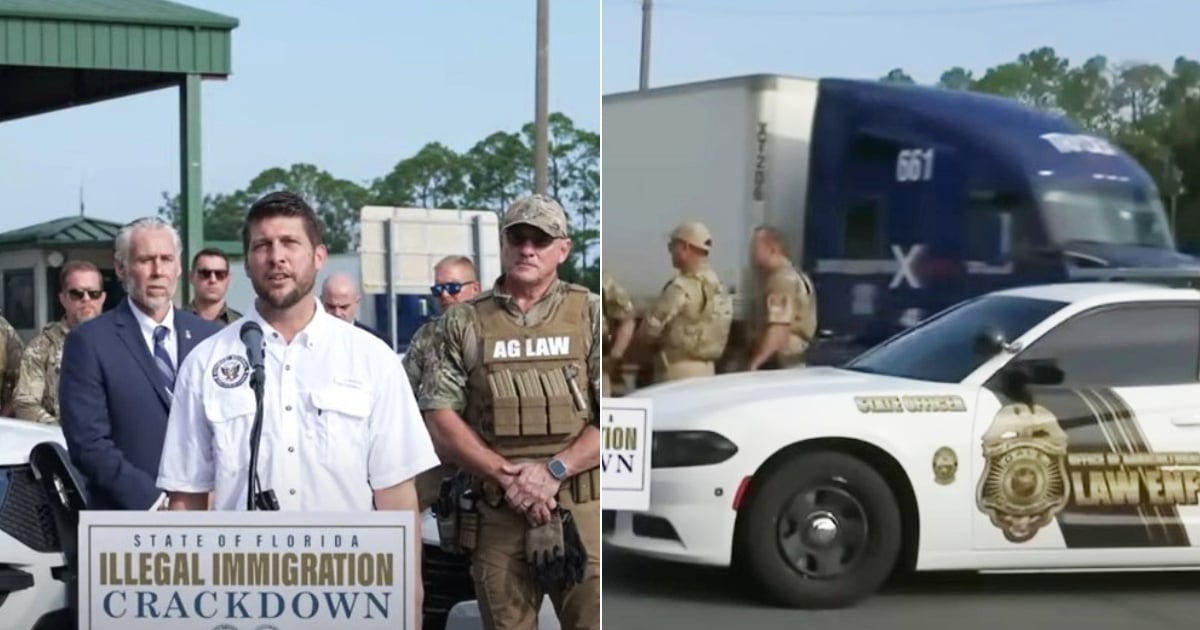
This week, Florida unveiled new measures that significantly tighten requirements for commercial truck drivers navigating the state's roads. The announcement outlines the implementation of immigration checks and English proficiency tests at all of the state's agricultural inspection stations, which will now also serve as border checkpoints for drivers.
Florida's Attorney General, James Uthmeier, stated that the 23 agricultural inspection points will be transformed into stations for verifying immigration status and language skills, supported by agents certified under the federal 287(g) program in direct collaboration with Immigration and Customs Enforcement (ICE). "If you're here illegally or can't speak English, there's no reason for you to be driving large commercial vehicles on Florida roads," Uthmeier declared at a press conference. He further emphasized that the state is "considering all legal options to ensure that drivers without legal immigration status or proper training do not operate heavy vehicles on our roads."
The measure also fully activates an executive order issued in May, requiring all truck drivers to demonstrate English proficiency as a condition for operating in the state. According to Agriculture Commissioner Wilton Simpson, the controls will include new technologies like X-ray scanners and the expansion of lanes at entry points to facilitate the inspection of each incoming vehicle. "We will turn these stations into fortresses of immigration control and road safety," Simpson stated.
Conflict with Sanctuary States and Federal Pressure
Florida's actions extend beyond state lines, with demands that the federal government withdraw funding and revoke the authority to issue Commercial Driver’s Licenses (CDL) from states like California and Washington. According to Uthmeier, these states have allegedly issued commercial driving permits to undocumented immigrants without adhering to federal standards. "States like California and Washington have ignored the rules […] resulting in three deaths," Uthmeier wrote in a letter to the Department of Transportation and the Federal Motor Carrier Safety Administration (FMCSA).
The Trump administration backed this effort, announcing the suspension of all work visas for commercial drivers, a nationwide decision that further complicates the landscape for migrant truckers.
The Tragedy Behind the Decision
This legal and political escalation was triggered by an accident on August 12 on the Florida Turnpike. Harjinder Singh, a 28-year-old Indian immigrant, made an illegal U-turn with his semi-trailer, causing a minivan to crash into the trailer, resulting in the deaths of its three occupants. Singh, who entered the U.S. illegally in 2018, held commercial driving licenses issued by Washington (2023) and California (2024).
Subsequent investigations revealed that he did not speak English and could not identify basic road signs. According to authorities, he "answered only two out of twelve verbal questions correctly and identified just one out of four traffic signs" during the post-accident examination. Singh fled to California with his brother, the truck's co-driver, and was apprehended a week later by federal agents. He currently faces six criminal charges, including three counts of vehicular homicide, and is held without bail as a flight risk.
Uthmeier Accuses Negligence in Driving Exams
Florida's Attorney General accuses "sanctuary" jurisdictions like California, Washington, and New Jersey of facilitating CDLs for individuals who do not qualify or meet the basic requirements for commercial transport. Besides Singh's case, Uthmeier cited the arrest of another undocumented driver, Roberto Carlos Vergara, who was intercepted in Bay County while operating a commercial truck with a CDL issued in New Jersey.
"It's hard to imagine someone who doesn't speak English passing these exams and receiving the necessary authorization," Uthmeier criticized in statements reported by Fox News. The attorney general also announced an investigation into officials and companies that have approved or facilitated licenses for immigrants without meeting the established requirements.
Concerns of Discrimination and Job Loss
Florida's decision has sparked alarm among trucker organizations and immigration rights advocates, who warn that the measure could result in discrimination, racial profiling, and massive job losses, especially among drivers who, despite being legalized or holding valid licenses in other states, now fear driving through Florida.
Additionally, some sectors fear this policy could disrupt supply chains by further limiting the availability of transporters in an industry already facing a shortage of qualified labor.
A National Direction
With this measure, Florida embarks on a new era of immigration policy applied to the transportation industry: linking immigration status and English proficiency as mandatory requirements to operate heavy trucks, regardless of licenses obtained in other states. Far from being an isolated response to a fatal accident, the action spearheaded by Uthmeier forms part of a broader strategy of confrontation with sanctuary states and national immigration hardening, with impacts that threaten to spill over the state's borders and spread across the country.
FAQs on Florida's New Trucking Regulations
What new requirements are being imposed on truck drivers in Florida?
Florida has introduced immigration checks and English proficiency tests for commercial truck drivers at all agricultural inspection stations, which will now also serve as border checkpoints.
Why is Florida implementing these new regulations?
The regulations are in response to a fatal accident caused by a driver who was in the U.S. illegally and did not speak English, highlighting safety concerns on Florida roads.
How might these regulations affect truck drivers from other states?
Drivers from states like California and Washington, where CDLs may have been issued without meeting federal standards, might face challenges in operating in Florida under the new rules.
What are the potential broader impacts of Florida's new trucking regulations?
These regulations could lead to job losses, discrimination, and disruptions in supply chains, impacting the trucking industry nationwide.