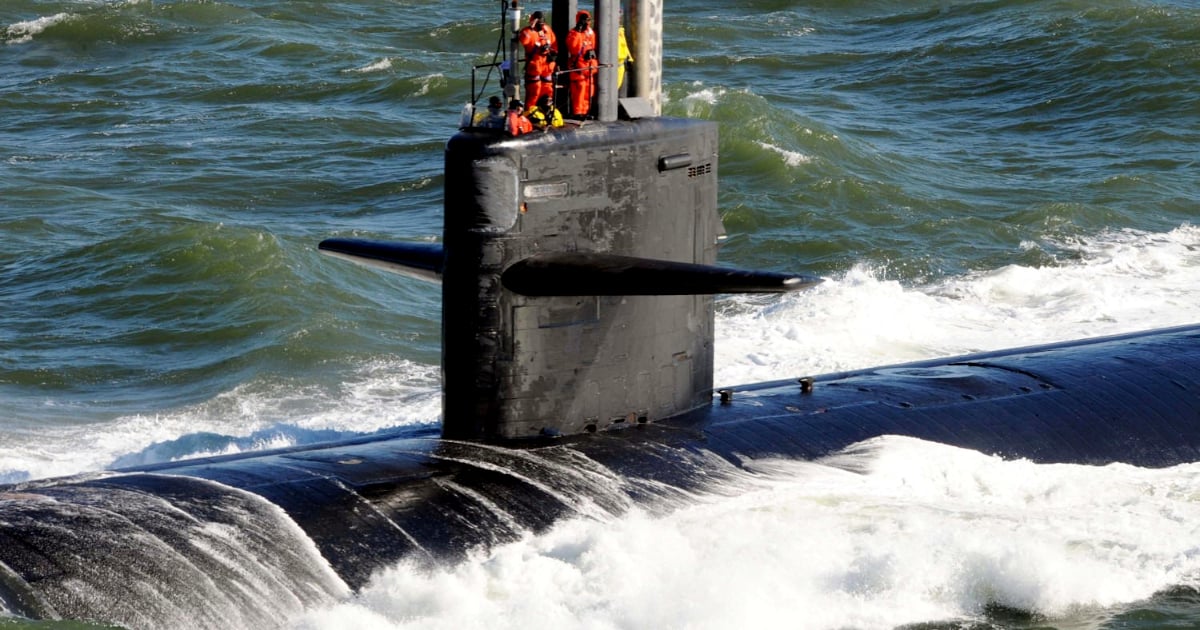
The United States has escalated its military presence in the Caribbean by dispatching a nuclear-powered attack submarine and a guided-missile cruiser. The White House has framed this move as part of a broader initiative to combat regional drug trafficking. However, many analysts see it as a direct strategy to apply pressure on the regime of Nicolás Maduro.
According to Reuters, the USS Lake Erie, a cruiser armed with guided missiles, and the USS Newport News, a Los Angeles-class nuclear submarine, are scheduled to arrive off the Venezuelan coast early next week. They will join an existing naval force that already includes three Arleigh Burke-class destroyers (USS Gravely, USS Jason Dunham, and USS Sampson) and an amphibious squadron with 4,500 personnel, including 2,200 Marines.
Trump's Strategy: Drugs and National Security
This deployment aligns with President Donald Trump's strategy of linking anti-drug efforts with national security concerns. "President Trump is committed to stopping drug trafficking and holding those responsible accountable," stated his spokesperson, Karoline Leavitt. She referred to Maduro as the head of a "narco-terrorist cartel" and highlighted that Washington has offered a $50 million reward for his capture.
Operation Details and Potential Actions
The Pentagon has not disclosed the exact mission of the new units, but defense sources cited by Reuters and CNN have confirmed that the operation includes intelligence gathering, aerial and maritime patrols, surveillance of drug trafficking routes, and potentially selective strikes, should the White House authorize them. The operation will also involve P-8 Poseidon aircraft designed to track submarines and fast boats, along with other warships. Officials have indicated that the mission will continue for several months and will be adapted based on threat assessments.
The Cartel of the Suns and Global Pressure
Washington maintains that the Cartel of the Suns, a network of Venezuelan military and government officials accused of smuggling cocaine to the United States and Europe, operates under the direct control of Nicolás Maduro and his inner circle. In July, the State Department listed this cartel as a global terrorist organization alongside the Tren de Aragua, thus broadening the legal tools available to target its members.
The Pentagon's message is unequivocal: under the rule of chavismo, Venezuela has transformed into a narco-state that poses a direct threat to U.S. and regional security.
Potential for Escalation
The arrival of the nuclear submarine and missile cruiser significantly bolsters the offensive capabilities of the U.S. fleet in the Caribbean. While the operation is officially part of the anti-drug campaign, its scale raises concerns that it could lead to a direct confrontation with Caracas.
"The United States will not allow cartels to use Venezuela as a platform," a U.S. official told Reuters, amid increasing tensions reminiscent of the 1989 Panama crisis. As Maduro decries an "imperial conspiracy" and mobilizes millions of militia members within his country, the region watches closely as the Venezuelan crisis becomes a focal point in continental geopolitics.
U.S. Military Strategy in the Caribbean
What is the purpose of the U.S. military deployment in the Caribbean?
The deployment is part of a broader initiative to combat drug trafficking in the region, but analysts suggest it also aims to increase pressure on the regime of Nicolás Maduro in Venezuela.
What assets are included in the U.S. military deployment?
The deployment includes a nuclear-powered submarine, the USS Newport News, a missile cruiser, the USS Lake Erie, three Arleigh Burke-class destroyers, and an amphibious squadron with Marines, among other assets.
How has the Venezuelan government responded to the U.S. military actions?
Venezuelan President Nicolás Maduro has condemned the U.S. actions as an "imperial conspiracy" and has mobilized militia forces within the country in response.