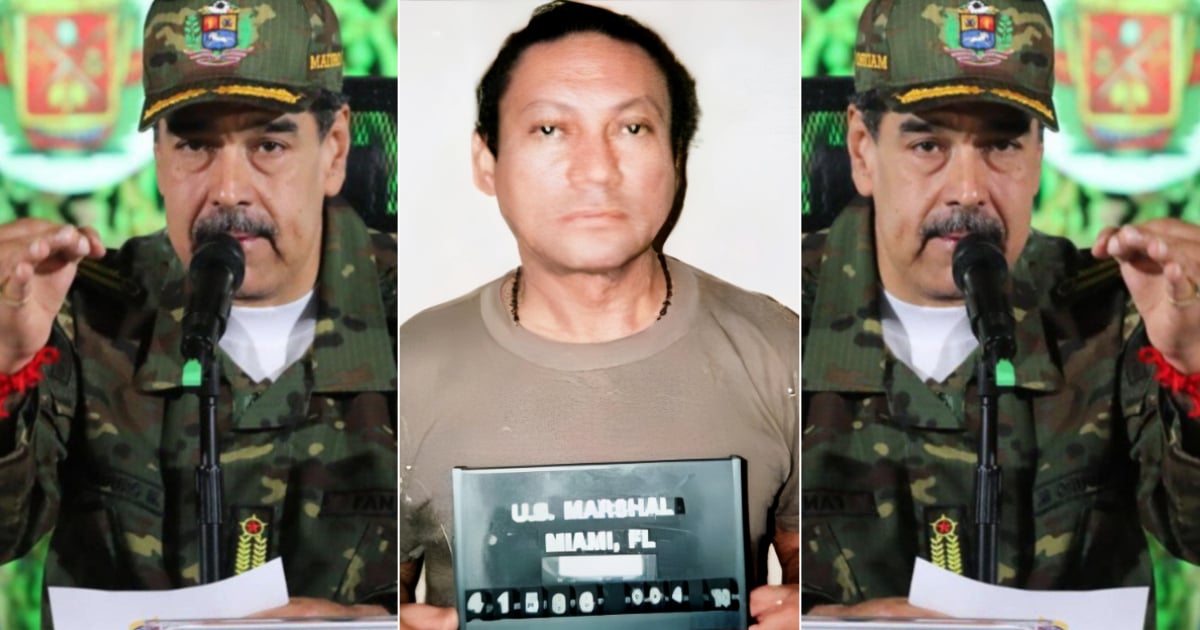
The ongoing military buildup near Venezuela, reminiscent of the 1989 U.S. invasion of Panama, has ignited a heated discourse on social media platforms such as CiberCuba. Under the headline “Maduro Under Pressure: The Ghost of Noriega Resurfaces with U.S. Deployment in the Caribbean,” numerous Cubans and Venezuelans are exchanging often conflicting views on the potential parallels between Manuel Antonio Noriega and Nicolás Maduro and the possible outcomes of Washington's latest maneuver.
The Shadow of Panama
For some, the historical comparison is unavoidable. "I hope Maduro ends up like Noriega," expressed one user, confident that the Chavista government may be nearing its end, akin to Panama's regime over three decades ago. Others echoed this sentiment, suggesting that socialism is on its way out in both America and the world.
However, not everyone sees it this way. Several individuals pointed out the stark differences between today’s circumstances and those of 1989. "Venezuela is not Panama, and Maduro is not Noriega," one commentator emphasized. They argue that Venezuela’s size, along with international support from powers like Russia, China, and Iran, coupled with a larger military force, makes a similar military operation impractical.
One widely shared message warned, "A direct invasion of Venezuela risks triggering a third world war." Others countered that a massive invasion isn’t necessary: "They could take out Maduro like they did Bin Laden," a Cuban suggested.
Ideological Clashes: Patria o Vida vs. Patria o Muerte
Ideological passions also fueled the debate. One user voiced solidarity with Caracas: "Go ahead, Venezuela; Cuba and other friendly countries stand with you, without fear. Patria o Muerte, venceremos!" This sparked a wave of sarcastic and critical responses.
“Stop gossiping and take your pill, Cubans don’t support another dictatorship like the one we have here,” replied another participant. "Communism will be eradicated forever. Patria y Vida. Freedom for the oppressed peoples," another insisted, referencing the opposition slogan gaining traction in Cuba.
The fear that young Cubans might be sent as "cannon fodder" in a potential conflict also surfaced in comments. "Those mothers don’t want their sons going to a foreign war; if they go, they won’t come back alive," warned one user.
The Impact of Sanctions and Corruption
Among Maduro's defenders, some highlighted the economic sanctions’ impact. "If the sanctions are lifted, you will see what a humble and hardworking country can achieve," one commenter stated.
However, others responded harshly: "What sanctions? The Chavistas have been looting oil, gold, and all resources for 26 years, while the people starve." The corruption within the Venezuelan elite was frequently mentioned: "Today, Chávez’s daughter is a multimillionaire in France. Where did she get all those millions? That’s the real blockade for the Venezuelan people."
Geopolitical Theater?
Some critics downplayed the military deployment, viewing it as mere theater. "It’s all drama; nobody will fire a shot," one user opined. "It’s just Trump’s spectacle to distract from his internal problems," another elaborated.
However, others cautioned about the symbolic impact of a withdrawal without results. "If the U.S. moves troops and then retreats, Maduro will echo Fidel in 1961: we defeated imperialism. The issue isn’t just military; it’s the historical narrative," noted a widely shared analysis.
The Legacy of Noriega
Some comments recalled personal memories from the Noriega era. "In Cuba, they said he was innocent, and I believed it until proven otherwise. We’ve been deceived so many times!" wrote one user.
Others remembered the official propaganda of those years and how the fall of the Panamanian general was used as a warning and example in the region. Historical parallels were also drawn: "Noriega was a CIA agent, Maduro is not. That’s the big difference," argued one user, while another retorted that "in the end, both got caught up in drug trafficking."
A Regional Domino Effect
The discussion also extended to Cuba and Nicaragua’s roles. "If Venezuela falls, Cuba and Nicaragua will follow," opined a commentator, reminding of Havana’s economic reliance on Venezuelan oil. "The domino effect is real; these dictatorships prop each other up," they added.
Others were more radical: "If they’re in the Caribbean, they should start with Cuba, remove the PCC, and then move on to Venezuela."
Between Fear and Humor
Reactions ranged from alarm to humor. "They say there’s no more toilet paper in Miraflores; there’s a huge panic," quipped one user. Another was more blunt: "Noriega hid in a church, Maduro will hide underground."
But there were also warnings about the human cost of conflict: "Losing in elections is not the same as dying in battle. If Venezuela surrenders, the empire will keep intervening everywhere," wrote a Chavismo supporter.
An Open Conclusion
The debate made one thing clear: Noriega’s figure remains an uncomfortable specter in Latin America, dividing opinions. For some, it’s the mirror in which Maduro will eventually see his reflection; for others, it’s proof that Venezuela won’t become another Panama.
Amid hopes for change and fears of military escalation, social media once again became a battleground of ideologies, where the ghosts of the past intersected with present uncertainties.
Exploring the U.S. Pressure on Venezuela
Why is there a comparison between Maduro and Noriega?
The comparison stems from the U.S. military buildup near Venezuela, which is reminiscent of the 1989 invasion of Panama. Critics see parallels between Noriega's regime and Maduro's government, sparking debate on potential outcomes.
What are the key differences between Venezuela and Panama?
Venezuela is significantly larger and has international backing from countries like Russia, China, and Iran. Additionally, its military is more sizeable compared to Panama's in 1989, making a similar invasion more complex.
How do sanctions impact Venezuela?
Sanctions are argued to severely impact Venezuela's economy, hindering its development. However, critics claim that internal corruption and resource mismanagement by the government are the primary issues.