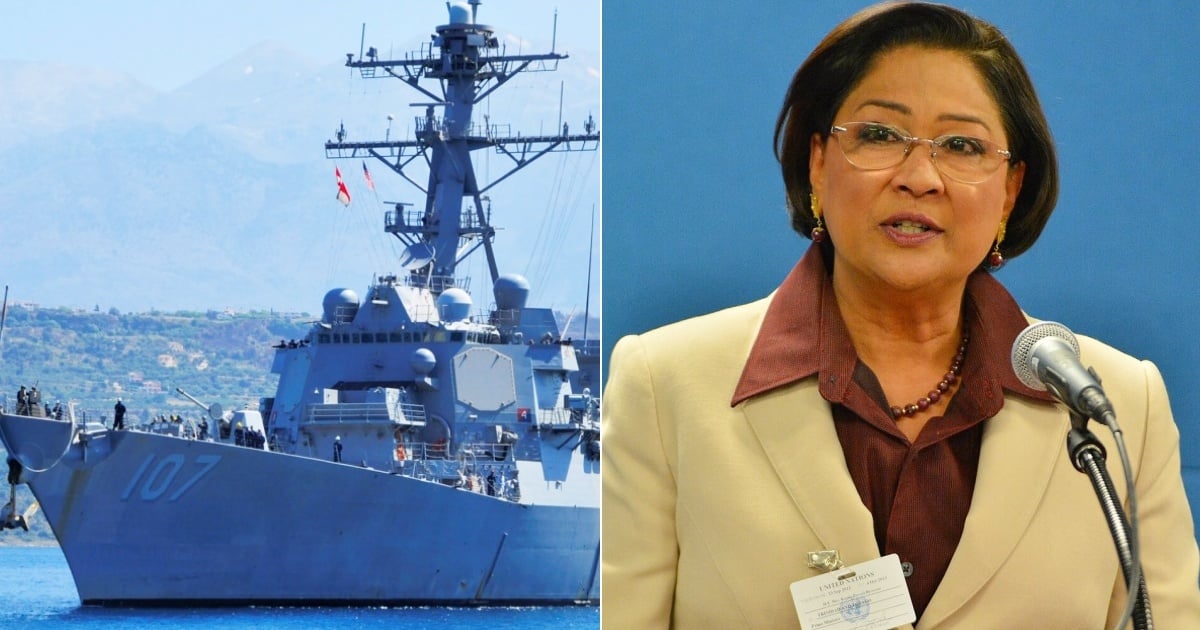
Kamla Persad-Bissessar, the Prime Minister of Trinidad and Tobago, has sent a strong message to the region and to Nicolás Maduro's regime by publicly supporting the United States' military deployment in the Caribbean Sea. This decision is seen as a strategic shift in regional policy, further complicating the geopolitical landscape for Venezuela, as reported by EFE.
Amid an unprecedented surge in violence linked to drug trafficking and transnational criminal organizations, Persad-Bissessar declared that her country would provide "unhesitating" access to Trinidadian territory if Washington requests it to counter a potential Venezuelan attack on Guyana.
"Should the Maduro regime launch any attack against the Guyanese people or invade Guyanese territory, and if the U.S. government requests access to Trinidadian land to defend the people of Guyana, my government will grant it without reservation," she stated in a televised speech over the weekend.
A Direct Warning to Maduro's Regime
The Prime Minister's statement comes at a time of high tension in the region, marked by the deployment of U.S. destroyers and amphibious warships, such as the USS Gravely, USS Jason Dunham, and USS Sampson, in waters near Venezuela. The operation is aimed at combating drug cartels, particularly the so-called Cartel of the Suns, which regional and U.S. governments directly link to the Chavista leadership.
Persad-Bissessar justified her support for Washington by highlighting that Trinidad and Tobago has suffered for two decades from drug trafficking, human trafficking, and arms smuggling.
"Trinidad and Tobago has been engulfed in bloodshed and violence over the past 20 years due to drug trafficking, human smuggling, and firearms. The Caribbean nations, particularly my own, have seen a massive rise in transnational crime and gang activity," she stated.
Rising Violence and Organized Crime in the Caribbean
According to figures published by Insight Crime, Trinidad and Tobago recorded 625 murders last year, with a homicide rate of 45.7%, of which 43.6% are linked to gang activities. This insecurity has also been mirrored in other islands such as Suriname, Barbados, and the Turks and Caicos Islands, which have also witnessed an alarming spike in crime rates.
Faced with this crisis, the Prime Minister insisted that small island states lack the necessary resources to combat drug cartels, justifying, in her view, support for foreign military operations: "We simply do not have the financial and military resources necessary to confront the drug cartels."
Furthermore, she warned that criminal networks have managed to infiltrate power structures in the Caribbean.
"Cartels have infiltrated the upper echelons of Caribbean societies, allowing them to exert significant influence over political, legislative, media, banking, security, and economic decisions," she said.
The Esequibo Dispute and Guyana's Role
Trinidad and Tobago's stance reaffirms the regional alliance supporting Guyana, a country engaged in a longstanding territorial dispute with Venezuela over the Esequibo—a 160,000 km² region rich in natural resources. Although administered by Guyana, Caracas claims it as its own and has intensified its aggressions in recent months, including holding a referendum to annex it in December 2023.
Guyana has responded by strengthening its international cooperation. In a recent statement, the Guyanese government expressed its commitment to regional security and denounced the threat posed by transnational organized crime, specifically naming the Cartel of the Suns as a destabilizing actor: "This organization has the capacity to overpower state institutions, undermine democracy, corrupt the rule of law, and threaten human dignity and development," warned Georgetown.
Maduro's Response
In response to increased international pressure, Maduro's regime ordered the deployment of 4.5 million militia members nationwide and alleged a supposed conspiracy orchestrated from Guyana with support from U.S. oil giant ExxonMobil. Venezuela's foreign ministry described Guyana's statement as "miserable" and accused Georgetown of acting under the influence of foreign powers.
However, from Washington, the response was firm: White House spokeswoman Karoline Leavitt assured that the United States is ready to "use all its power" to curb the flow of drugs in the region.
International Support and New Alliances
Trinidad and Tobago's support is seen as a strategic decision that could facilitate future military operations in the Caribbean. Cuban-American congressman Carlos Giménez, a member of the Armed Services Committee, publicly thanked the Trinidadian government for its gesture.
Meanwhile, other Caribbean governments are beginning to align with this new strategy. Jamaica's Prime Minister, Andrew Holness, recently proposed declaring gangs as terrorist organizations, opening the door to joint efforts with international actors.
A Dual Message from Trinidad and Tobago
Despite her support for Washington, Persad-Bissessar wanted to clarify that Trinidad and Tobago maintains good relations with the Venezuelan people: "We have always had good relations with the Venezuelan people, and that will continue," she emphasized, making it clear that her stance is part of the fight against crime, not an animosity towards Venezuelan citizens.
The Prime Minister also called for peace. "We hope that common sense and peace will prevail," she highlighted, although she reiterated that nothing will prevent her government from welcoming U.S. aid in combating the cartels.
Key Questions on the Caribbean Crisis
What is the main reason for the U.S. military presence in the Caribbean?
The U.S. military deployment in the Caribbean aims to combat drug cartels, particularly the Cartel of the Suns, which is linked to the Venezuelan government's leadership.
How has Trinidad and Tobago been affected by transnational crime?
Trinidad and Tobago has faced significant challenges from drug trafficking, human trafficking, and arms smuggling, contributing to increased violence and crime over the past two decades.
What is the Esequibo dispute between Venezuela and Guyana?
The Esequibo dispute involves a territorial disagreement over a resource-rich region of 160,000 km², administered by Guyana but claimed by Venezuela.