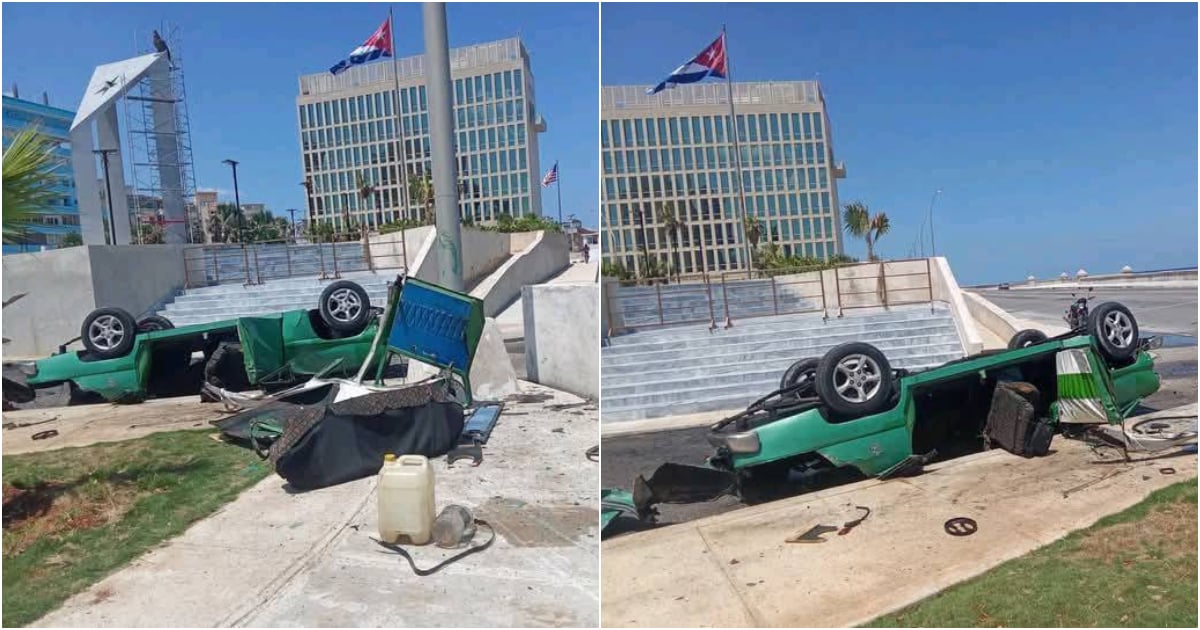
In a stark reminder of the dangers lurking on Havana's Malecón, a car carrying eight passengers, including three minors, flipped over in a notorious curve by the Anti-Imperialist Tribune "José Martí" this past Sunday afternoon. This incident once again brings to light the high accident rate in this area and the lack of effective preventive measures.
Pedro Lizardo Garcés Escalona shared the news on his Facebook profile, including images of the accident. Meanwhile, the Facebook group "Entérate con el Cubano Fiel," which is linked to Cuba's Ministry of the Interior, reported that all individuals involved were safe, based on updates from the Calixto García General Hospital. According to social media accounts, the vehicle, an old-fashioned "almendrón," lost control in the curve, resulting in the rollover.
In a separate Facebook post by user La Tijera, Elvin Fiel, a person who assisted in the rescue, recounted, "I took them to the Juan Manuel Márquez Pediatric Hospital; they are now out of danger." A family member of the victims responded, expressing gratitude, "I am the brother of one involved, even my nieces were there, that is, my family. Very thankful... may life bless you." He further confirmed, "The car lost steering, but everyone, including the children, is safe."
Community Concerns Over Hazardous Curve
Residents and drivers echo concerns about the perilous nature of the curve where the accident took place. They claim it's poorly designed and has a history of similar crashes. Despite past installations of traffic signs and warnings following previous accidents, new incidents continue to occur.
Complaints from those who frequent the area indicate the curve lacks an appropriate banking angle—the cross slope given to a road on a curve—facilitating rollovers, compounded by poor signage and driver recklessness. This combination turns that section of the Malecón into a critical point that continues to claim victims, despite repeated public warnings.
Recent Accidents Shed Light on Broader Issues
Back on July 10, a light jeep and a white car collided violently in the same region, where the speed limit is set at 50 kilometers per hour to mitigate risks in this high-traffic area with slick pavement. Additionally, this Sunday, a truck overturned on the Monumental route before the Santa Fe Bridge in Guanabacoa, though the exact causes remain unknown.
Another severe traffic accident occurred on Saturday afternoon in the Las Guásimas area of Arroyo Naranjo, Havana, resulting in significant material damage and leaving a motorcyclist injured, whose condition is yet to be determined. According to social media posts and eyewitnesses, the accident happened when a privately owned Hyundai Palisade ignored a "Stop" sign and collided head-on with a motorcycle traveling on the main road.
Systemic Failures in Cuban Road Safety
On the same day, another incident at the intersection of San Lázaro and Escobar streets in Centro Habana highlighted the risks citizens face in streets lacking clear signage and with drivers who disregard the right of way, paired with an ineffective traffic control system. Moreover, a traffic accident on Friday afternoon in Playa, at the crossroads of 19 and 46 streets, resulted in a car overturning in the street, causing alarm among passersby and locals.
Despite control measures, road accidents remain a critical issue in Cuba. The National Road Safety Commission reported 3,035 accidents, with 2,670 injuries and 290 fatalities, by May 2025. The government continues to blame human error while sidestepping structural causes like deteriorating roads, insufficient signage, and the public transport crisis, forcing many to resort to risky transportation means.
Alcohol consumption and traffic law violations are common causes of accidents. Additionally, there is a pressing need to bolster mandatory rest periods for professional drivers and the structural maintenance of bridges and road signage at high-risk points. The widespread deterioration of old vehicles still in use and poor road conditions contribute fatally to the increasingly deadly accidents reported nationwide.
The Cuban government has admitted that 75% of the country's roads are in a technical state ranging from fair to poor. This situation poses a significant challenge for the communist regime, directly impacting citizens' quality of life and the delivery of essential services.
Frequently Asked Questions About Traffic Safety in Cuba
What caused the recent accident near the Anti-Imperialist Tribune?
The accident was caused by a vehicle losing control in a hazardous curve, leading to a rollover.
Why is the Malecón curve considered dangerous?
The curve is considered dangerous due to its poor design, lack of appropriate banking, and inadequate signage, all contributing to a high accident rate.
What measures are needed to improve road safety in Cuba?
Improving road safety in Cuba requires better road maintenance, enhanced signage, stricter enforcement of traffic laws, and addressing the public transport crisis.