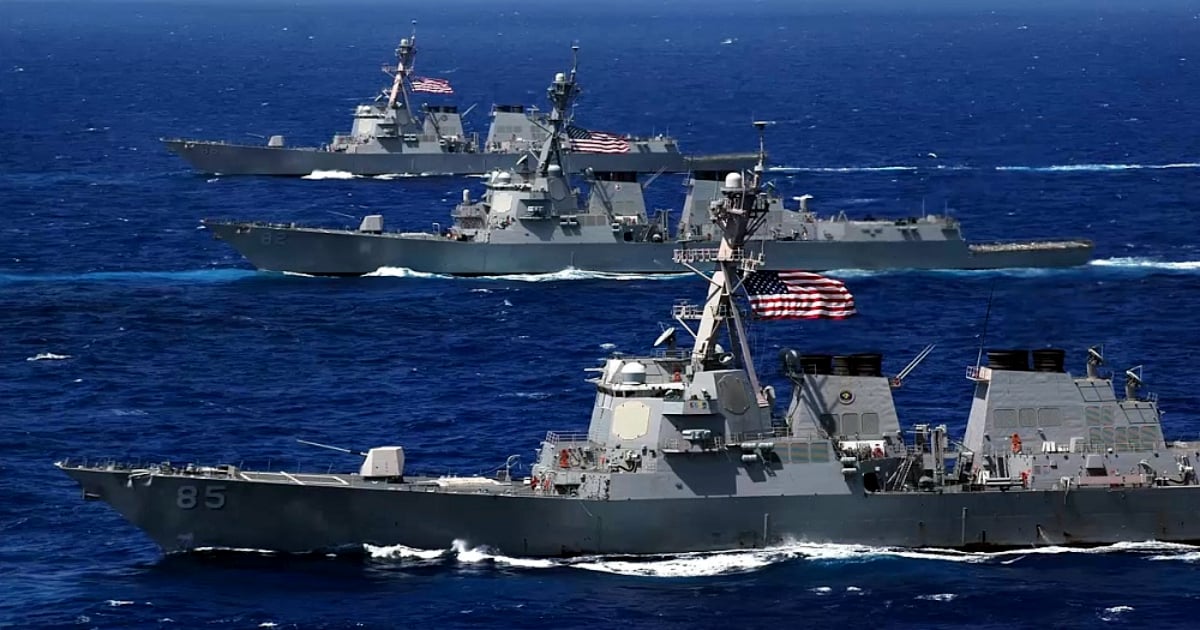
Three U.S. Navy guided-missile destroyers are advancing toward Venezuela's coastline, and they are expected to assume strategic positions in the Caribbean this week, according to Pentagon sources quoted by the Miami Herald. This maneuver is the focal point of a new military operation ordered by President Donald Trump aimed at combating drug cartels in Latin America.
The vessels—USS Sampson, USS Jason Dunham, and USS Gravely—are part of the Arleigh Burke class, which serves as the backbone of the U.S. surface fleet. Renowned for their versatility and firepower, these destroyers are equipped to handle simultaneous threats from the air, sea, and land, as well as conduct anti-submarine missions. Their presence near Venezuela marks one of the most significant U.S. naval deployments in the Caribbean in recent years, sending a strong signal to Caracas during a period of heightened political and military tension.
The Aegis System: A Technological Edge
At the core of the destroyers' combat capabilities lies the Aegis system, an advanced network of radars and missiles that can detect, track, and neutralize multiple threats in real-time. Developed during the Cold War and continuously updated, Aegis provides these ships with a technological edge that few navies worldwide can match.
Each destroyer is equipped with a 96-cell vertical launch system capable of firing long-range Tomahawk cruise missiles, anti-air interceptors, anti-submarine rockets, and other high-precision projectiles. Additionally, they feature 5-inch naval guns and Phalanx close-in weapon systems designed to destroy incoming missiles or aircraft that penetrate external defenses. This combination of capabilities makes the destroyer group a crucial deterrent, not only against narcotics trafficking but also in geopolitical scenarios like the one surrounding Venezuela.
Large-Scale Deployment
According to U.S. defense officials, the operation involves around 4,000 sailors and Marines, supported by P-8 Poseidon maritime patrol aircraft—specialized in detecting submarines and vessels over long distances—other support ships, and at least one nuclear attack submarine.
The White House has emphasized that the mission's goal is to halt the flow of drugs into the United States and dismantle transnational criminal networks. However, military analysts suggest that the scale and nature of the deployment also reflect an intention to exert direct pressure on Nicolás Maduro's regime, which Washington accuses of leading the Cartel of the Suns.
"President Trump has been clear: he is willing to use every element of American power to stop the drugs flooding into our country and bring those responsible to justice," spokesperson Karoline Leavitt stated in a recent press briefing.
Caracas Mobilizes Militia
Caracas was quick to respond. On Monday, Maduro announced the mobilization of 4.5 million militia members across the nation to "defend national sovereignty." In a televised speech, Maduro claimed that these militias would be equipped with rifles and missiles to ensure the defense of "seas, skies, and lands" against the U.S. threat.
Although the Bolivarian Militia is formally one of the five components of the National Armed Forces, experts note that its operational capacity is limited compared to the naval and air power deployed by the United States.
Regional Escalation
The deployment of destroyers near Venezuelan waters is part of a series of measures by Washington that have increased pressure on Caracas: the designation of several Latin American cartels as terrorist organizations, the inclusion of the Cartel of the Suns in that list, and the offer of a $50 million reward for Maduro's capture.
The naval operation has raised concerns in Latin America. The Mexican government warned that Washington's unilateral actions could pave the way for direct intervention in the region. Human rights organizations have also questioned the use of bases like Guantanamo to deport alleged members of criminal organizations detained in migration operations.
Between Narcotics and Geopolitics
While the Pentagon's official justification is the fight against drug trafficking, the positioning of destroyers near Venezuela has a strong geopolitical component. The Caribbean, historically sensitive for regional security, once again becomes a battleground between Washington and a government allied with Havana.
The imminent arrival of these ships at strategic positions off the Venezuelan coast increases tension and reinforces the perception that the United States is prepared to escalate its pressure on Maduro beyond economic and diplomatic sanctions.
Key Questions About U.S. Naval Deployment Near Venezuela
What is the purpose of the U.S. naval deployment near Venezuela?
The deployment aims to combat drug cartels in Latin America and exert pressure on Nicolás Maduro's regime, which is accused by Washington of leading the Cartel of the Suns.
What capabilities do the Arleigh Burke-class destroyers have?
These destroyers are equipped with the Aegis system, capable of detecting and neutralizing multiple threats simultaneously. They have a 96-cell vertical launch system for various missiles and additional defensive weapons.
How has Venezuela responded to the U.S. naval presence?
Venezuela has mobilized 4.5 million militia members to defend against the perceived U.S. threat, although experts question their capacity to counter the U.S. naval and air power.