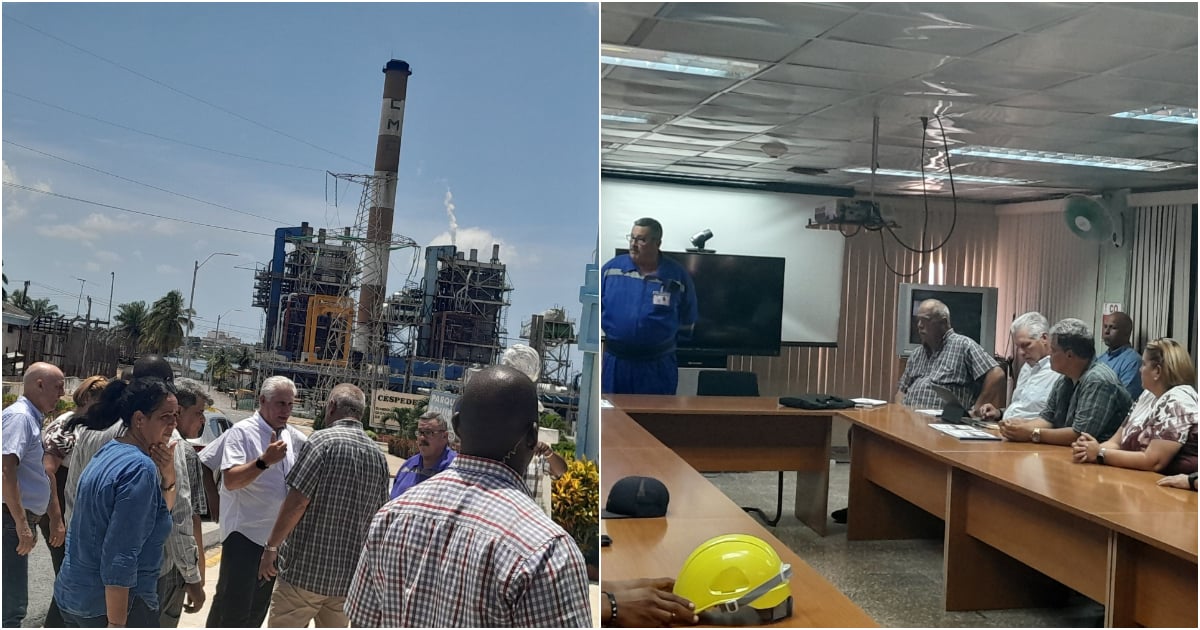
Today, Cuban leader Miguel Díaz-Canel visited the Carlos Manuel de Céspedes thermoelectric plant in Cienfuegos to assess the progress of overdue repairs. This official visit stands in stark contrast to the frustration of millions of Cubans suffering from daily blackouts due to the collapse of the national electrical system.
After stopping in Villa Clara, the president made his way to the central province, adding the plant visit to his agenda. Unit 4 of the plant has been out of commission since December due to a breakdown in the power grid. Repairs on this unit began months ago due to boiler issues but remain unfinished, according to a report from Cuba's presidency on their X account.
The statement mentioned that while significant work is being done to restore Unit 4, no specific timeline was provided for its return to the grid. Currently, Unit 3 is operational and generating 158 megawatts. Under normal circumstances, the plant supplies about 14% of the nation's electricity through fossil fuel combustion, making it a critical energy source.
In early May, Unit 3 was reconnected to the national grid after being offline for over three months. Díaz-Canel's itinerary also included a visit to the Military Industrial Shipyard Center, which constructs and repairs vessels, and a plant producing hygiene products associated with the Military Industries Union.
Accompanied by Defense Minister Álvaro López Miera and other high-ranking officials, Díaz-Canel urged the acceleration of investment projects and the resolution of longstanding delays, citing the complexity of the tasks involved. His schedule commenced at Punta Las Cuevas, a diverse farm and educational facility linked to the University of Cienfuegos's Faculty of Agricultural Sciences, as reported by the official newspaper 5 de Septiembre.
On the previous day, Díaz-Canel toured the Ernesto Che Guevara power plant in Santa Cruz del Norte, urging plant directors to oversee every detail of repairs, even down to the welds, as he attempts to demonstrate control over the relentless energy crisis affecting millions of Cubans. This was not his first visit to the plant; similar visits occurred in 2022 and 2024, each time accompanied by promises of recovery.
Despite these assurances, blackouts continue unabated, becoming the new norm for Cubans who endure persistent darkness. On Friday, during peak hours, the projected available capacity is 2,220 MW against a demand of 3,850 MW, resulting in a deficit of 1,630 MW and an overall impact of approximately 1,700 MW.
In May, Argelio Jesús Abad Vigoa, Deputy Minister of Energy and Mines, claimed power cuts would not exceed four hours. However, Cubans are enduring a summer with outages lasting up to 20 hours, cooking with wood or charcoal, losing food supplies, and spending nights outdoors to escape the heat. While officials call for "savings" and blame household appliance use, most families feel their patience is wearing thin.
Understanding Cuba's Energy Challenges
What is causing the energy crisis in Cuba?
Cuba's energy crisis is largely due to the aging infrastructure of its electrical grid, lack of maintenance, and reliance on fossil fuels, which have led to frequent blackouts and power shortages.
How are Cubans coping with the prolonged blackouts?
Many Cubans are resorting to cooking with wood or charcoal and spending nights outside to escape the heat. The continuous power cuts disrupt daily life, leading to food spoilage and challenging living conditions.
What steps is the Cuban government taking to address the energy crisis?
The government is attempting to repair and maintain key power plants and urging investment in infrastructure improvements. However, these efforts have been slow, and significant progress has yet to be seen.