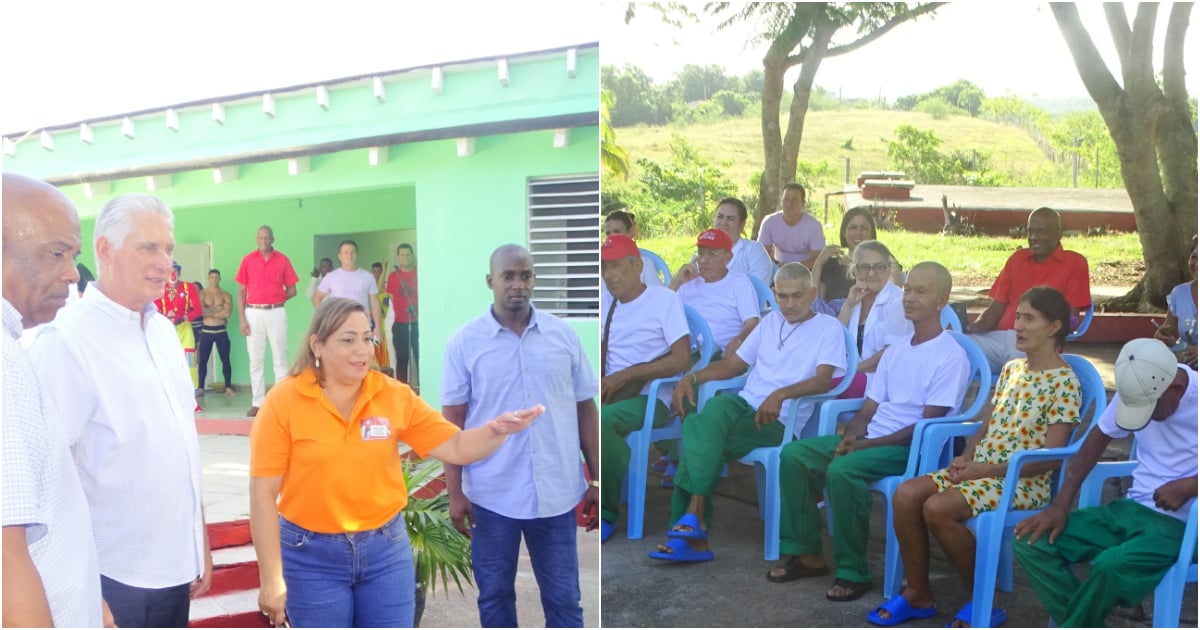
President Miguel Díaz-Canel recently visited the William Darias Social Protection Center in Santa Clara, which is touted as a model for the care of the homeless. This visit comes amidst controversy over the state's neglect of the thousands left on Cuba's streets without effective solutions. Since July, the center, designed to accommodate 60 people, has only managed to retain 30 out of 43 individuals who have passed through, according to journalist Henry Omar Pérez's report on Facebook.
During the visit, Díaz-Canel was joined by Susely Morfa, the first secretary of the Communist Party in Villa Clara, and provincial governor Milaxy Yanet Sánchez. Together, they toured the facility's dining halls, sleeping quarters, and medical consultation areas, greeting elderly residents engaged in cultural activities. This visit aimed to project an image of a government actively providing answers to the plight of marginalized individuals.
According to Maraiky León Iglesias, head of the Provincial Department of Prevention, Assistance, and Social Security, the center's approach involves interviews, medical assessments, clothing distribution, and meals, followed by housing arrangements and cultural or sports activities for reintegration. Solutions also include returning individuals to their home provinces, reuniting them with family, or admitting them to nursing homes or psychiatric hospitals, based on each case's specifics.
Despite Díaz-Canel's remarks about transforming lives and harnessing the knowledge of those who come through the center, a real plan for the countless Cubans roaming the streets and terminals without aid remains absent. The center opened shortly after former Minister of Labor and Social Security Marta Elena Feitó Cabrera denied the presence of homeless people in Cuba.
On July 14, Feitó Cabrera claimed in a parliamentary session that Cuba had no "beggars," only individuals she disparaged as "drunks" and "pretenders." Her comments, dismissing hunger on the island and blaming citizens for their poverty, sparked outrage across social media, independent media outlets, and the public. Hours later, her resignation was accepted by the Communist Party and State Council, following a "joint analysis" with government leadership.
Subsequently, the government acknowledged that over 310,000 people on the island live in poverty or social vulnerability amid severe economic turmoil. By the end of the month, Prime Minister Manuel Marrero Cruz visited a homeless center in Ciego de Ávila, attempting to mitigate backlash from Feitó Cabrera's statements.
While the Cuban government masks indigence with terms like "vulnerable" and "transients," a growing number of elderly, sick, and marginalized individuals survive outdoors without effective policies or genuine acknowledgment of the nation's hidden issues. Even official media have reported on this forgotten layer of society, where people who have lost nearly everything—home, family, mental health, employment—scavenge for survival.
On August 1, the provincial newspaper Girón published an article exposing the dire conditions faced by "transients" at the Jagüey Grande Social Protection Center. The report, "Inhabitants of Dust (II): The Land That Was Never Promised," portrays it more as a "cemetery of living men" according to testimonies collected.
The Council of Ministers' Agreement 10056/2025 describes "transients" as having "a multi-causal human behavior disorder" involving instability, insecurity at home, lack of self-care, economic autonomy, family support, and a favorable life project. However, the measure focuses more on managing visibility than reversing homelessness. Although the government purports to offer solutions, the root causes of homelessness in Cuba remain unaddressed.
Understanding Cuba's Homelessness Crisis
What is the significance of Díaz-Canel's visit to the social center?
Díaz-Canel's visit aims to showcase government efforts in addressing homelessness, despite criticism over inadequate state solutions.
Why was former Minister Marta Elena Feitó Cabrera's statement controversial?
Her denial of homelessness and derogatory remarks about those affected sparked widespread outrage and backlash from various sectors.
How does the Cuban government define "transients"?
The government describes them as having a "multi-causal behavior disorder" related to instability, lack of self-care, and insufficient family support.