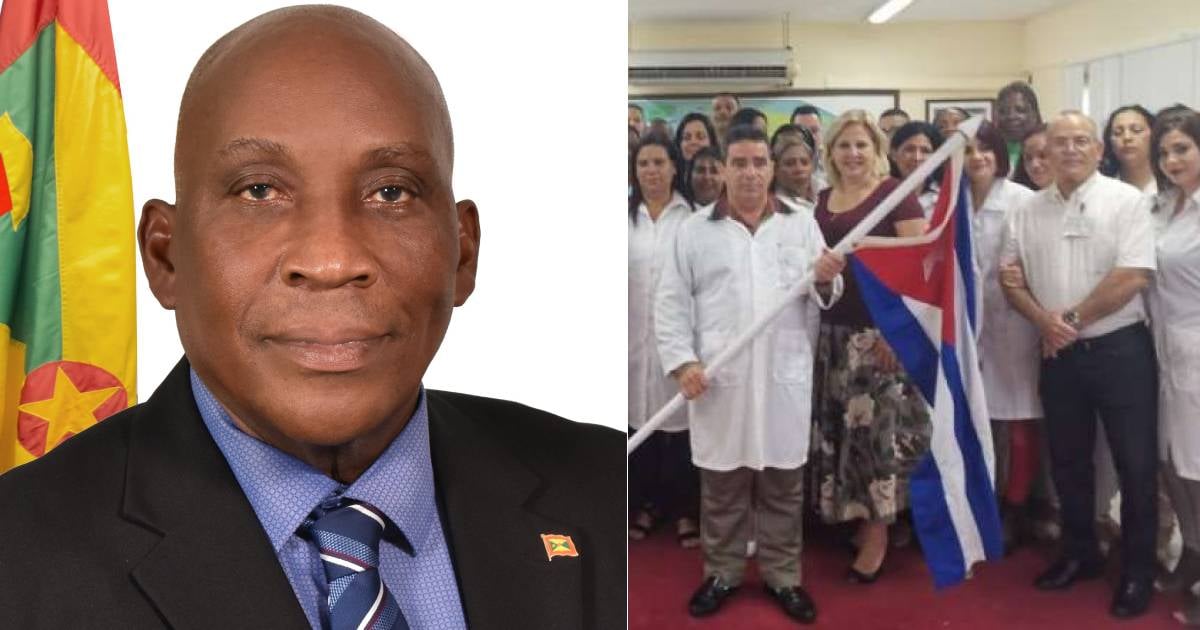
Grenada's Finance Minister, Dennis Cornwall, has made headlines as the first official from his nation to have all of his U.S. visas revoked. This comes as a consequence of Washington's decision to impose sanctions on Caribbean leaders involved in agreements with Cuban medical brigades. This move directly impacts a key figure in Prime Minister Dickon Mitchell's administration and sets a significant precedent in the Caribbean region.
The local news outlet, The New Today, revealed that the U.S. Department of State has rescinded Cornwall's three visas (B1, B2, and A1), thereby barring him from attending meetings with the International Monetary Fund and the World Bank. His former spouse, Ophelia Cornwall, also had her visa revoked.
Back in March, Cornwall had publicly stated, alongside Foreign Minister Joseph Andall, his readiness to forfeit the privilege of traveling to the United States rather than retract his support for Cuba and the continuation of medical brigades in Grenada. "I'd rather lose my visa than turn my back on the Cuban people," he declared in Parliament at the time.
Having studied in Cuba during the 1980s under the government of Maurice Bishop, Cornwall has maintained a strong connection with Havana. This background partly explains his staunch defense of Cuban medical cooperation despite mounting international pressure.
Impact of Washington's Sanctions
Cornwall's situation reflects a new policy from the State Department, announced by Secretary Marco Rubio, aimed at penalizing officials from Cuba, Africa, and the Caribbean for what is perceived as a global scheme of "forced labor" in Cuban medical missions.
"Visiting the United States with a visa is a privilege, not a right. We are committed to combating human trafficking, including forced labor," Rubio stated in an official message.
Both Washington and human rights organizations accuse the Cuban government of withholding a significant portion of the salaries of doctors sent abroad, subjecting them to coercive working conditions. In contrast, Havana defends these missions as acts of "solidarity" and a legitimate source of income to sustain its healthcare system.
According to The New Today, unconfirmed reports suggest that the Grenadian government directly channels 65% of the doctors' salaries to the Cuban regime, while the professionals themselves receive 35% in their accounts.
So far, Prime Minister Dickon Mitchell's government has not issued an official statement regarding the visa revocations for Cornwall and his ex-wife. Nonetheless, the sanction strikes a blow to one of the prominent figures in his cabinet, sending a clear message to other Havana allies in the region.
Representing the rural district of St Patrick East, Cornwall remains unable to set foot on U.S. soil as long as the restrictions are in place. Yet, rather than appearing impacted, he seems to have fulfilled his pledge to sacrifice a personal privilege in the name of his political allegiance to Cuba.
Key Questions About U.S. Sanctions and Cuban Medical Brigades
Why did the U.S. revoke Dennis Cornwall's visas?
The U.S. revoked Cornwall's visas as part of a broader policy to sanction Caribbean leaders involved in agreements with Cuban medical brigades, which the U.S. views as "forced labor" schemes.
What has been the response of the Grenadian government?
As of now, the Grenadian government under Prime Minister Dickon Mitchell has not released an official response to the visa revocations.
How does Cuba defend its medical missions?
Cuba defends its medical missions as acts of solidarity and a legitimate source of income crucial for maintaining its healthcare system, despite international criticisms.