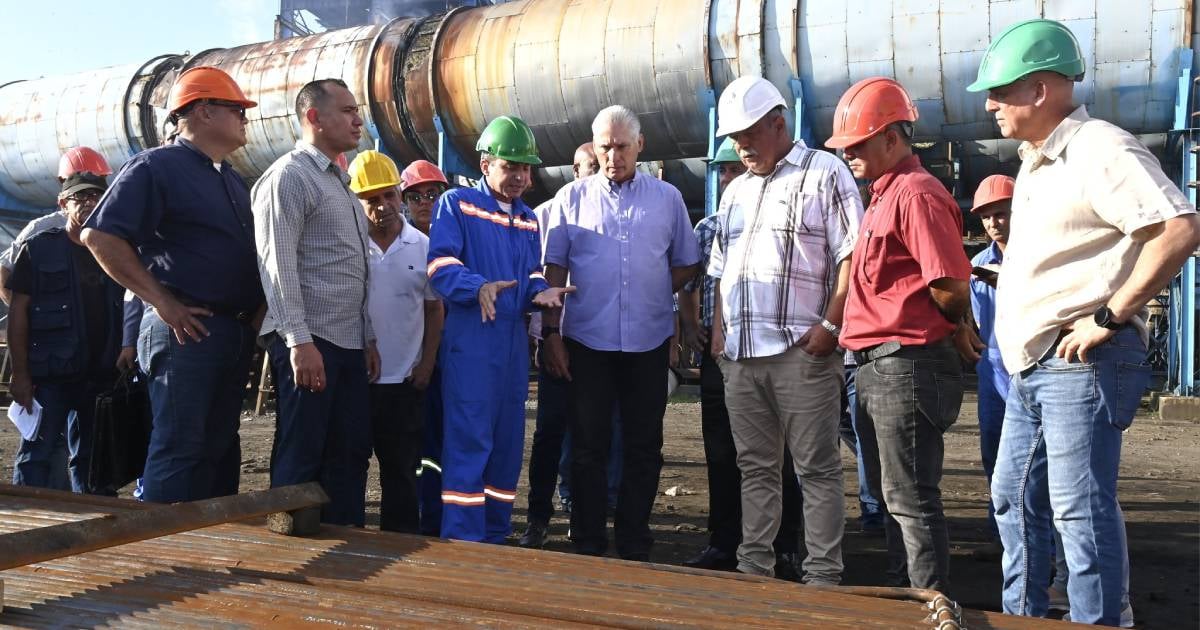
On Thursday, Cuban leader Miguel Díaz-Canel visited the Ernesto Guevara Thermoelectric Plant in Santa Cruz del Norte and insisted that plant management closely monitor every detail of repairs, down to the welds. This visit is part of an effort to project control over the ongoing energy crisis that continues to disrupt the lives of millions of Cubans.
In a series of posts by the Cuban Presidency on social media platform X, Díaz-Canel emphasized the importance of prioritizing the workers involved in maintenance, stating that "reviving the electrical system is currently the nation's top priority." Despite his presence among engineers and welders, the Unión Eléctrica (UNE) announced that power outages are set to exceed 1,800 MW, effectively plunging the entire island into prolonged blackouts, sleepless nights, and unbearable heat.
This is not Díaz-Canel's first visit to the thermoelectric plant; he made similar appearances in 2022 and 2024, each time offering assurances that recovery of capacity was imminent. On this occasion, he highlighted the need for detailed oversight, even down to the welds, indicating a focus on superficial details while the population waits for reliable electricity.
Meanwhile, as Díaz-Canel spoke of energy recovery, the UNE reported that blackouts would persist throughout the day, with a projected impact of 1,420 MW at midday and a more severe shortfall during peak hours, leading to 2,240 MW of deficit against a demand of 3,800 MW. This situation results in 1,630 MW of power cuts across much of the country.
On Wednesday, widespread outages affected the island throughout the day, with a peak impact of 1,869 MW at 8:50 p.m., a figure that exceeded expectations due to the shutdown of unit 6 at the Nuevitas Thermoelectric Plant. Official data highlights what millions of Cubans experience daily, where "normalcy" equates to darkness.
Díaz-Canel's visit to the Ernesto Guevara plant is part of an official propaganda strategy aimed at showcasing concern for the crisis. However, outcomes remain unchanged, mired in promises of modernization, solemn declarations, and increasingly lengthy power outages.
A Troubled History of Failures
The Ernesto Guevara Thermoelectric Plant was constructed in the early 1990s with three generator blocks, each producing around 100 MW, operating on crude oil and fuel oil. For over a decade, it has functioned under severe technical constraints, having surpassed its capital maintenance cycles.
In April 2023, a fire in unit 3 temporarily halted its repairs, delaying synchronization with the National Electric System. Although its three units occasionally contribute around 190 MW to the country, the lack of parts, fuel, and modernization has turned the plant into a symbol of the electrical system's precarious state.
In March, the government announced a modernization plan with Russian funding, which includes constructing a new 200 MW block. However, these plans remain unfulfilled, lingering in the realm of promises.
Understanding Cuba's Energy Crisis
What is causing the ongoing power outages in Cuba?
Cuba's power outages are primarily due to aging infrastructure, lack of maintenance, and insufficient resources to modernize and repair existing facilities.
What measures is the Cuban government taking to address the energy crisis?
The Cuban government has announced plans for modernization with Russian funding, including constructing new power blocks, but these remain largely unimplemented.
How have the power outages affected daily life in Cuba?
The power outages have led to prolonged blackouts, causing discomfort due to heat, disrupting daily activities, and contributing to a growing sense of frustration among the population.