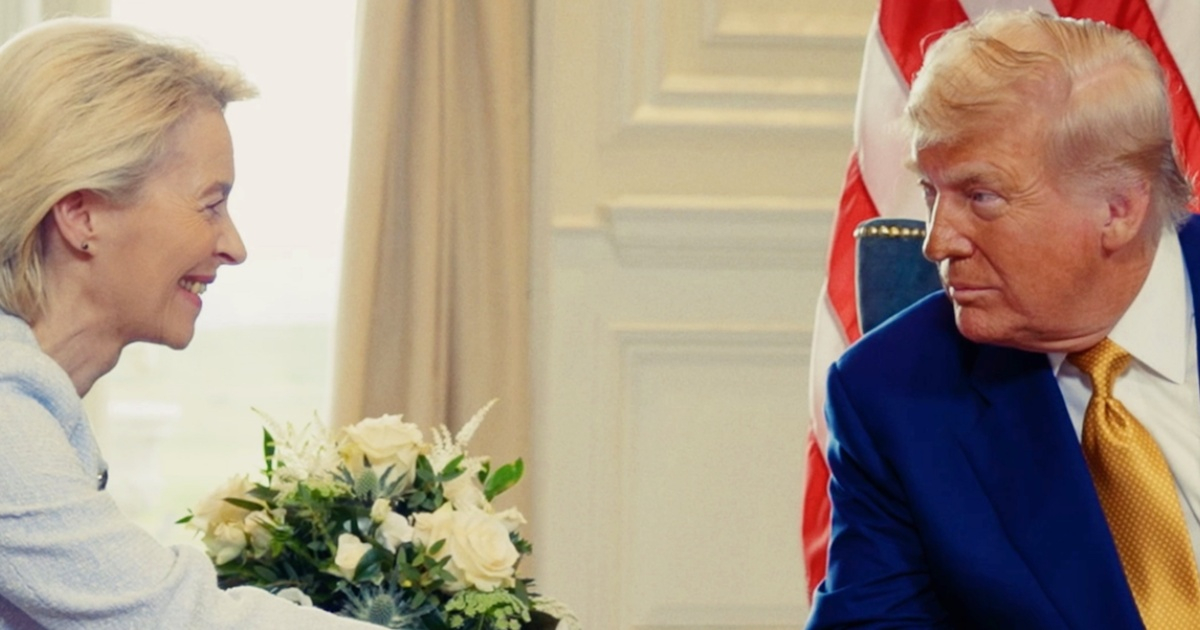
The European Union and the United States have officially sealed a trade agreement that reshapes transatlantic economic relations. This comes after intense weeks of negotiations aimed at averting a tariff war. The document, which formalizes the political understanding reached between President Donald Trump and European Commission President Ursula von der Leyen in Scotland at the end of July, includes measures with significant economic impacts for both regions.
Among the key elements of the agreement is a 15% tariff on most European imports to the U.S., alongside Europe's commitment to make substantial purchases of American energy and technology up until 2028.
15% Tariffs: A "Tolerable" Solution to Prevent a Trade War
The core of the agreement involves Washington imposing a general 15% tariff on roughly 70% of European imports. This measure, which took effect on August 7, replaces previous tariffs of up to 27.5% in crucial sectors like the automotive industry.
EU sources described the agreed tariff as "tolerable," emphasizing that it prevents "the worst-case scenario," which could have been an open trade war with tariffs of 30% or higher. For the auto sector, particularly sensitive for countries like Germany and France, the new 15% tariff represents a significant reduction from the former 27.5%. However, its implementation hinges on when Brussels begins executing its part of the deal.
European Trade Commissioner Maros Sefcovic explained that there is a "commitment to apply the 15% cap on cars and auto parts" from the day the EU enacts the agreement, with the possibility of retroactivity to August 1 if the schedule is met.
Substantial European Commitment: Energy, Military, and Technology Purchases from the U.S.
In return, the European Union has committed to unprecedented purchases from the United States in several strategic sectors, including:
Energy: Brussels will acquire liquefied natural gas (LNG), oil, and nuclear energy products from American companies, with a total estimated value of 640 billion euros by 2028. This initiative aligns with the EU's goal to reduce its energy dependence on Russia.
Military Equipment: The EU also agrees to buy arms and defense technology from U.S. firms, although the total amount allocated for this sector has not been specified.
AI Chips: Europe has pledged to import AI chips worth at least 40 billion euros, aiming to narrow the technological gap with China and the United States in advanced computing.
Beneficial Sectors and Sensitive Exceptions
The agreement also specifies products that will be exempt from the new tariffs or will benefit from "zero or near-zero" rates. These include:
- Aircraft and aircraft parts.
- Generic medicines and their ingredients.
- Chemical precursors.
- Natural resources not available in the U.S., such as cork.
Conversely, other sectors traditionally strong in European exports, like wine and spirits, have been left out of the agreement for now. "We haven't managed to include them yet," Sefcovic admitted, although he assured that "the doors are not closed forever."
Internal Criticism and Final Political Support
Although the initial reception of the political agreement was lukewarm in several European capitals—Spanish Prime Minister Pedro Sánchez described it as "unenthusiastic"—the final signing of the document was preceded by a meeting of EU ambassadors, who regarded the text "positively," according to diplomatic sources.
The timing of the pact's consolidation was also symbolic: just three days earlier, von der Leyen, Emmanuel Macron, and German Chancellor Friedrich Merz were at the White House supporting Ukrainian President Volodymyr Zelensky. This event also served to strengthen the common front with Trump.
True to his style, Trump publicly referenced the agreement. "We just closed a great deal with the Germans," he stated in one of his speeches. During the negotiations, he had repeatedly threatened to raise tariffs to 35% if a consensus favorable to the United States was not reached.
A Roadmap for the "Trump Era"
Although the document is not legally binding, it serves as a clear roadmap for commercial relations between the two powers. In von der Leyen's words: "The agreement is a concrete demonstration of our commitment to fair, balanced, and mutually beneficial trade and investment. It offers predictability for our businesses and consumers, stability in the world's largest trade relationship, and security for European jobs and long-term economic growth."
The text also includes an open clause for future expansions. "The U.S. and the EU agree to consider other sectors and products important to their economies and value chains for inclusion in the list of products subject only to the 15% tariff," the document reveals.
Sefcovic himself summarized the situation with a note of caution about the future: "This is not the end, just the beginning."
Key Insights on the U.S.-EU Trade Agreement
What is the central focus of the U.S.-EU trade agreement?
The central focus is a 15% tariff imposed by the U.S. on about 70% of European imports, intended to prevent a trade war.
What commitments has the European Union made in the agreement?
The EU has committed to significant purchases from the U.S. in energy, military equipment, and AI chips, totaling billions of euros by 2028.
Which products are exempt from the new U.S. tariffs?
Products like aircraft parts, generic medicines, chemical precursors, and certain natural resources not available in the U.S. are exempt from the tariffs.