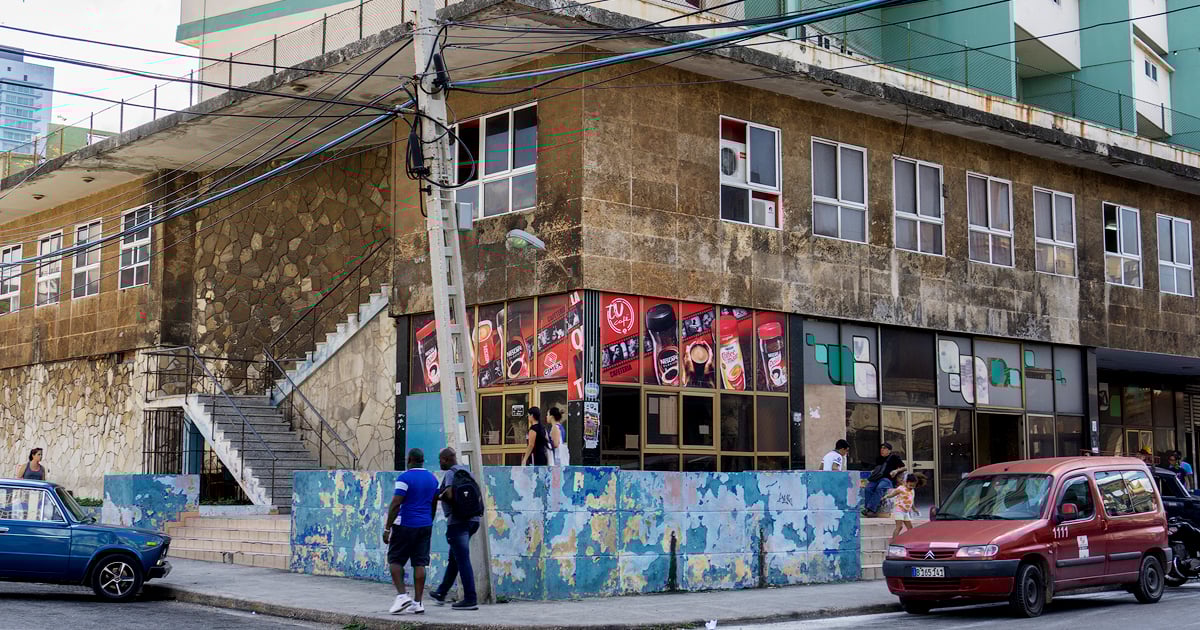
The historic Focsa Building in Havana's El Vedado district has recently welcomed a new dollar-only supermarket, highlighting the Cuban regime's increasing reliance on the U.S. dollar. Operated by CIMEX—a subsidiary of the military conglomerate GAESA—in partnership with the Spanish company Inversiones Pucara S.A. (Ipsa), the store opened this week amidst both anticipation and criticism, as reported by independent newspaper 14ymedio.
Branded as a Supermix Market, the supermarket boasts shelves stocked with imported goods ranging from meats and dairy to pet food. Yet, the allure of these offerings is marred by payment challenges: banking connections are down, and cashiers are accepting only U.S. dollars in cash. With no change available, customers are given candies or chocolates as change, according to the report.
Prices are described as "medium to high" by shoppers, underscoring the exclusivity of a store out of reach for most Cubans, whose average monthly salary in the informal market falls below $20. This situation is even more ironic given its location in a building that, in the 1950s, symbolized Cuban bourgeoisie prosperity and was nationalized post-1959 to house top regime officials and allies.
The Impact of Dollarization on Cuban Retail
The launch of this supermarket at the base of the Focsa is part of a broader trend towards dollarization in Cuba's retail sector. Since early 2025, the government has been promoting new and reopened stores accepting only foreign currency, widening the gap between those with dollar access and the majority reliant on the depreciated Cuban peso.
In February, the Ministry of Domestic Trade announced the opening of 50 new dollar-only stores nationwide. Shortly after, a store in Holguín, "Las Maravillas," quietly opened, offering perfumes, cleaning products, and baby items. That same month, CiberCuba reported that the Altahabana Shopping Center in Havana began operating exclusively in dollars, accepting cash, international credit cards, or local prepaid cards.
By March, the policy of reopening stores had already established a circuit of foreign currency commerce, sidelining the CUP and MLC. By May, reports indicated over 85 stores across the island were operating solely in dollars. The phenomenon has intensified over time; in July, CiberCuba highlighted the continued dollarization of essential goods while MLC usage declined rapidly. This trend underscores that access to essential goods is increasingly tied to the ability to obtain U.S. dollars, exacerbating social inequality in the country.
GAESA's Expanding Economic Influence
The opening of the market in the Focsa building is not an isolated incident but rather part of a broader strategy by the military conglomerate GAESA. Recent leaks of internal financial documents—obtained by the Miami Herald and analyzed by CiberCuba—reveal an empire with liquid assets exceeding $18 billion, cementing GAESA as the regime's true economic powerhouse, surpassing even state reserves.
These revelations highlight how GAESA accumulates liquidity—over 76% in dollars—without paying taxes on foreign currency and receiving continuous state subsidies, operating with complete impunity and without citizen oversight or independent audits. CIMEX, a key subsidiary and partner in this new store, is part of this structure, suggesting that the Focsa establishment is not merely a commercial strategy but also an expansion of military control over hard currency commerce.
The contrast is stark: while the country grapples with widespread power outages, food and medicine shortages, and minimum wages barely exceeding $16 a month, GAESA amasses vast fortunes without accountability. Analysts describe this structure as a "kleptocratic oligarchy," a state within a state prioritizing its financial gains over the population's urgent needs.
In this context, the new dollar-only store at the Focsa is not just another exclusive retailer: it is a manifestation of an economic strategy by a military conglomerate backed by political power, consolidating its dominance and expanding its presence in everyday life with spaces reserved for those with access to foreign currency.
Understanding Cuba's Economic Shift
Why is the Cuban government opening dollar-only stores?
The Cuban government is opening dollar-only stores to increase access to foreign currency, which is crucial for importing goods and alleviating some economic pressures. This strategy, however, deepens social inequality as most Cubans earn their salaries in the devalued peso.
How does GAESA influence the Cuban economy?
GAESA, a powerful military conglomerate, influences the Cuban economy by controlling significant sectors, including retail through subsidiaries like CIMEX. It accumulates wealth without paying taxes on foreign currency and operates with minimal oversight, making it a dominant force in the economy.
What impact does dollarization have on Cuban society?
Dollarization in Cuba creates a divide between those who can access dollars and those who cannot, exacerbating social inequality. It limits access to essential goods for much of the population who earn in the devalued peso, widening the economic gap.