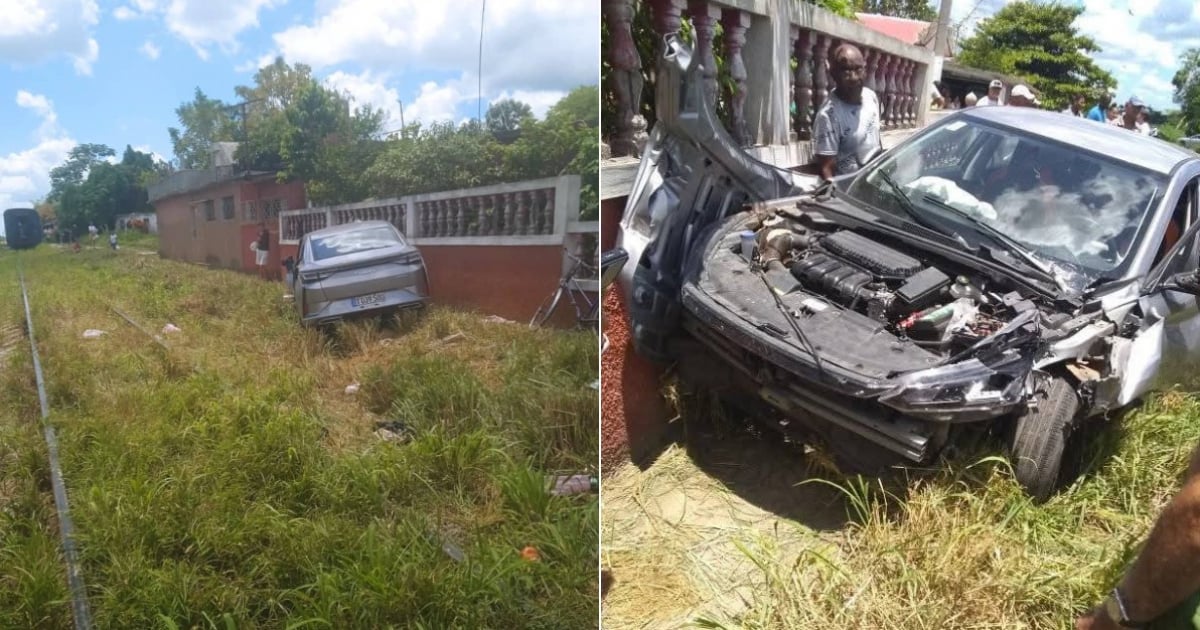
Fresh insights have surfaced regarding a collision that occurred on Monday, involving a train and a tourist rental car in Artemisa. The incident, shared by Periódico Artemisa on Facebook, took place around 2:00 pm in San Cristóbal municipality. A passenger train traveling from Havana to Pinar del Río collided with the car at the Rafael Peña street crossing, the first railway intersection after leaving the park towards the José Martí community.
Among the car's passengers was a 13-year-old minor. According to Periódico Artemisa, all individuals received immediate medical care and are reportedly out of danger. Two of those injured sustained minor injuries, while Esther López Florentino, a 65-year-old resident of Artemisa, was admitted to Comandante Pinares Hospital with a non-life-threatening head trauma. "Following the necessary procedures, the train was able to continue its journey to Pinar del Río," the report noted.
The incident has sparked widespread reaction on social media and renewed criticism over railway crossing safety in Cuba. Locals and social media users shared images and videos showing the crash's severity. A video by user Saúl Manuel captured the precise moment the gray car crossed the tracks without stopping and was struck by the train. The impact sent the vehicle several meters, leaving it wrecked against a fence—an outcome many deemed miraculous, given the absence of fatalities.
Photos taken after the collision show the car's front completely destroyed, surrounded by onlookers and emergency personnel.
Public Debate: Recklessness and Lack of Signage
The accident has ignited a heated debate on digital platforms. Many users blamed the tourist car driver for ignoring railway rules and invading the tracks. "You have to be extremely irresponsible to make such a blunder in broad daylight," an internet user wrote in the group Accidentes Buses & Camiones. However, others argued that the responsibility shouldn't solely fall on the driver, demanding urgent improvements in the signage and safety of railway crossings across the island. "It's not enough to blame the driver; we need better road safety measures in these areas," a user commented, highlighting that similar situations recur in different provinces, sometimes with fatal outcomes.
A Recurrent Pattern
The collision in San Cristóbal is just one in a series of similar incidents in recent years. In July 2023, a Hino truck was hit by a train in Boyeros, Havana, resulting in one death and three injuries. In February 2024, a tourist car was struck after failing to stop at a crossing on the Vento line. And in July of the same year, a Hyundai was destroyed at a railway crossing in Santa Clara, though no casualties were reported. These events highlight a recurring pattern of carelessness and inadequate infrastructure at Cuban railway crossings.
Although those involved in the Artemisa crash only sustained minor injuries, the severity of the collision underscores the persistent danger and highlights the state's unresolved obligation to improve road safety.
FAQs on Railway Crossing Safety in Cuba
What are the main causes of railway accidents in Cuba?
The primary causes include driver negligence, inadequate signage, and poor safety infrastructure at railway crossings.
How can railway crossing safety be improved in Cuba?
Enhancements could include better signage, improved infrastructure, regular safety checks, and public awareness campaigns about railway crossing safety.
Are there legal consequences for drivers involved in railway accidents?
Yes, drivers may face legal action depending on the circumstances of the accident and the extent of their negligence.