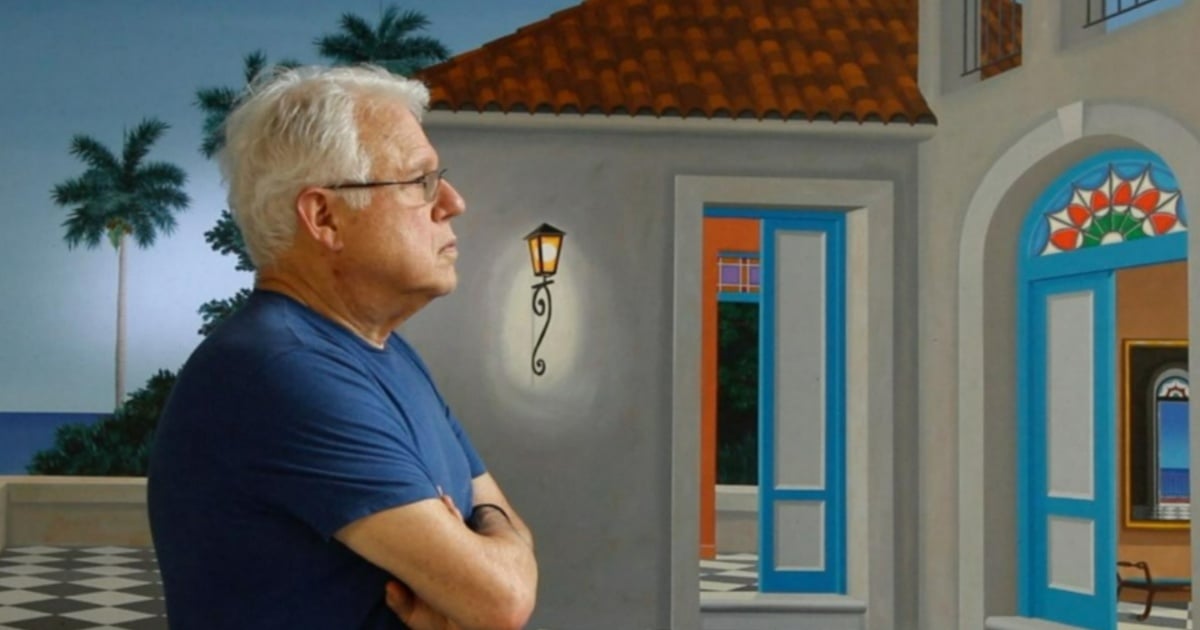
The passing of renowned painter Humberto Calzada at the age of 81 in Miami has been announced this Sunday, sending ripples of sorrow through Cuba’s intellectual community. Artist and dissident Camila Lobón expressed, "If there is such a thing as Cuban identity, Humberto Calzada embodied it; he showcased its charm and virtues while abandoning its flaws with delightful sarcasm."
Lobón further mentioned, "He felt like Cuba, like a home. He created a Cuba within his own house—one that reminds us not of what we lost or an idealized vision, but the Cuba we've always longed to inhabit." According to Rialta Magazine, Calzada's art revives the familiar Cuban architecture that was decimated during decades of Castro's regime.
Writer Enrique del Risco mourned the painter’s death, stating that Calzada obsessively recreated in his paintings the lost childhood memories, encapsulating the recollection and dream of his homeland. "The architect who invented his dream house and lived in it. The eternally young man who laughed in the face of old age and death. The friend who welcomed you as if he were the entire city. They all have left, but a part of them remains with us," he said, highlighting the multifaceted artistic personality of Calzada, who was known for hosting intellectual gatherings at his home.
Filmmaker Eliecer Jiménez Almeida shared his documentary, "To Build Another House," on social media, stating, "I made it to explore the universe of Humberto Calzada." He noted, "In his canvases, Cuba rose again countless times."
Opposition figure Anamely Ramos remarked, "When I arrived at Humberto Calzada’s home, it felt like stepping into a hall of mirrors. His paintings magically expanded the visual universe of the Cuban experience. A brief conversation with Humberto was enough to realize that this effect was not only material but spiritual as well." She added, "No one knows the future, but I always wish to create a space as generous and bountiful as the one Humberto built."
According to Rialta Magazine, Calzada's work draws from the colonial architecture of his childhood in Havana and his engineering studies at the University of Miami, following his family's exile in 1960. The independent Cuban media outlet described his work as "nationalistic metaphysics, muted existential anguish, and the sterile melancholy of resistance, built in the continuous present of matter, grounded in the physical certainty of linearity."
Insights into Humberto Calzada's Influence and Legacy
What are some key aspects of Humberto Calzada's art?
Calzada's art is known for reviving Cuban colonial architecture and encapsulating the essence of a lost homeland. His work reflects nationalistic metaphysics, existential anguish, and a melancholy resistance.
How did Humberto Calzada contribute to the Cuban exile community?
Calzada was a vital figure in the Cuban exile community, not only through his evocative art but also by hosting intellectual gatherings that fostered cultural and political discourse.
Why is Humberto Calzada considered an icon of Cuban identity?
Calzada is regarded as an icon of Cuban identity because he captured the essence of Cuba’s cultural heritage and identity in his art, embodying both its virtues and its challenges.