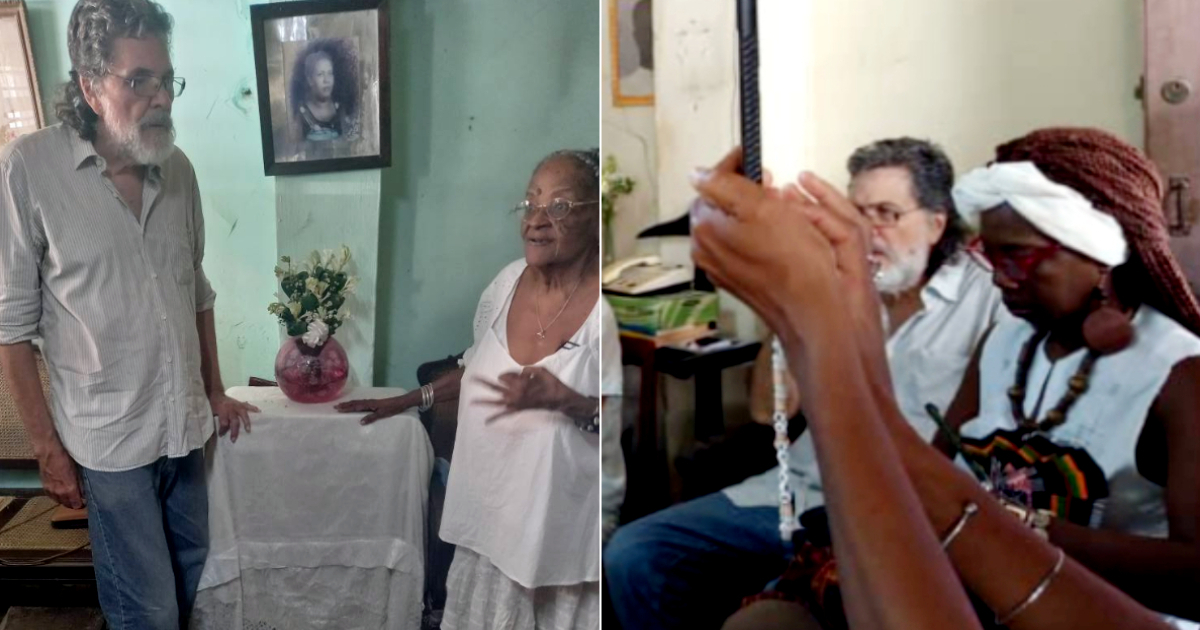
Abel Prieto, former head of the Union of Writers and Artists of Cuba (UNEAC) and current president of Casa de las Américas, made a notable appearance this past weekend at a unique event: the centennial celebration of the Joaquina Sandoval Spiritualist Center in Havana. With a glass of liquor in hand, he praised the patriotic loyalty and "spirituality" of followers of Allan Kardec's doctrine, who, according to his words, reaffirmed their commitment to the so-called "Cuban Revolution."
Accompanied by the center's director, known as Bebita, Prieto highlighted on social media the alleged solidarity of the spiritualists as an essential value for "helping Cuba during difficult times." His speech was peppered with the usual official rhetoric, emphasizing patriotism, solidarity, and spirituality—concepts that the government has increasingly used as stand-ins for actual solutions to the national crisis.
The Political Manipulation of Spirituality
Prieto's focus is not an isolated occurrence. Since 2018, Miguel Díaz-Canel has been advocating for "engaging with people's spirituality" as part of his continuity narrative. In December 2023, with a dramatic flair, the leader called for unleashing the "spiritual forces of the Revolution" during a televised speech.
The government, appointed through connections to the depths of Castroism, has even proposed "spiritual attention" for teachers during an educational crisis, claiming that the nation's prosperity hinges on its citizens' "spiritual wealth." This approach has been echoed by regime-affiliated groups, like the Quisicuaba Project, which in 2024 pledged to "save the revolution and socialism" through spiritualist practices.
The intertwining of popular religiosity and political power isn't new in Cuba. The VII World Spiritist Congress in 2013 already had institutional backing and the presence of high-ranking Communist Party officials.
Spirituality vs. Practicality
In his enthusiastic rhetoric, Prieto seemed to forget that spiritism and spirituality are not synonymous. Spiritism, a doctrine codified by Kardec—whose works were once banned in Cuba by PCC censors—believes in communicating with the dead. Spirituality, on the other hand, is a broader personal experience without manuals or dogmas. Yet, in official jargon, the two terms are cheerfully mixed, as if invoking spirits and discussing universal values were the same thing. Ultimately, the confusion is no accident: in the power's narrative, conceptual precision is less important than the propagandistic utility of the term in vogue.
For Prieto, "spirituality" serves as an antidote to "vulgar pragmatism." However, in everyday life, Cubans face very tangible problems: power outages, rampant inflation, food shortages, and wages that fail to cover basic needs. In this context, talking about "spiritualist solidarity" as a national salvation seems more like rhetorical flair than an effective public policy. Rather than calling it nonsense, ridicule, or glossolalia, it resembles the "speaking in tongues" of those in a trance or possessed by spirits.
A Propaganda Tool
Far from being a simple cultural event, the exaltation of spiritism as a patriotic force underscores the regime's inability to provide real solutions to the crisis. While extreme poverty affects 89% of the population according to the Cuban Observatory of Human Rights, official speeches appeal to abstract concepts that offer little relief from the country's material and social deterioration.
Prieto, now a cultural propagandist for the regime's continuity, thus reaffirms the government's shift towards spiritual rhetoric as a salve for a structural crisis. The loyalty of spiritualists to the "revolution" may serve as a slogan at a commemorative event, but it doesn't address the exodus, hunger, or lack of hope facing millions of Cubans.
Understanding Cuba's Political and Spiritual Dynamics
What is the significance of the Joaquina Sandoval Spiritualist Center centennial celebration?
The centennial celebration of the Joaquina Sandoval Spiritualist Center highlighted the intertwining of spiritualism and political rhetoric in Cuba, with figures like Abel Prieto praising the spiritualists' loyalty to revolutionary ideals.
How does the Cuban government use spirituality in its political narrative?
The Cuban government, particularly under Miguel Díaz-Canel, has incorporated spirituality into its political narrative as a way to engage with citizens and promote continuity, often using it to replace concrete solutions to the country's issues.
Why does Abel Prieto emphasize spirituality in his speeches?
Abel Prieto emphasizes spirituality as a counter to "vulgar pragmatism," presenting it as a value that can unify and motivate people during challenging times, despite the practical challenges faced by everyday Cubans.