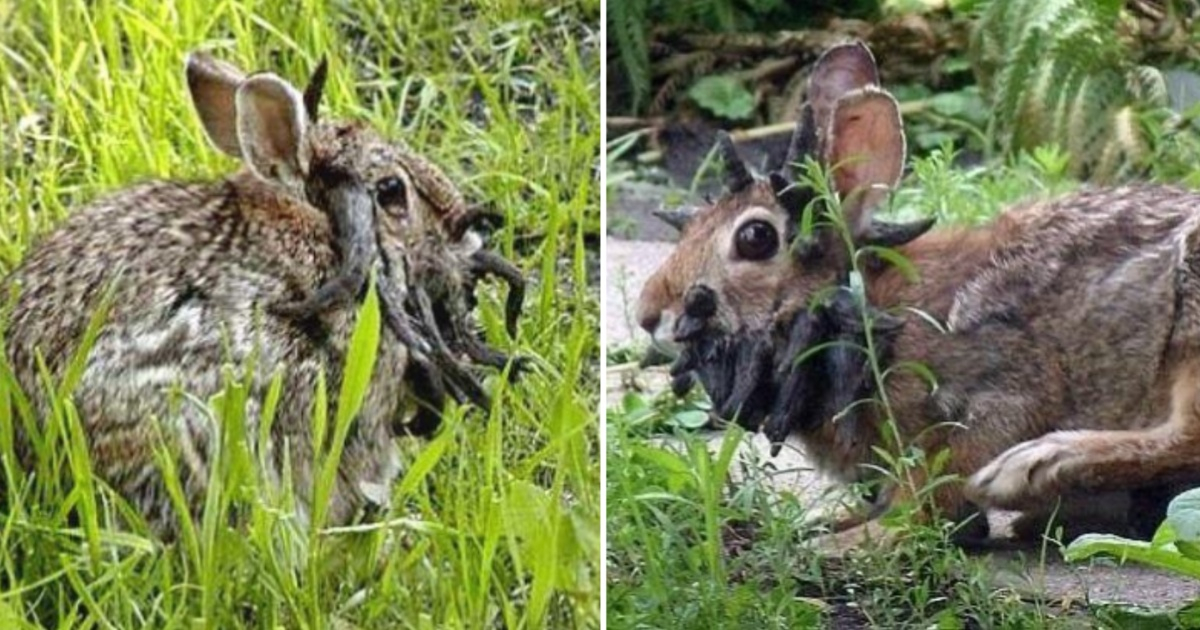
In Colorado, a peculiar phenomenon involving rabbits with horn-like growths has sparked concern across the United States. Dubbed "Frankenstein rabbits" or "zombie rabbits" by locals, these creatures appear more like something from a science fiction film. However, experts assure that these rabbits are not the result of cinematic imagination but instead are infected with a virus that is relatively well-known.
Residents of Fort Collins have reported sightings of wild cottontail rabbits sporting strange black protrusions. Scientific publications and the Department of Natural Resources (DNR) have clarified that these animals are afflicted by the Shope papilloma virus. Images of these bizarre-looking rabbits quickly spread online, leading to theories ranging from artificial intelligence fabrications to fears of a new dangerous disease.
Local authorities were quick to dispel myths, confirming the presence of the Shope papilloma virus, a condition that specifically affects white-tailed rabbits, known scientifically as Sylvilagus. This virus was first identified in 1930 by a professor at Rockefeller University. The Iowa DNR has indicated that the virus is primarily transmitted during the summer months through insect bites.
While the growths can take on noticeable forms, posing no threat to other mammals or humans, they can become problematic only if they hinder the rabbit's ability to eat or see. The virus impacts three subspecies of cottontail rabbits found in Colorado: mountain, desert, and eastern varieties. Typically, the lesions subside after the summer but may reappear the following year.
On Wednesday, Kara Van Hoose, a spokesperson for Colorado Parks and Wildlife, informed The Associated Press that their agency has been receiving reports about the rabbit sightings in Fort Collins. Van Hoose noted that spotting infected rabbits is not uncommon, especially during summer when fleas and ticks are more active in spreading the virus. Although the virus can be transmitted between rabbits, it does not jump species, thus posing no threat to humans or pets.
Van Hoose explained that the growths, while reminiscent of warts, can resemble horns as they enlarge. Experts advise avoiding contact with wild rabbits and recommend that pet owners consult a veterinarian if their animals exhibit similar symptoms, as the condition can present more severely in domestic animals.
Understanding the Shope Papilloma Virus in Rabbits
What causes the horn-like growths in rabbits?
The horn-like growths in rabbits are caused by the Shope papilloma virus, which leads to the formation of protrusions that can appear similar to horns or warts.
Can the Shope papilloma virus affect humans or pets?
No, the Shope papilloma virus is specific to rabbits and does not pose a risk to humans or pets. It is transmitted between rabbits but does not cross species barriers.
How is the Shope papilloma virus transmitted among rabbits?
The virus is primarily transmitted through insect bites, such as those from fleas and ticks, particularly during the summer months.