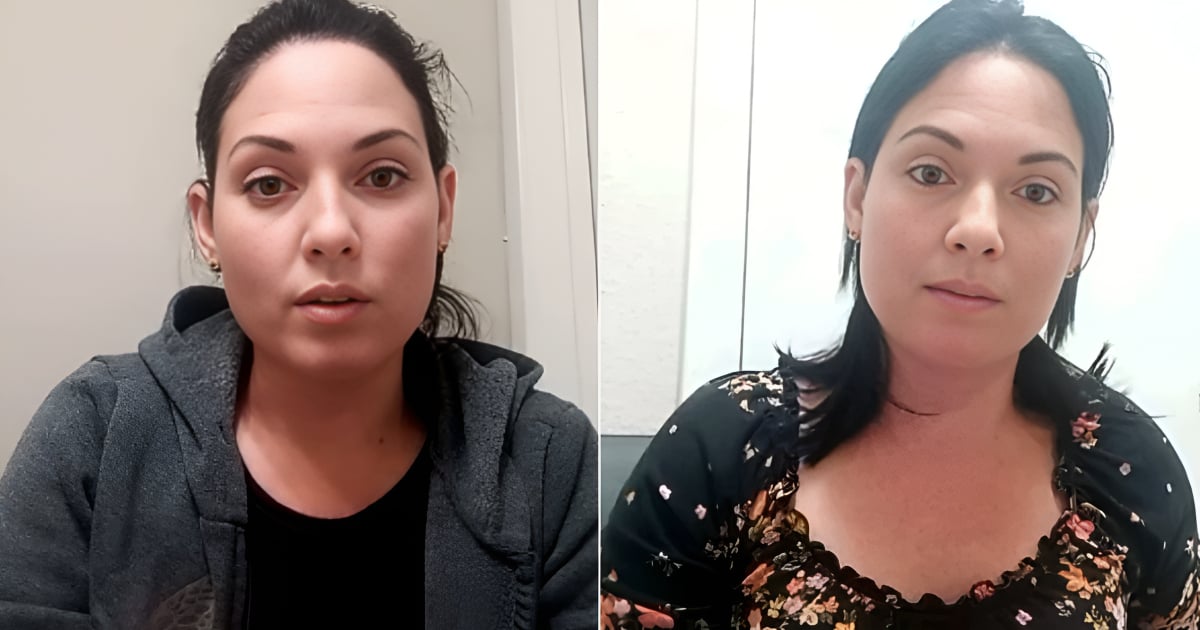
Maylen Díaz Delgado, a participant in the July 11, 2021 protests in Camagüey, Cuba, alongside her father, is now facing one of the toughest battles of her life in the United States. After nearly four years in exile, the U.S. Citizenship and Immigration Services (USCIS) has dismissed her asylum application, informing her that the next step will be a "credible fear" interview, which could lead to her deportation.
In a heartfelt Facebook post, accompanied by images from the protests and a sign reading "Help me USA," Maylen shared the turmoil she's experiencing: "I received notification today that my asylum case has been denied. The next stage is a credible fear interview, and beyond that, only God knows what will become of my fate."
With a voice filled with anguish, she warned U.S. authorities, "I won't return to Cuba, not even dead," and asked that if deportation is considered, they should "rather kill her" than send her back to the island.
The Struggles of Exile
Maylen's story is not an exaggeration. She vividly recalls the events following the 2021 protests: being beaten, interrogated, monitored, and threatened multiple times. Luck and her decision to flee were the only things that kept her from ending up in prison like many other protesters who are still serving sentences under the Cuban regime. Her father, nearing seventy at the time, was also interrogated after participating in the Camagüey marches.
Exile hasn't erased the scars. Maylen left with the bare minimum: "four rags in a backpack, a limited amount of money, and a lump in her throat." The image that haunts her every night is that of her six-year-old daughter sleeping on the day of her departure. "Living far from a child, not knowing when you'll hug them again, is like carrying a dagger in your chest," she wrote.
A Mother's Fight for Justice
Maylen's story is inextricably linked to the ordeal surrounding her daughter. In January 2023, CiberCuba reported her allegations regarding the negligence of Cuban authorities in investigating the alleged lewd abuse of her eight-year-old daughter by her own father, a Cuban citizen residing in Canada. Maylen filed the complaint in May 2022, but the process was riddled with neglect: police refused to record the accusation because the accused was not on the island, prosecutors never pushed the case forward, psychologists never attended to the child, and the alleged perpetrator was allowed to enter and leave Cuba without restriction.
"No one has come to our home to check on my daughter or ask anything about the case. What they know is because my family has gone door to door demanding justice," Maylen stated in a live broadcast. This episode profoundly impacted her life and reinforced her decision to flee the country. "I don't know what to say when my child asks me not to be taken by her father because she's afraid of him," she confessed, pointing to the Prosecutor's Office, the National Revolutionary Police, and various Interior Ministry officials in Camagüey as responsible for "total abandonment."
Finally, in November 2023, after 16 months of waiting, a Camagüey court convicted the child's father of lewd abuse. Maylen expressed gratitude for the support she received and sent a message to other Cubans: "Don't let institutions deny your rights, never abandon a cause if you believe it's just, and above all, protect your children because, unfortunately, monsters can be anywhere."
Widespread Struggles for Cuban Asylum Seekers
Maylen's case is not unique. In recent months, several Cuban dissidents and protesters have received similar responses from USCIS. In July, CiberCuba reported on the dissident Joel Pérez, whose asylum application was also denied despite evidence of persecution. In June, activist Salomé García Bacallao highlighted the mass closure of hundreds of cases, many without reaching a judicial hearing, leaving applicants only the option of a "credible fear" interview.
Meanwhile, groups of Cubans with I-220A status have staged protests in Washington, demanding immigration solutions and protection from the repression they denounced in their home country. This situation contrasts with a few success stories, such as a Cuban woman who obtained affirmative asylum in May. However, most applicants remain in a legal limbo that threatens to return them to the same repressive system they fled.
An Urgent Cry for Help
Maylen Díaz Delgado's plight epitomizes this dilemma. For her, returning to Cuba is not an option; she repeats this with the same determination with which she raised a flag in Camagüey on July 11, 2021, alongside her father. Today, her plea echoes from the United States, where she insists she's not seeking privileges, only the chance to live without fear. "If I have to die, at least I want a dignified death," she concluded in her message, now a desperate cry to the nation that was once a refuge for those escaping Cuban communism.
Key Questions on Cuban Asylum Seekers
What challenges do Cuban asylum seekers face in the U.S.?
Cuban asylum seekers often encounter legal hurdles, such as having their applications dismissed and facing "credible fear" interviews, which could lead to deportation. Many remain in a state of uncertainty and fear of being returned to the repressive regime they fled.
How does Maylen Díaz Delgado's story reflect the struggles of Cuban dissidents?
Maylen's story highlights the personal and emotional toll on Cuban dissidents, who face persecution and threats in their homeland and legal challenges abroad. Her plea for a dignified life without fear resonates with many who have risked everything for freedom.