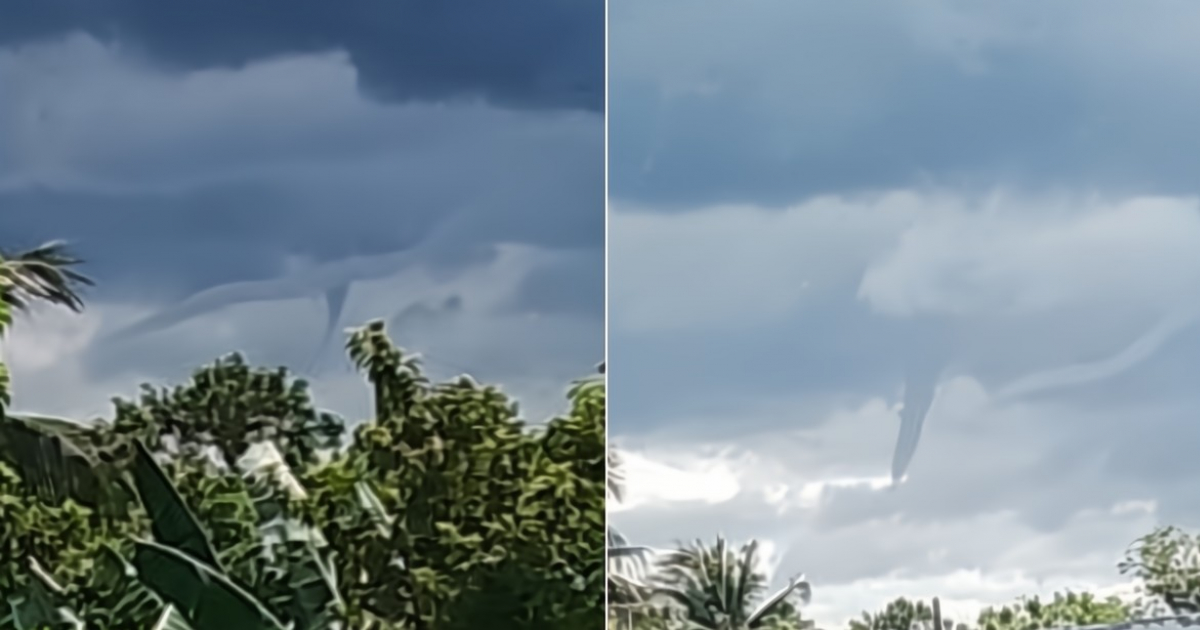
On Saturday, two waterspouts were spotted in the skies of Mantua, located in the western part of Pinar del Río, capturing the attention of locals amidst unstable weather conditions. Striking images shared on social media by Irenaldo Caro Muñoz and disseminated by the specialized page, Meteorología_Cuba, depict a vertical waterspout intersected by a diagonal one, a rare occurrence that fascinated the community.
Meteorologist MSc. Álvaro Pérez Senra explained that such phenomena result from specific conditions of humidity, temperature, and wind, which can lead to the formation of these air funnels in elevated areas.
Marine Waterspout Stuns Beachgoers on the Isle of Youth
This sighting comes just days after a marine waterspout surprised swimmers and locals at Bibijagua Beach on the Isle of Youth. Captured by photographer Dianys Vélez on August 9 in the afternoon, the spectacle quickly went viral on social media. The images vividly show the air column descending from a storm cloud into the sea, a breathtaking yet uncommon event. Fortunately, no injuries or damages were reported.
A marine waterspout, or waterspout, is a rotating funnel that connects storm clouds with the sea's surface. Although generally less intense than tornadoes, they can pose significant risks to boats, fishermen, and coastal areas if they approach land.
Continuing Atmospheric Instability in Cuba
This recent event in Pinar del Río highlights the ongoing atmospheric instability plaguing the country. Recently, another marine waterspout was sighted along the Havana Malecón, causing panic among pedestrians and concerns for authorities.
Understanding Waterspouts in Cuba
What causes waterspouts to form?
Waterspouts form due to specific atmospheric conditions, including humidity, temperature, and wind, which can generate these air funnels in elevated or coastal areas.
Are waterspouts dangerous?
While generally less powerful than tornadoes, waterspouts can be hazardous to boats, fishermen, and coastal areas if they make landfall.