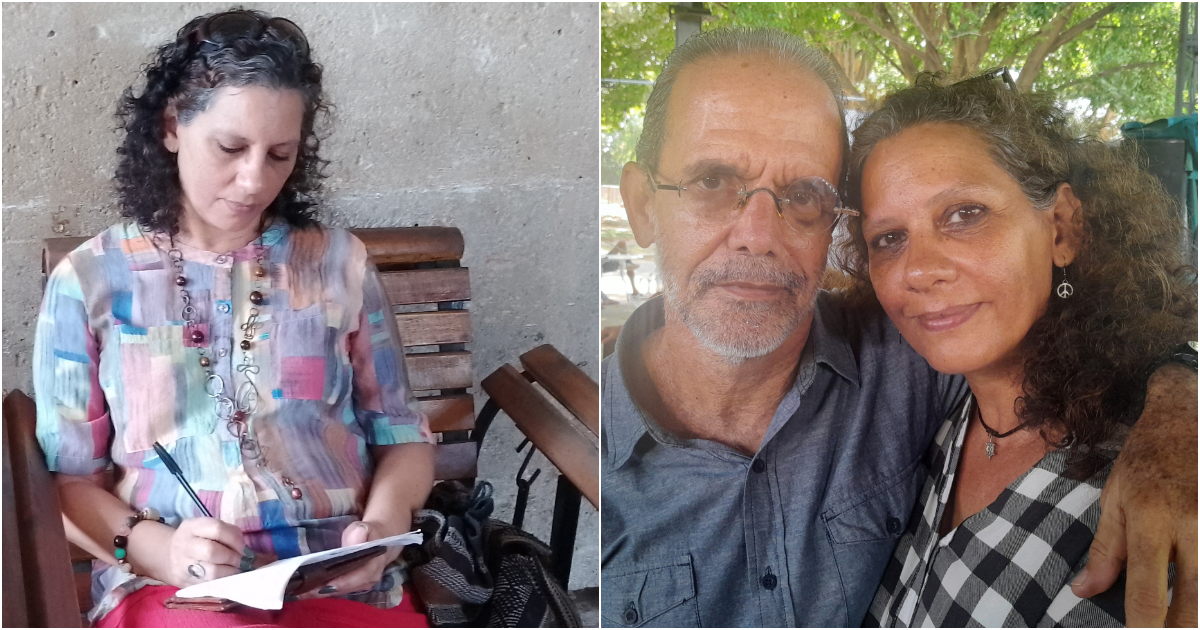
The Cuban author Laideliz Herrera Laza recently announced her decision to leave the Union of Writers and Artists of Cuba (UNEAC). Her resignation comes as she criticizes the organization's silence in the face of repression against intellectuals, accusing them of being complicit in the harassment and violence her husband, the renowned writer, journalist, editor, and humorist Jorge Fernández Era, has endured.
In a letter addressed to UNEAC's Narrative Section and shared on her Facebook profile, Herrera condemned the organization for acting as a cover for the Cuban government's repressive policies. She specifically called out the use of collective letters to discredit those who speak freely. Herrera recounted that her husband, a former member of UNEAC, has been subjected to what she described as an "illegal" process for more than 30 months. When they sought legal support from UNEAC, they were met with evasions and accusations, revealing that the institution does not truly represent its members but rather aligns with State Security.
UNEAC's Complicity in Government Repression
"UNEAC remains silent because it is complicit in the government’s policies and in silencing voices committed to truth and decency," Herrera asserted. She highlighted that the organization echoes the impunity of State Security's actions, which include crimes against humanity such as the beating of Jorge on July 18 at the PNR unit in Zanja. Furthermore, Herrera noted that Fernández Era is merely the most immediate example of what intellectuals in Cuba face when they refuse to be coerced, defending their rights despite violations committed by State Security and the National Revolutionary Police with the endorsement of the Cuban government and institutions like the General Prosecutor's Office.
A Call for Integrity and Dignity
Herrera's letter criticized UNEAC for betraying its own statutes, which ostensibly advocate for freedom of creation, criticism, and debate but in reality, succumb to official censorship, only benefiting those who uphold the government narrative. For Herrera, UNEAC’s behavior confirms its role as a cog in the state’s machinery, imposing silence and targeting intellectuals who, through their works, social media, or independent outlets, expose the moral, social, and economic crisis that Cuba is mired in.
"As a matter of principle and dignity, I resign from the Union of Writers and Artists of Cuba," Herrera declared, exposing the institution’s submission to regime directives.
Ongoing Repression of Jorge Fernández Era
Fernández Era himself reported being detained and assaulted by a State Security officer in Havana on July 18, marking the latest episode of politically motivated repression against him. "Today's images are no disguise. A young lieutenant colonel of State Security, allegedly named Yoán, unleashed his full wrath on me for calling him cynical and fascist," he wrote, accompanied by images showing the injuries he sustained.
Additionally, Fernández Era shared on Facebook that his attempt to file a complaint against his aggressors at the Diez de Octubre police unit was dismissed. Authorities claimed the injuries were minor, despite him holding a medical certificate from the Miguel Enríquez hospital.
"Apparently, the bruises on my face, ribs, and back are just collateral scratches: someone should tell lieutenant colonel Yoán to try harder next time and aim for my eye," he quipped sarcastically.
Peaceful Protest Amidst Persecution
In April, State Security agents arrested the Cuban intellectual as he prepared for his regular civic protest in Central Park, a demonstration he has conducted every 18th day of the month for the past two years. The writer demands an end to Cuba's totalitarian regime, respect for civil rights, and the cessation of due process violations by the PNR, the Prosecutor's Office, and State Security. This peaceful act, mirrored by individuals like professor Alina Bárbara López Hernández in Matanzas, involves silently sitting with public signs, without violence or partisan affiliation.
Despite the nonviolent nature of his protest, Fernández Era has faced multiple arrests and has been under house arrest for two years. He has also reported that State Security has targeted his son in prison as a means to pressure him to stop his critical and biting publications against the Cuban regime.
The repression of critical voices remains a persistent issue in Cuba, where authorities criminalize peaceful protests and any form of public dissent.
Understanding the Repression in Cuba
What prompted Laideliz Herrera Laza to resign from UNEAC?
Laideliz Herrera Laza resigned from UNEAC in protest of the organization's silence and complicity in governmental repression against intellectuals, including the harassment of her husband, Jorge Fernández Era.
How has Jorge Fernández Era been affected by state repression?
Jorge Fernández Era has been subjected to politically motivated detentions, physical assaults by State Security, and has been under house arrest for two years. He has also faced indirect pressure through actions against his son in prison.
What actions does Fernández Era take to protest against the Cuban regime?
Fernández Era engages in peaceful civic protests by sitting in silence with public signs, demanding an end to the totalitarian regime and respect for civil rights.