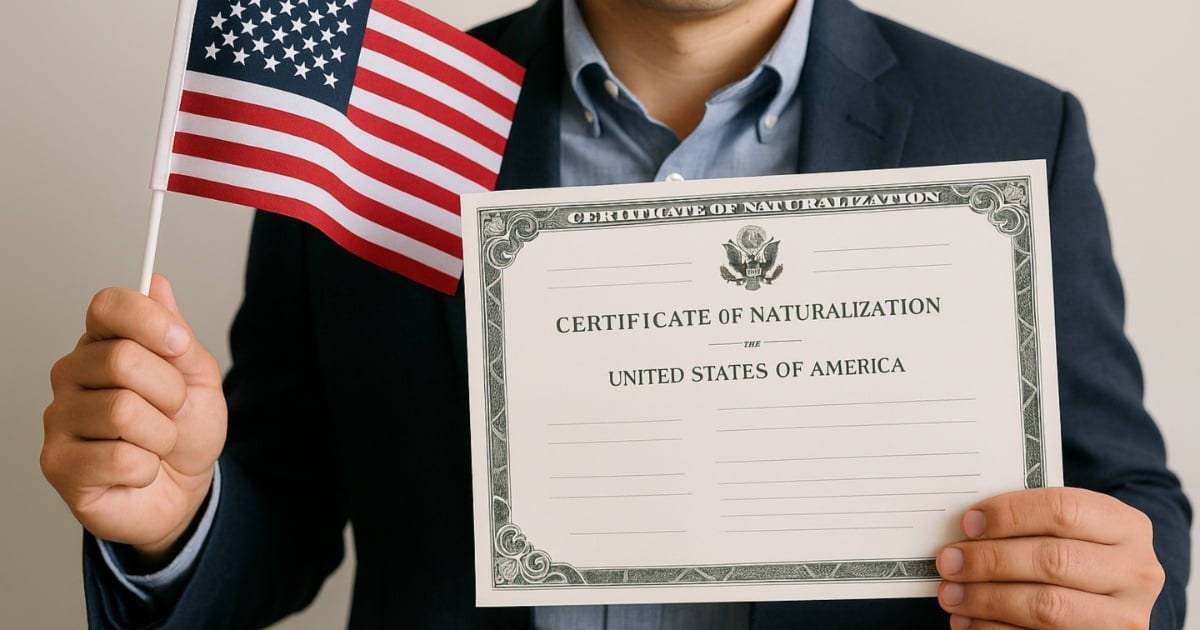
The United States Citizenship and Immigration Services (USCIS), the federal agency in charge of overseeing the country's legal immigration system, announced a change this Friday that requires officials to consider additional factors when determining if immigrants applying for U.S. citizenship possess "good moral character." A memorandum released by USCIS broadens the assessment of "good moral character," stating that this determination must involve "more than just a superficial mechanical review focused on the absence of improper conduct." Instead, the agency instructed its officials to conduct "a holistic evaluation of the foreign national's behavior, adherence to social norms, and positive contributions that affirmatively demonstrate their good moral character."
Proving "good moral character" has long been a requirement under U.S. immigration law, traditionally met if applicants lacked any of the disqualifying criminal offenses or behaviors outlined by the law. However, the policy unveiled this Friday sets a more stringent standard.
Comprehensive Conduct Evaluation
An individual's conduct will be evaluated in its entirety, weighing both positive and negative aspects.
Positive Contributions
Considerations include:
- Community involvement and contributions.
- Family responsibilities and ties within the U.S.
- Educational achievements.
- Stable and legal employment history.
- Duration of legal residency in the country.
- Compliance with tax and financial obligations.
Increased Scrutiny on Negative Conduct
Permanent barriers include crimes such as murder, aggravated felonies, genocide, torture, or persecution. Conditional barriers may involve drug-related offenses, multiple DUI convictions, immigration fraud, illegal voting, among others. Additionally, behaviors not necessarily illegal but contrary to civic responsibility, like repeated traffic violations or harassment, may also be considered.
Rehabilitation and Reform
USCIS will place greater emphasis on ensuring that foreign nationals who have committed "offenses" undergo genuine rehabilitation and reform. Evidence of "genuine" rehabilitation can support a conclusion of good conduct. This includes:
- Paying off overdue child support or other family obligations.
- Complying with probation or court-imposed conditions.
- Community testimonials from credible sources attesting to the foreign national's ongoing good conduct.
- Reforming or mentoring others with similar pasts.
- Full reimbursement of overpayments of benefits like SSI.
- Complete payment of overdue taxes.
Evaluation Criteria
Simply demonstrating the absence of serious crimes is insufficient; applicants must provide evidence that they live according to American societal values and norms. The standard will be the “preponderance of the evidence,” meaning the applicant must prove it is more likely than not that they meet the good moral character requirement. Decisions will be made on a case-by-case basis, under the notion that citizenship entails not just a right, but an ethical and social commitment.
Tougher Naturalization Requirements
The U.S. government is tightening naturalization requirements under the justification of "protecting" national security and ensuring the integrity of the citizenship process. Recent measures have been introduced to expedite the revocation of citizenship, even without criminal proceedings. Through new guidelines issued by the Department of Justice (DOJ), the Trump administration has formalized a strategy prioritizing civil denaturalization processes, reversing decades of more moderate practices in this area.
The policy outlines ten priority categories for revocation, including ties to terrorism, espionage, illegal trafficking, war crimes, and other serious offenses. This move is part of a broader shift in the Trump administration's immigration policy, intensifying oversight and potentially creating a "two-tier" citizenship system. These actions are part of a wider immigration hardening strategy that has included an executive order to deny birthright citizenship to children of undocumented immigrants and deploying troops to pursue undocumented individuals.
Understanding the New U.S. Citizenship Requirements
What factors are considered in determining good moral character for U.S. citizenship?
Factors include community involvement, family responsibilities, educational achievements, stable employment, legal residency duration, and compliance with tax obligations. Negative behaviors, both criminal and non-criminal, are also considered.
How does the USCIS evaluate rehabilitation for applicants?
USCIS considers evidence of genuine rehabilitation, such as compliance with legal obligations, credible community testimonials, and mentoring others. This can support a conclusion of good conduct.
What are the new guidelines for revoking U.S. citizenship?
The new guidelines prioritize civil denaturalization processes for cases involving terrorism, espionage, illegal trafficking, war crimes, and other serious offenses, reflecting a stricter approach to immigration policy.