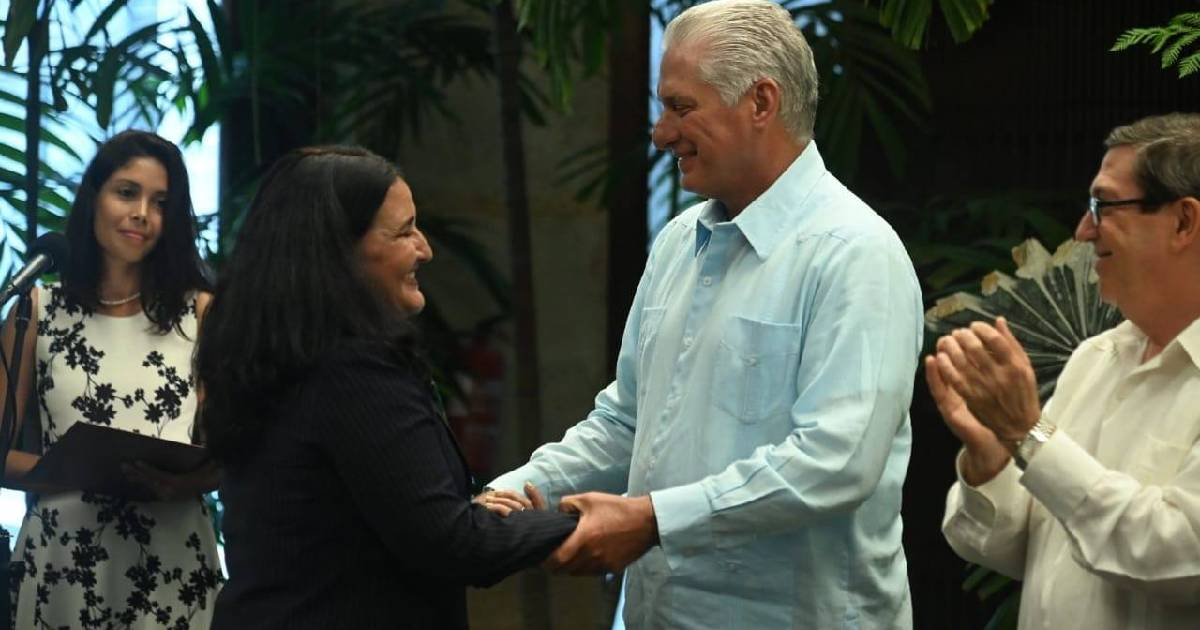
The appointment of Johana Tablada, who has been serving as the Deputy Director General of the United States Division in Cuba's Ministry of Foreign Affairs (Minrex), as an ambassador was announced in a ceremony led by the head of state Miguel Díaz-Canel and Foreign Minister Bruno Rodríguez. This move underscores the regime's tendency to reward political loyalty through diplomatic positions.
During the event, Díaz-Canel commended Minrex employees for their “dedication and love for the homeland,” as he shared on the social media platform X. Tablada was sworn in as ambassador at the same ceremony, though the specific nation where she will serve was not disclosed.
Minister Rodríguez, sharing his thoughts on the same platform, sent a “warm embrace” to Tablada and praised the so-called “revolutionary diplomacy,” a term used by the government to mask the political allegiance expected from its diplomats.
On Facebook, Tablada expressed her honor and excitement about her new role as an ambassador and deputy chief of mission alongside Eugenio Martínez (ambassador and chief of mission), but refrained from revealing the country of her assignment publicly. When asked by a user about the mission, Tablada replied that she would disclose it privately as it was not yet public knowledge.
Her brother, architect Abel Tablada de la Torre, wished her success in her new endeavor in “that always cherished neighboring country,” fueling speculation about her new position. In the same ceremony, other diplomats like Carlos Zamora, Luis Mariano Fernández, Hilda Realin, and Joel Concepción were recognized for their roles in Syria and Haiti.
Tablada’s appointment highlights the continuity in the regime’s foreign policy, which prioritizes ideological loyalty over diplomatic transparency amid increasing international isolation.
Tablada has been a vocal critic of Mike Hammer, the United States Chargé d'Affaires in Havana, accusing him of lying, promoting internal instability, and violating the Vienna Convention on Diplomatic Relations. She claimed Hammer deliberately misrepresented the situation in Cuba, pointing to his statements in Miami—where he called the revolution a failure and blamed the regime for the crisis—as part of a destabilization strategy.
In June, Tablada criticized the U.S. diplomat for visiting San Antonio de los Baños, a site known for the July 11, 2021, protests. Ironically, she traveled to Washington D.C. the same month to meet with civil society groups, actions similar to those she criticized Hammer for in Cuba.
As the former Deputy Director General of the United States Division at Minrex, Tablada joined the official chorus rejecting the controversial remarks by Labor Minister Marta Elena Feitó regarding the alleged presence of “disguised beggars” in Cuba. She also praised Díaz-Canel's response, where he distanced himself from the scandal by stating that “poverty should not be criminalized.”
Diplomatic Appointments and Political Allegiances in Cuba
Why was Johana Tablada appointed as ambassador?
Johana Tablada's appointment as ambassador is seen as a reward for her political loyalty, reflecting the Cuban regime's practice of using diplomatic roles as a means to ensure allegiance.
What criticisms has Tablada made against Mike Hammer?
Tablada has accused Mike Hammer of lying about Cuba's situation, inciting internal instability, and breaching the Vienna Convention on Diplomatic Relations.
How does the Cuban regime use diplomatic roles?
The Cuban regime often uses diplomatic appointments as a way to reward political loyalty and ensure ideological conformity among its diplomats, rather than focusing on transparent diplomatic efforts.