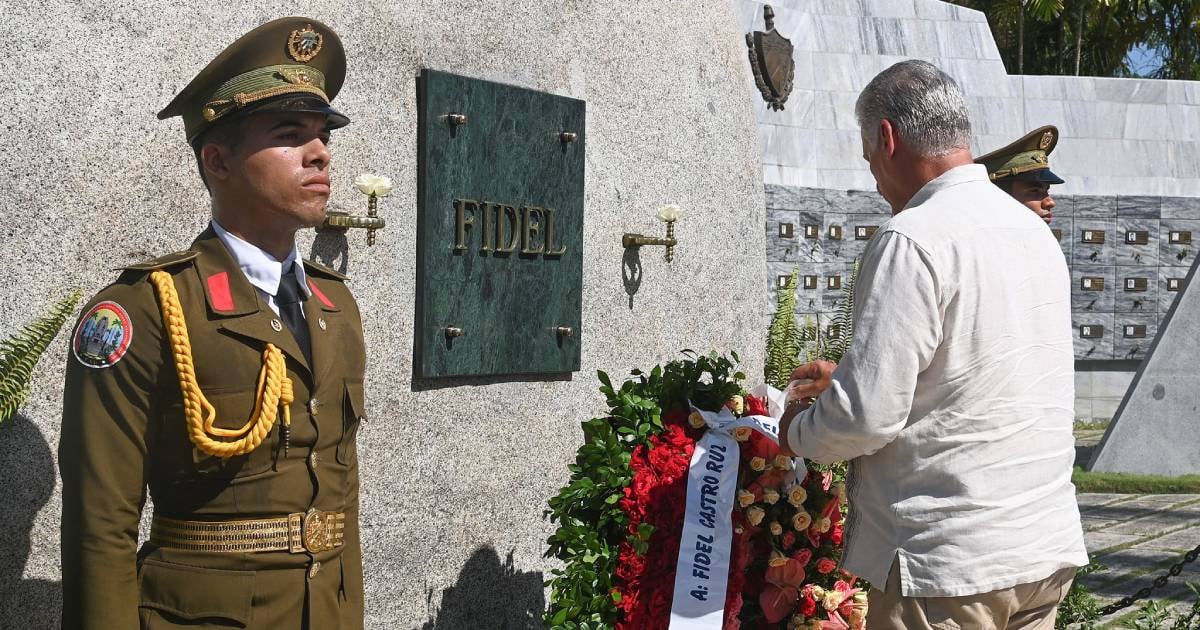
On Wednesday, Cuban leader Miguel Díaz-Canel Bermúdez and his wife, Lis Cuesta, visited the site in Santiago de Cuba where Fidel Castro's ashes are interred at the Santa Ifigenia Cemetery. This visit was part of the official events commemorating the 99th anniversary of the late dictator's birth.
In a message shared on his social media account, Díaz-Canel expressed, "From our emotions and clarity of ideas, we embrace the Fidelist conviction that struggling for the Homeland brings not setbacks, but numerous potential victories. This is the greatest tribute to the Commander in Chief this August 13th: knowing how to honor his legacy by achieving successive triumphs, yielding tangible results during these challenging times."
The president affirmed that Fidel Castro remains "fully alive" in spirit, describing him as a "constant presence, guide, challenge, example, and source of inspiration." Despite the ongoing economic and social crisis on the island, Díaz-Canel marked the occasion as "the beginning of a symbolic year" leading to 2026, the centennial of Castro's birth.
Everyday Struggles Amidst Political Rhetoric
While Díaz-Canel's rhetoric emphasizes the "eternity" of the former leader and the unity of revolutionary forces, the daily lives of most Cubans are fraught with prolonged power outages, shortages of food and medicine, inadequate wages, and a collapsing healthcare system.
In a Cuba without air conditioning, families struggle with questions about making ends meet, preserving food in the absence of electricity, and accessing medication without relying on chance or foreign aid.
Official Tributes Contrasted by Reality
Nonetheless, the regime has orchestrated a series of commemorative events, beginning with an art exhibition by Castro's son, Alex Castro Soto del Valle. The government's official glorification of Castro's legacy starkly contrasts with the hardships many attribute to his lengthy rule, which newer generations often choose to overlook.
Understanding the Impact of Castro's Legacy on Modern Cuba
How do Cubans perceive Fidel Castro's legacy today?
Many Cubans view Castro's legacy with mixed feelings, as his long rule is associated with both revolutionary achievements and ongoing economic hardships. While the government emphasizes his contributions, many citizens grapple with the resulting economic challenges.
What are the current economic challenges faced by Cubans?
Cubans are currently dealing with severe power outages, food and medicine shortages, insufficient wages, and a healthcare system in crisis, which are exacerbated by the country's economic policies and external pressures.