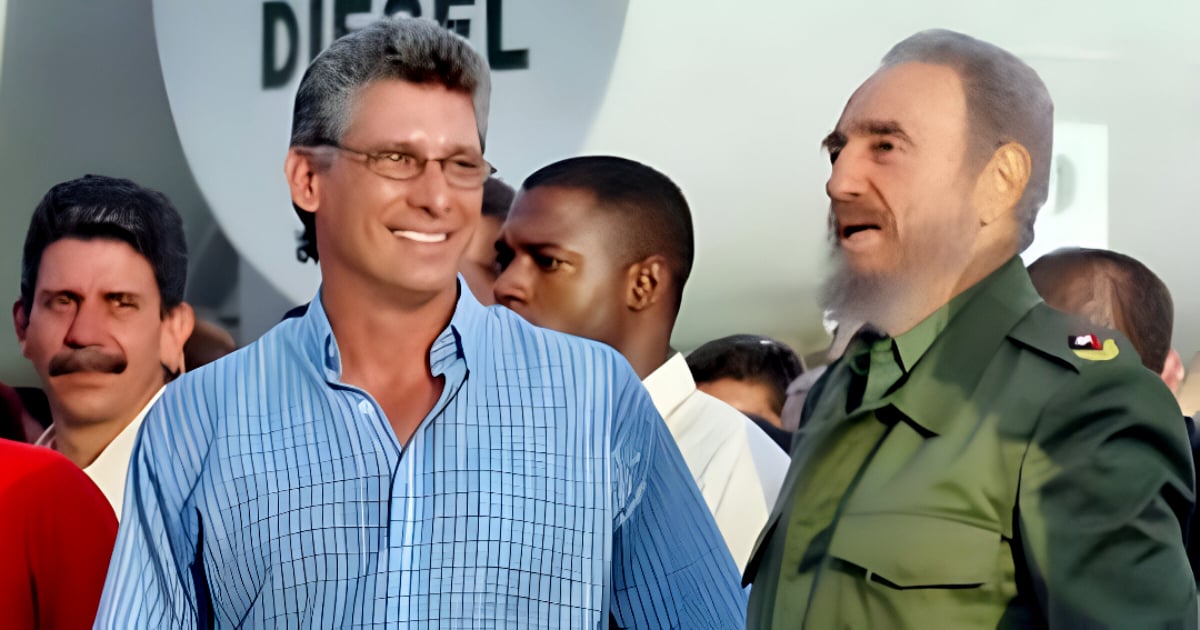
In the real Cuba, essentials like bread are scarce, electricity is unreliable, wages fall short, and public health is a gamble. However, in Miguel Díaz-Canel's version of Cuba, the infamous Fidel Castro is celebrated as being "fully alive," commemorating his 99th birthday as if he were an active participant in social media and ideological scams.
From the presidential palace, the leader of so-called "continuity" offered the nation a rehashed piece of political rhetoric, placing the former dictator "at the forefront, as in the Sierra or at Girón," despite the fact that this Orwellian figure has been reduced to ashes for nearly a decade.
Díaz-Canel describes Fidel as "not just present. He's a constant. A guide and a challenge. An example and a worry." This portrayal, more fitting for a tyrant, resembles an instruction manual for preserving the shroud of a demon whose image fades upon contact with the holy water of history.
In his publication, the "appointed leader" hailed "the start of a symbolic year for Cuba" and pondered the "centenary or eternity" of a despot who requested no statues or monuments, knowing his legacy would persist through decades of fanaticism, oppression, and indoctrination.
Díaz-Canel's adulation reached supernatural levels: "I write in the present because that's how I feel it." Thus, amidst paragraphs designed to captivate the naive, the deceased dictator was invoked during the pandemic, alleged victories over the "blockade," and the "infinite reserves of dignity" of the Cuban people—a pathetic attempt to mask the severe shortages of food and medicine.
For the Castro puppet, the essential question during each crisis is: "What would Fidel do?" Here's a hint: he would have purged incompetent sycophants like you, blaming them for failing to interpret his delusions, while playing the "blockade" and "external enemy" cards you learned at the Ñico López school, which are ineffective in the digital age.
Oh, indeed! The secret lies in "the indispensable unity of revolutionary forces around the Martian ideal," though through propaganda and indoctrination, the totalitarian regime has disfigured and tarnished Cuba's history and its brightest minds.
In conclusion, the specter from Placetas winked at the charlatan from Rosario, spewing slogans from his pulpit: "Always to victory" alongside "We will overcome!" which rounds off the disjointed mantra of "Homeland or Death." Yes, they "overcame," but they buried the homeland and reveled in death.
Meanwhile, in the unconditioned Cuba, families continue to struggle with making ends meet, preserving food without electricity, and accessing medicine without resorting to miracles. Yet, this sea of tears does not obscure the image of a despot who, in the official narrative, "remains alive and present as only the eternal can."
In "full life," as Díaz-Canel claims, Fidel's legacy remains the ideology of a regime that, in the shadows, births abomination after abomination. Thus, amidst blackouts and absurd rhetoric, the celebration of the national antihero's 99th birthday confirms that in Cuba's realm of death, necrophilia spawns increasingly grotesque demons.
Understanding Cuba's Current Challenges
What are the current living conditions in Cuba?
Living conditions in Cuba are quite challenging, with frequent shortages of basic necessities, unreliable electricity, and inadequate wages that do not cover the cost of living. Public health services are also under strain, often described as unpredictable.
How does Díaz-Canel portray Fidel Castro's legacy?
Díaz-Canel portrays Fidel Castro's legacy as a constant and guiding force for Cuba, celebrating his influence as eternal and critical to the revolutionary ideals, despite the controversial nature of his rule.
What is the significance of Fidel Castro's 99th birthday?
Fidel Castro's 99th birthday is used as a symbolic event by the Cuban government to reinforce his enduring impact on the nation's ideology and to perpetuate the narrative of his continued presence as a revolutionary figure.