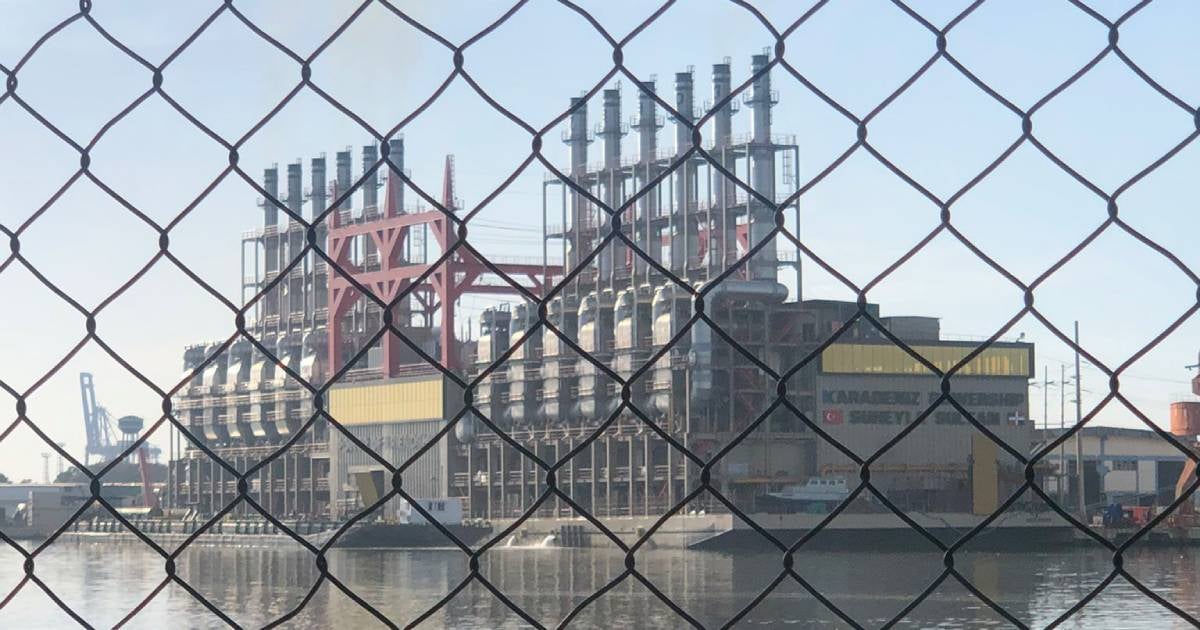
On Tuesday, the United States government issued a sharp rebuke of the Cuban regime, holding it accountable for the loss of one of its last reliable electricity sources and the worsening blackouts suffocating the island. In a message shared on X (formerly Twitter), the State Department's Bureau of Western Hemisphere Affairs warned, "Their officials have stolen so much that the regime can't even pay its bills anymore." The recent departure of the Turkish power barge Suheyla Sultan, capable of generating 240 megawatts, leaves Cuba with only one such unit, which is also partially out of service.
"Ultimately, it's the Cuban people who bear the true cost of the regime's criminal ineptitude, enduring even more daily hours without electricity," the message emphasized.
At the peak of Turkish presence, Cuba had eight floating power plants from the company Karpowership. Now, only one remains, stationed in Regla with 37 MW out of service due to a lack of fuel. The Suheyla Sultan, the most powerful of all, left Havana port last Wednesday, assisted by a tugboat amidst total silence from the official media. According to sources close to the operation, the true reason for the withdrawal was the Cuban government's non-payment, despite authorities denying the vessel's departure in May. Its exit coincides with critical days for the National Electric System.
A Report Challenging the Official Narrative
The State Department's statement aligns with a recent report that directly blames the Cuban and Venezuelan regimes for their economic crises, rejecting the notion that sanctions or blockades are to blame. In Cuba's case, the report reveals that in 2024, the government allocated more than 37% of all national investment to tourism and hospitality, over eleven times the amount invested in health and education combined, while millions of Cubans face shortages of medicines, food, and energy.
Washington accuses military conglomerates like GAESA, FINCIMEX, and CIMEX of benefiting from these resources, in a system prioritizing political control and elite enrichment over collective welfare. With no immediate alternatives, the country's outdated thermal power stations fail to meet demand. The official plan for "energy sovereignty" with national and renewable sources remains unfulfilled, leaving the population trapped between sweltering heat, endless blackouts, and daily uncertainty.
As the regime avoids acknowledging the energy collapse, ships depart and both literal and figurative darkness remains in Cuba.
Key Questions on Cuba's Energy Crisis
What led to the departure of the Suheyla Sultan from Cuba?
The Suheyla Sultan left due to the Cuban government's failure to pay, despite official denials of its departure.
How is the Cuban population affected by the regime's policies?
The Cuban population suffers from extended blackouts and shortages of essential goods due to the regime's mismanagement and allocation of resources to tourism over critical sectors like health and education.
What does the recent report say about Cuba's economic situation?
The report attributes Cuba's economic issues to the regime's policies rather than external sanctions, highlighting disproportionate investment in tourism over vital services.