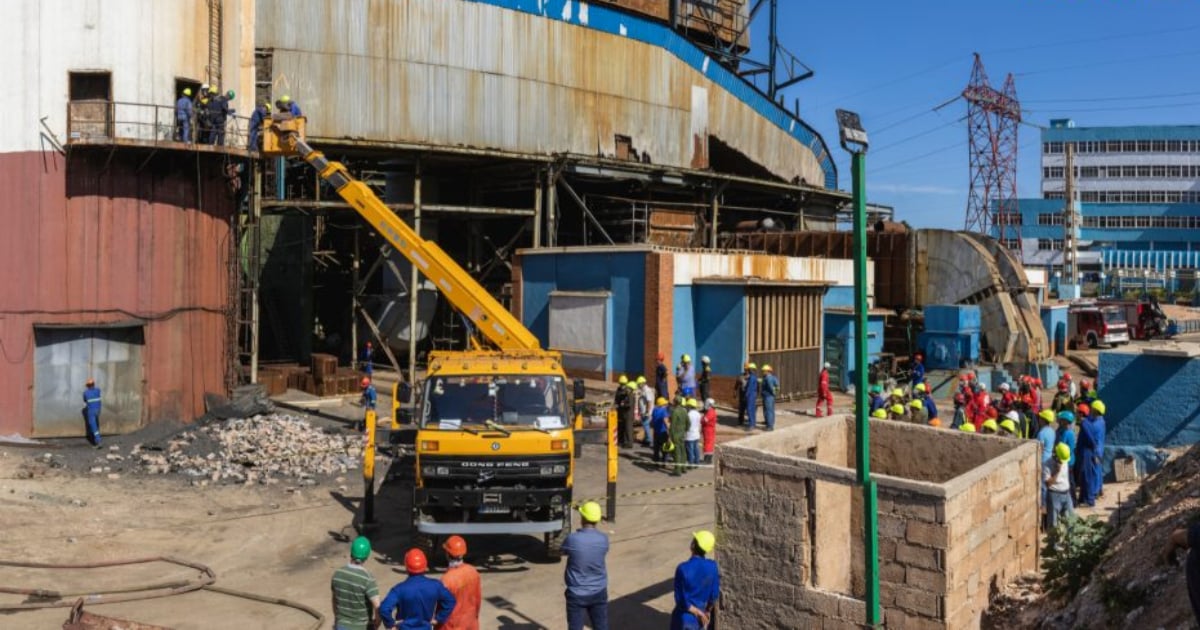
Amidst the ongoing crisis in Cuba, a pressing question is circulating among its citizens: how many power plants could potentially be constructed with the $18 billion managed by the Grupo de Administración Empresarial S.A. (GAESA), which is aligned with the Revolutionary Armed Forces? The query gained traction following a Facebook post by Javier Bobadilla, who speculated that this amount could not only significantly boost Cuba's energy production but also leave surplus funds for oil purchases.
"The fact that GAESA has $18 billion floating around, without any clarity on its origins or current whereabouts, is a financial marvel attributed to the late General López-Calleja. (...) Where is this money? Nobody knows. López-Calleja orchestrated his scheme skillfully, but now it's beginning to unravel," Bobadilla remarked.
Transforming Cuba's Energy Landscape with $18 Billion
Bobadilla's post, fueled by the ongoing debate around GAESA's resources, encapsulates the frustration felt by many Cubans. Despite the existence of these funds, the regime has not allocated them to address the country's urgent needs. He asserts, "Even without being an expert, I can confidently say that there's enough money to multiply Cuba's energy capacity fivefold and still have plenty left over for purchasing oil."
Based on global pricing benchmarks and Cuba's current circumstances, an investment of $18 billion could finance approximately 12 modern combined-cycle power plants, each with a capacity of 500 MW. This would more than satisfy the nation's electricity demands, drastically reducing power outages.
Alternatively, this capital could be directed toward fuel acquisition for electricity production. Purchasing around 225 million barrels of crude oil would sustain the country's current electricity consumption for over 15 years. While these are rough estimates, they underscore the transformative potential of these funds if redirected to alleviate the energy crisis.
Misuse of Resources: A Political Choice
Bobadilla shares a theory supported by numerous comments: "Why not invest in power plants? Because no general can yet claim ownership of a power plant in Cuba and charge for electricity in dollars. Hotels and real estate, however, are a different story. But that might change soon," he predicted.
Economists like Pavel Vidal highlight that GAESA functions as a shadow central bank, amassing reserves without redistributing or investing in essential sectors. Despite the average monthly salary being around $16, the military conglomerate received over 9,260 million pesos from the state budget in August 2024, without paying a single dollar in taxes.
In Cuba, a mere $43 million annually is enough to supply 63 essential medications, and $250 million could stabilize the national power grid. These figures pale in comparison to the $18 billion GAESA holds back. Yet, the money is neither allocated to these critical areas nor invested in energy infrastructure but remains in national and foreign accounts or is funneled into tourism, even as the sector declines.
The K23 Hotel: A Symbol of Misplaced Priorities
In 2024, amidst rolling blackouts and fuel shortages, the government inaugurated the K23 Tower, a luxury hotel in Havana funded by GAESA. Standing 154 meters tall with over 560 rooms, its construction cost between $226 and $565 million, according to estimates for such projects using imported materials.
The hotel's estimated power consumption is around 1.93 MW continuously, a stark contrast to the frequent breakdowns of the country's thermal power plants. With that investment, the government could have repaired several plants or built a power plant similar in capacity to the Antonio Guiteras, yet they prioritized a tourism symbol devoid of visitors.
Questionable Decisions Amidst Economic Struggles
Prime Minister Manuel Marrero insists that tourism is the "engine of Cuba's economy," despite the sector failing to meet its goals for over three years and showing negligible recovery. While new hotels rise, Cubans endure blackouts, food shortages, overwhelmed hospitals, and wages that don't cover basic needs.
Visitor arrivals have dropped by more than 60% compared to 2019, hospitality services face constant criticism, and competitiveness is low. Even Tourism Minister Juan Carlos García Granda admitted that 2024 marked "the worst moment." Other ministers acknowledge that the food industry and agriculture can't sustain the sector, forcing imports that further deplete foreign currency reserves.
The "tourism first" mentality has eroded food production, public services, and the healthcare system. Instead of investing in energy infrastructure or enhancing living standards, the regime channels resources into an industry that fails to support itself. Calculations indicate that with GAESA's immobilized funds, Cuba could completely revamp its electrical system or secure fuel for over a decade. Still, the government opts for empty hotels and grandiose tourism projects.
Exploring the Impact of GAESA's Financial Choices on Cuba
What could $18 billion accomplish for Cuba's energy infrastructure?
With $18 billion, Cuba could potentially finance approximately 12 modern combined-cycle power plants, each with a 500 MW capacity, or purchase enough crude oil to sustain electricity consumption for over 15 years.
Why doesn't the Cuban government invest in energy infrastructure?
The Cuban government prioritizes tourism and other sectors over energy infrastructure because it aligns with their economic strategy, despite the detrimental impact on the country's energy supply and living standards.
How does GAESA function within Cuba's economy?
GAESA operates as a parallel central bank, accumulating reserves without redistributing or investing in critical sectors, contributing to the economic challenges faced by the Cuban population.