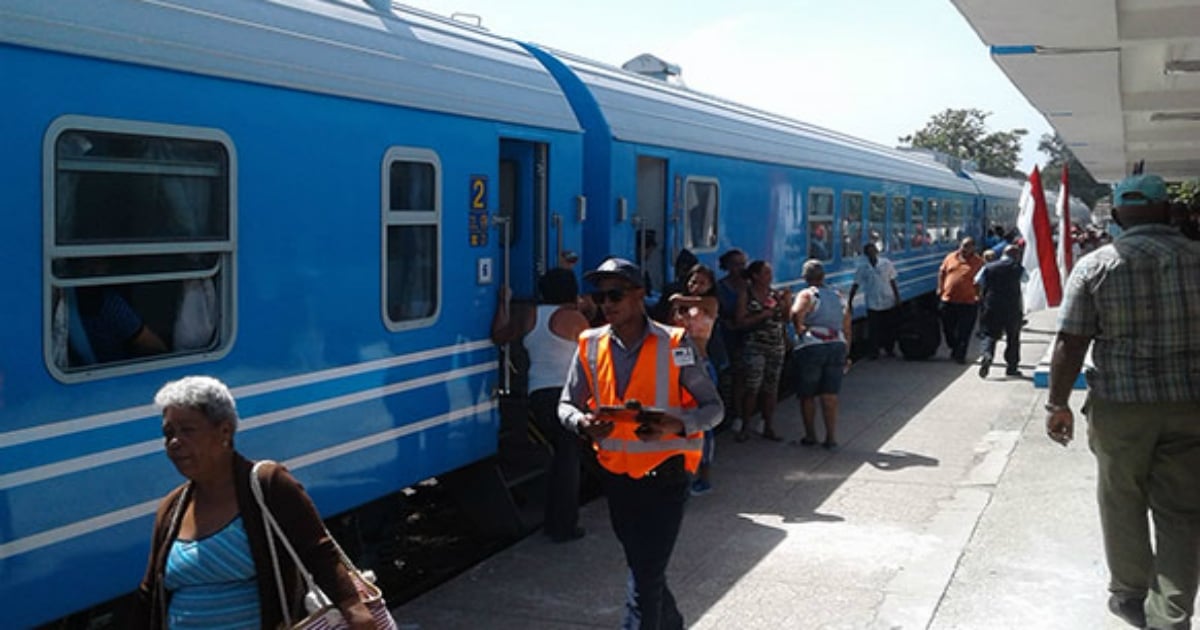
This past Friday, Granma newspaper reported the launch of field tests for offering Wi-Fi on national trains, promoting it as a step towards modernizing transportation. These tests took place on the night of August 7, involving specialists from the Cuban Telecommunications Company and the Railway Company for Communication Technologies, Signaling, Informatics, and Electricity (COSIE).
According to the state-run media, the Telecommunications Integrated Solutions Company (Solintel S.A.), in partnership with the Cuban Telecommunications Company and Railway Communication Technologies (COSIE), claimed to have successfully validated the Wi-Fi infrastructure and service quality on car 6407 of the train running the Havana-Guantánamo route. This project, winner of the Innova 2024 contest by the Informatics and Telecommunications Business Group (GEIC), is highlighted as an innovation that will regulate radioelectric emissions and enhance passenger experience.
Official narratives position this initiative as part of Cuba's "digital transformation" in transportation, aligning with new internet access options in the country. However, this announcement paints a starkly contrasting image against reality: just two days earlier, the same train was involved in an accident that revealed the chronic deterioration of the island's railway system.
The Derailment That Exposed the Cracks
On August 6, at 2:30 p.m., the Guantánamo-Havana train derailed outside Matanzas, near the Bellamar Caves. Over 820 passengers were aboard when seven cars left the tracks, damaging approximately 200 meters of the Central Line and halting rail traffic for more than 24 hours. Five individuals sustained injuries, with three hospitalized for minor injuries.
Among the injured were two train attendants, one struck by falling passengers during the jolt, and a passenger who suffered head and elbow injuries. Although none were in critical condition, all remained under medical observation. Initial investigations point to track deterioration as the cause. The engineer, upon detecting the issue, activated the emergency brake, preventing a larger disaster. Nevertheless, the extent of the damage required the deployment of repair crews and the transfer of remaining passengers by bus.
Innovation Amidst a System on the Brink of Collapse
The contrast is glaring: while the propaganda machine emphasizes train connectivity, the basic infrastructure continues to fail. Cuba's railway system has suffered decades of neglect, with deteriorating tracks, outdated rolling stock, and recurring accidents year after year.
The Wi-Fi project itself faces technical and financial hurdles: vast areas of the network lack coverage, specialized equipment is necessary, and there's no defined business model. All this in a country plagued by frequent power outages, costly and limited internet access, and public transportation barely able to meet service demands.
A Long-Delayed Announcement
The promise of Wi-Fi on trains isn't new. The government first introduced it in March 2023 as part of a plan for passengers to access email, web browsing, social media, and the corporate intranet. At that time, it was promised that the service would be operational on specific routes by the end of the year, a goal that was not met.
In May 2024, Solintel announced initial field tests without specifying routes or costs, acknowledging the lack of funding for widespread deployment. Deadlines were extended, tests continued, and obstacles remained. That the Wi-Fi validation on the Havana-Guantánamo route was "successfully" announced on August 8, right after an accident on the same line, is not just a coincidental misfortune: it reflects the official priority order, where the image of modernity overshadows addressing structural issues threatening passenger safety and lives.
While Wi-Fi on trains could be an improvement for travelers, its announcement amidst a fragile and dangerous railway system raises more questions than it answers. The gap between technological promises and broken tracks causing derailments highlights that in Cuba, the modernization narrative often runs on tracks desperately needing something more urgent than wireless connectivity: safety, maintenance, and reliability.
Key Questions About Cuba's Railway Wi-Fi Initiative
What is the purpose of the Wi-Fi project on Cuban trains?
The Wi-Fi project aims to modernize Cuban transportation by providing passengers with internet access, enhancing their travel experience by allowing them to access email, web browsing, social media, and corporate intranet.
What caused the recent train derailment in Cuba?
The preliminary investigation indicated that the train derailment was caused by deteriorating tracks, highlighting the chronic neglect and disrepair of Cuba's railway infrastructure.
What challenges does the Wi-Fi initiative face?
The initiative faces several challenges, including technical and financial barriers such as lack of coverage in many areas, need for specialized equipment, and unclear business models, alongside the country's frequent power outages and limited internet access.