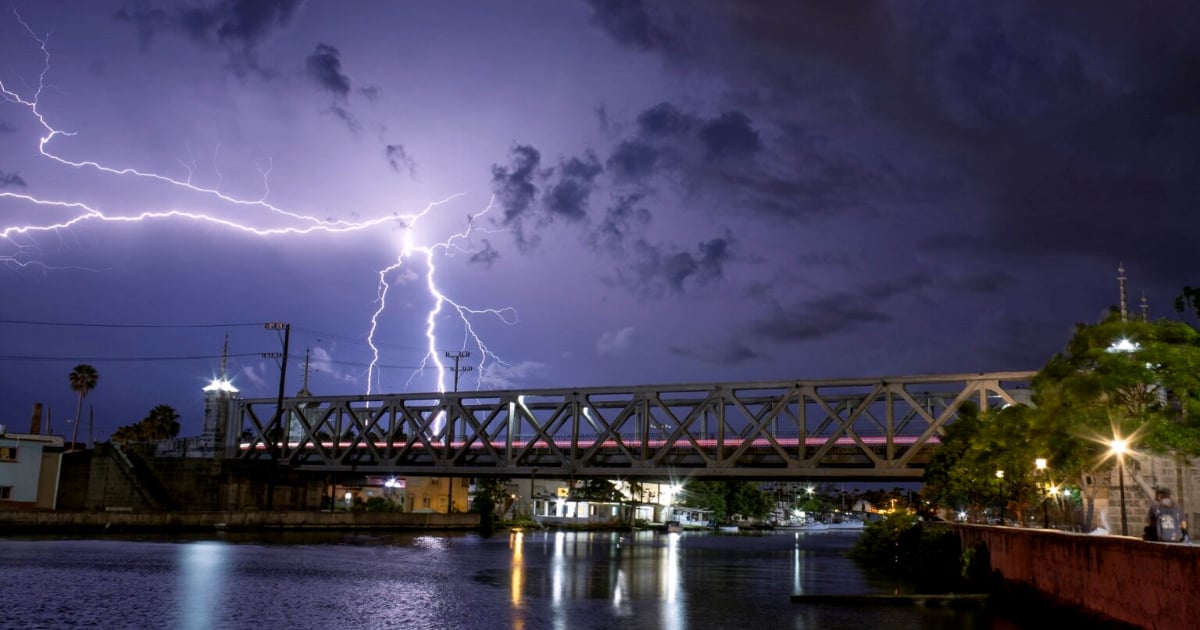
A 42-year-old woman tragically lost her life on Friday in the Colón municipality of Matanzas province after being struck by lightning while working on agricultural tasks near the La Luisa community.
The incident, which occurred in the afternoon, was reported by the Civil Defense Council of the area. The unfortunate news was relayed by the command center at the Mario Muñoz Monroy General Teaching Hospital, where she was transported without vital signs.
Raisdel Naya, head of the Risk and Disaster Reduction Management Center (CGRRD) in Colón, confirmed the tragic event and extended condolences to the victim's family and friends.
This tragic event takes place during a particularly deadly summer for lightning strikes in Cuba. In June, two teenagers, aged 13 and 16, died in Bauta, Artemisa, while playing soccer outdoors when struck by lightning. That same day, in a separate but equally tragic incident, a three-year-old girl drowned at Playa Baracoa.
In July, a group of young people in Ciego de Ávila narrowly escaped being struck by lightning while playing soccer during a thunderstorm. Meteorologist Frank Fernández Castañeda criticized the event as "recklessness that could cost lives" and reiterated warnings against outdoor activities during such conditions.
In August, beyond the fatality in Colón, the Manicaragua municipality in Villa Clara reported the death of three teenagers and one injured minor due to a lightning strike during an afternoon storm.
Statistics underscore that lightning strikes are the leading cause of death from natural phenomena in Cuba, even surpassing hurricanes. From 1987 to 2017, an average of 54 deaths occurred annually, totaling 1,742 victims over three decades, according to data from the Ministry of Science, Technology and Environment (CITMA) and the Institute of Meteorology.
Experts highlight that lightning can strike miles away from the storm's core. They advise seeking shelter in enclosed buildings or vehicles at the first sound of thunder, avoiding trees, poles, metal structures, and bodies of water, and halting any activities in open spaces.
The tragedy in Colón serves as a stark reminder that underestimating these natural phenomena can have fatal consequences and that preventive education remains crucial for saving lives.
Understanding the Risks of Lightning Strikes in Cuba
What is the leading cause of death from natural phenomena in Cuba?
Lightning strikes are the leading cause of death from natural phenomena in Cuba, surpassing even hurricanes.
How many lightning-related deaths occur annually in Cuba?
On average, 54 people die annually in Cuba due to lightning strikes, based on data from 1987 to 2017.
What precautions should be taken during a thunderstorm in Cuba?
During a thunderstorm, it is advised to find refuge in enclosed buildings or vehicles, avoid trees, metal structures, and bodies of water, and cease any outdoor activities.