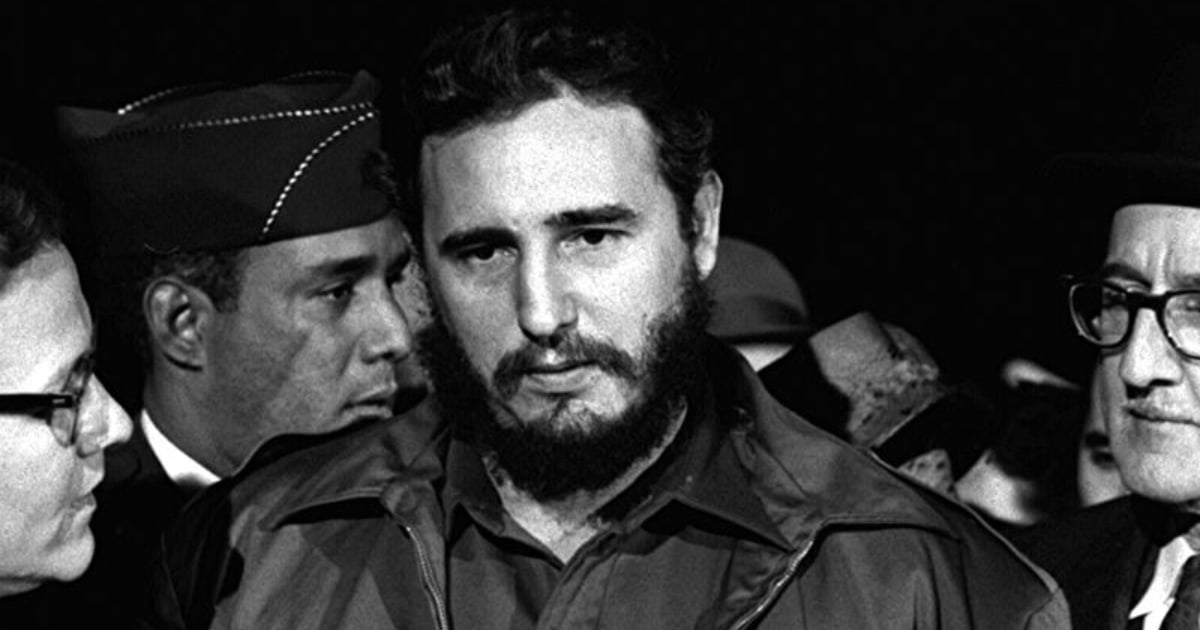
As the countdown to the centennial of dictator Fidel Castro's birth approaches, the Cuban regime has invoked one of his most violent phrases to reinforce its narrative. "If the Revolution is thwarted, the counterrevolution triumphs, and the counterrevolution could only succeed here on the basis of a sea of blood, a true sea of blood," the official newspaper Granma declared on its official X account. This phrase, originally from a speech on February 3, 1959, in Guantánamo, is being circulated by the Communist Party of Cuba's (PCC) official outlet as part of a campaign celebrating Castro's 100th birthday, which will occur in 2026.
Going beyond a mere historical commemoration, the government has made it clear that it will use the late dictator's image as an active political tool. "It's not about remembering him, it's about bringing him into this moment," stated Miguel Díaz-Canel, president and first secretary of the PCC, during the closing of the Tenth Plenum of the Central Committee in July, as he unveiled the centennial commemorative program. According to Díaz-Canel, the aim is to present Castro as a "living symbol of the Revolution."
Economic Crisis and Propaganda
However, this official strategy is overshadowed by a deep systemic crisis that manifests itself through prolonged daily blackouts, rampant inflation, widespread shortages, stagnant wages, and mass impoverishment. The Cuban populace, increasingly disillusioned, finds no solace in either past memories or current rhetoric. This somber reality contrasts sharply with recent revelations by El Nuevo Herald, which exposed how the monopoly conditions under which the Grupo de Administración Empresarial S.A. (GAESA)—the military elite's conglomerate—operates as a state within a state, amassing at least $18 billion that could potentially address many of the island's pressing issues.
Using History as a Political Weapon
Castro, born on August 13, 1926, in Birán, Holguín, and deceased on November 25, 2016, in Havana at the age of 90, is being wielded to reinforce a hardline stance. His image is used in school propaganda, children's workshops at his museum, and speeches that justify using violence to maintain power. Despite Castro's own wishes that no monuments be erected in his honor, the regime has turned his image into a cult object, dedicating an expensive museum in Havana, inaugurated in November 2021 in a luxurious Vedado mansion.
This center has faced criticism for its focus on indoctrinating children. Since July 2024, children aged 6 to 14 have participated in museum workshops, acting as guides and parroting official speeches about Castro. These activities, labeled as educational, have been criticized for being propaganda tools meant to perpetuate the Castroist ideology among new generations.
Repression as a Political Strategy
The "sea of blood" quote is not a warning from the past; it is a message directed at the present. On July 11, 2021, when thousands of Cubans took to the streets demanding freedom and food, the regime responded as hinted in that old speech: with repression, mass arrests, and unprecedented militarization. The combat order given by Díaz-Canel on July 11 was not just a tactical response; it remains a political line.
Ironically, in the same 1959 speech, Castro claimed the revolution had not come to power "for a group of men to rule," insisting that the people were the true governors and that the revolutionary triumph meant "first and foremost, the end of all that politicking and hypocrisy that characterized our country's public life." He emphasized that the revolution meant "not only that the people are free, not only that crime is over, not only that abuses, torture, beatings, and humiliations have ended for any citizen... but that the men now in power are nothing like those who have always been in power, whether under a dictatorship or even constitutional governments."
He also highlighted how "in a rich country like this, a hardworking and intelligent people like the Cuban people, a nation where 25 or 30 million people could live, the six million of us are practically starving here." A phrase that, 66 years later, resonates with even harsher truth, not due to its relevance but because of the evident failure of all promises made.
While the ruling elite insists on reviving the "historic leader" as an ideological shield, the population endures a present of misery, without power, food, or hope for the future. If anything, the regime has demonstrated over the years that it is willing to literally apply the threat of a sea of blood to cling to power.
Understanding the Cuban Regime's Strategies
What did Fidel Castro mean by "sea of blood"?
Fidel Castro's "sea of blood" remark was a warning that the counterrevolution could only succeed through violent means, implying significant bloodshed.
How is the Cuban regime using Fidel Castro's image today?
The Cuban regime is leveraging Fidel Castro's image to strengthen its narrative and maintain political control, using his legacy as a tool for propaganda and indoctrination.
What are the main challenges faced by the Cuban population today?
Cuban citizens face prolonged blackouts, rampant inflation, shortages, stagnant wages, and widespread poverty, exacerbating their daily struggles.