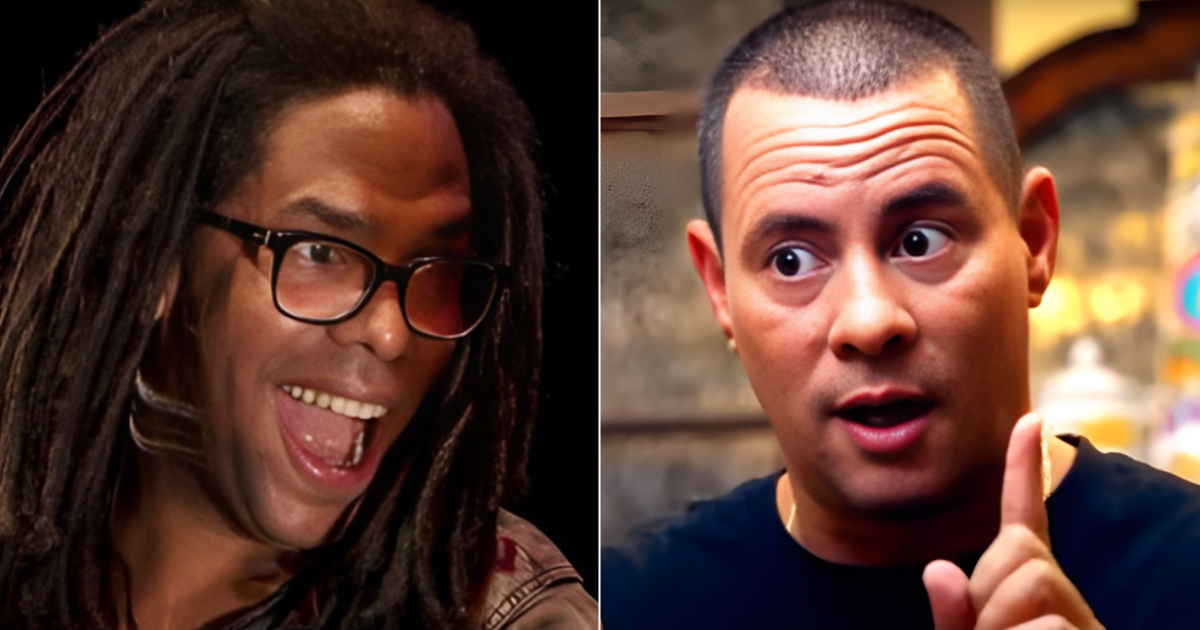
Cuban singer and songwriter Raúl Torres, known for his allegiance to the regime, has publicly defended Israel Rojas, the frontman of the band Buena Fe, following a controversial interview published by the independent outlet La Joven Cuba (LJC). In a fiery social media post, Torres characterized Rojas's interview as a "home run performance" and lashed out at LJC, labeling it a "counter-revolutionary" outlet engaging in "witch-hunt journalism."
Torres's post was full of praise for Rojas, whom he described as a "titan of Cuban culture" representing "a new Cuba breaking ancient chains." According to Torres, Rojas's perspective neither conforms to dogma nor aligns with dissidence. "Isra, a hardworking artist, a lucid critic... is unafraid to point out both the criminal U.S. blockade and our own internal mistakes. That's his greatness," Torres wrote.
In a passionate defense, the troubadour, known for his propagandistic anthems dedicated to Castro and Hugo Chávez, used emotional and grandiose language to attack the interviewers, accusing them of trying to "fish in troubled waters" with "ideologically biased questions." Torres claimed that LJC aimed to extract a controversial statement from Rojas to "feed the counter-revolutionary circus."
Media Manipulation and Dual Narratives
At the heart of his message, Torres criticized independent Cuban media and their growing influence on national public debate. He asserted that what truly bothers them is that Israel Rojas "doesn't fit their binary narratives," as his discourse "demands change without abandoning the [revolutionary] essence."
This argument, however, was met with skepticism by civil society sectors, who view Rojas's recent statements as an image-cleansing strategy more aimed at gauging the social climate than expressing genuine criticism of the system.
Torres's Nostalgic Rhetoric
One of the more contentious parts of Torres's post is his claim that the dictator Fidel Castro would have "raised a glass" in response to the interview, as Rojas "defends the Revolution by criticizing what doesn't work."
Contrary to this idealized view of "revolutionary" criticism, much of the Cuban public saw in the interview an attempt by the Buena Fe leader to appear tolerant after years of strict alignment with the official discourse and hostility toward those who protested during the July 11 social upheaval.
Torres also invoked his personal history to justify his loyalty to the regime: "I'm a Black man from a once-hungry family to whom the revolution gave dignity, education, and work," he wrote, making it clear that his support for figures like Rojas or leader Miguel Díaz-Canel is unwavering.
Lis Cuesta's Role in the Aftermath
Just a day after the controversy, Lis Cuesta Peraza, director of events at the Ministry of Culture and wife of Díaz-Canel, announced on social media that Rojas would join her class at the Instituto Superior de Arte (ISA) to discuss Cultural Industries. "The Management course will be honored with creators who break barriers," she wrote.
This move is interpreted as part of a strategy by the regime to rehabilitate criticized figures without breaking with the system. Rojas, widely criticized for denying the existence of political prisoners and legitimizing the July 11 repression, faced a wave of skepticism after suggesting, in his LJC interview, the possibility of pardoning some protesters. Many saw his words as a calculated attempt to reposition himself without bearing the political cost of genuine self-criticism.
The immediate appearance of Cuesta Peraza to include him in an "academic debate" is seen as a symbolic maneuver to frame him as a renewing actor, but always within the limits of the official discourse. The ISA, under the influence of the "not-first lady," has become a useful stage to promote what the regime attempts to present as "openness," while ignoring the repression, forced exile, and censorship faced by other critical artists.
Cuesta Peraza, known for her militant loyalty to the regime and rhetorical excesses on social media, seems now to play a key role in the symbolic reintegration of worn-out figures into the Castroist narrative. Her initiative, however, has been met with the same skepticism as Rojas's interview: as part of an official script to feign changes without altering anything.
Insights into the Controversial Interview
What was Raúl Torres's reaction to Israel Rojas's interview with La Joven Cuba?
Raúl Torres defended Israel Rojas and criticized La Joven Cuba, calling Rojas's interview a "home run performance" and labeling the outlet as "counter-revolutionary."
How did Torres describe Israel Rojas?
Torres described Rojas as a "titan of Cuban culture" who represents a "new Cuba breaking ancient chains" and praised his ability to criticize both the U.S. blockade and Cuba's internal mistakes.
What is the significance of Lis Cuesta's invitation to Israel Rojas?
Lis Cuesta's invitation to Rojas to participate in a debate at the Instituto Superior de Arte is viewed as a regime strategy to rehabilitate criticized figures without breaking from the system.