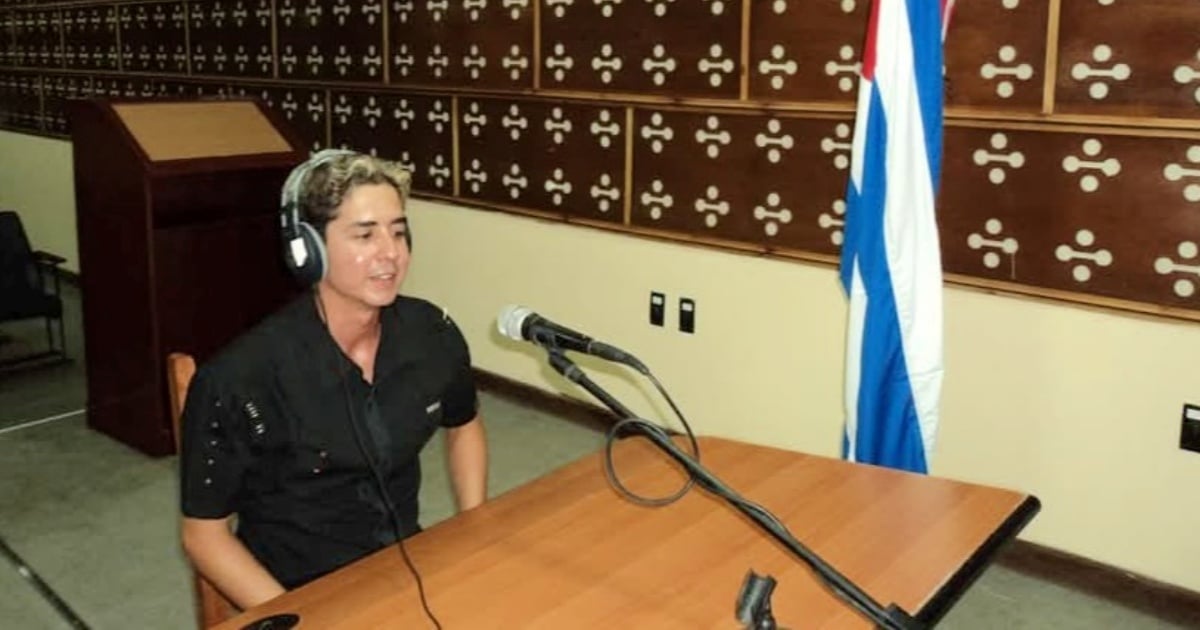
Enrique Pérez Fumero, a journalist affiliated with the official CMKC radio station and a university professor in Santiago de Cuba, remains in critical condition following a brutal assault in the early hours of Sunday in the historic center of the eastern city. On Monday night, Víctor Hugo Leyva Sojo, the provincial president of the Union of Cuban Journalists (UPEC) in Santiago de Cuba, reported that Pérez Fumero is "clinically stable despite the severity" of his injuries.
"Dear friends, I just returned from the 'Saturnino Lora' Provincial Hospital. I spoke with Dr. Ricardo Hodelin Tablada, Head of the Neurosurgery Department, and the doctors in Intermediate Therapy to learn about the status of our friend and colleague Enrique Pérez Fumero. At this moment, he is clinically stable within the gravity of his condition," Leyva Sojo explained.
The official source emphasized that Pérez Fumero is "in a better position to receive care in that unit," and remains under "strict observation." Leyva Sojo also mentioned that "for more effective treatment and monitoring, no visitors are allowed in that ward," and any changes in the patient's condition will be communicated.
Institutional Delays Under Scrutiny
The official response came only after Yosmany Mayeta Labrada, a journalist from Santiago now based in Washington, denounced the incident and the prolonged silence of state media, which avoided reporting the event for more than 24 hours. Mayeta was the first to disclose the attack and has provided ongoing updates, including a series of posts on Tuesday morning that contrast with the statements made by the UPEC president in Santiago, highlighting the collapse of Cuba's public health system.
"Enrique Fumero is being urgently transferred to the province of Las Tunas because in Santiago de Cuba - the country's second-largest city - THERE IS NO FUNCTIONING CT SCAN OR MRI. That's the harsh reality," Mayeta wrote.
He further explained, "What does that mean? If you don't make noise on social media, you don't matter. Enrique isn't the only critically ill patient in Santiago, but he is one of the few who had the fortune to go viral. Without public pressure, he would still be lying in a bed, waiting for a piece of equipment that doesn't exist."
Mayeta also criticized the lack of essential medical equipment, which jeopardizes thousands of Cubans who, like Enrique, rely on a deteriorated system without the capability to respond. "How dare they speak of a 'medical power' when they can't even diagnose in time? Thousands of Cubans die without knowing what killed them. Not because of their illness, but due to neglect," Mayeta questioned, calling for a "Chain of Outrage" and public denunciation of Pérez Fumero's plight.
Criticisms Against Official Coverage
In another post, Mayeta Labrada described the official coverage of the case as "cynical." He asserted, "Enrique is not alive thanks to the system. He is alive despite the system. Instead of journalism, you perform public relations for the authorities, whitewashing the healthcare disaster in Santiago de Cuba," he stated.
"Where were you when Enrique was being moved from hospital to hospital without a basic examination because THERE'S NO CT SCAN OR MRI IN SANTIAGO? Where were you when family members begged for help, and you looked the other way, as you always do with cases not approved by the Party Committee?" Mayeta asked, calling official sources "hypocrites."
"You don't report; you sugarcoat tragedies. You don't investigate; you obey. You don't denounce; you applaud while people die without care," he emphasized.
Yosmany Mayeta claimed that Enrique Pérez Fumero is not receiving care thanks to CMKC, the Ministry of Public Health, or the regime, but is receiving better attention now "because thousands of Cubans raised their voices, because the case went viral, and because you couldn't hide it."
The Brutality of the Assault
According to details previously shared by Mayeta Labrada, the attack occurred at the intersection of Barnada and San Mateo streets, in the historic heart of Santiago de Cuba and just a few blocks from the iconic Moncada Barracks. Pérez Fumero was violently beaten until he lost consciousness and remains hospitalized with a skull base fracture and multiple facial fractures.
"He barely breathes, barely speaks, but he is still alive," Mayeta wrote, adding that along with the theft of his belongings—Converse shoes, a mobile phone, and a wallet—his family does not rule out a homophobic motive behind the violence.
The initial silence from institutions was one of the most criticized aspects by Mayeta and other Santiago-based journalists who have expressed their outrage at the lack of response from state media and cultural organizations, despite the injured journalist's years of service within the official system.
"CMKC is silent. The official press is silent. The authorities are silent," Mayeta declared in a message demanding justice and a transparent investigation into what happened. "Today it was Enrique... tomorrow it could be anyone. Violence cannot continue ruling the streets as if it were part of the landscape. Action must be taken, and it must be taken now," he warned.
While some figures in the journalistic community and close friends of the journalist have publicly expressed their concern and wishes for his recovery, the case continues to generate a wave of reactions on social media, where users have shown their support using hashtags like #FuerzaEnrique.
Key Questions About the Assault on Enrique Pérez Fumero
What is the current health status of Enrique Pérez Fumero?
Enrique Pérez Fumero remains in critical condition but is clinically stable according to the latest reports from the hospital where he is being treated.
Why was there a delay in reporting the attack on Pérez Fumero?
There was a delayed response from official media, which avoided reporting the incident for more than 24 hours. This delay was criticized by journalist Yosmany Mayeta Labrada, who first disclosed the attack.
What concerns have been raised about Cuba's healthcare system in light of this incident?
The incident has highlighted issues such as the lack of essential medical equipment, which puts patients' lives at risk. This has led to criticisms of Cuba's healthcare system's capability to respond to emergencies.