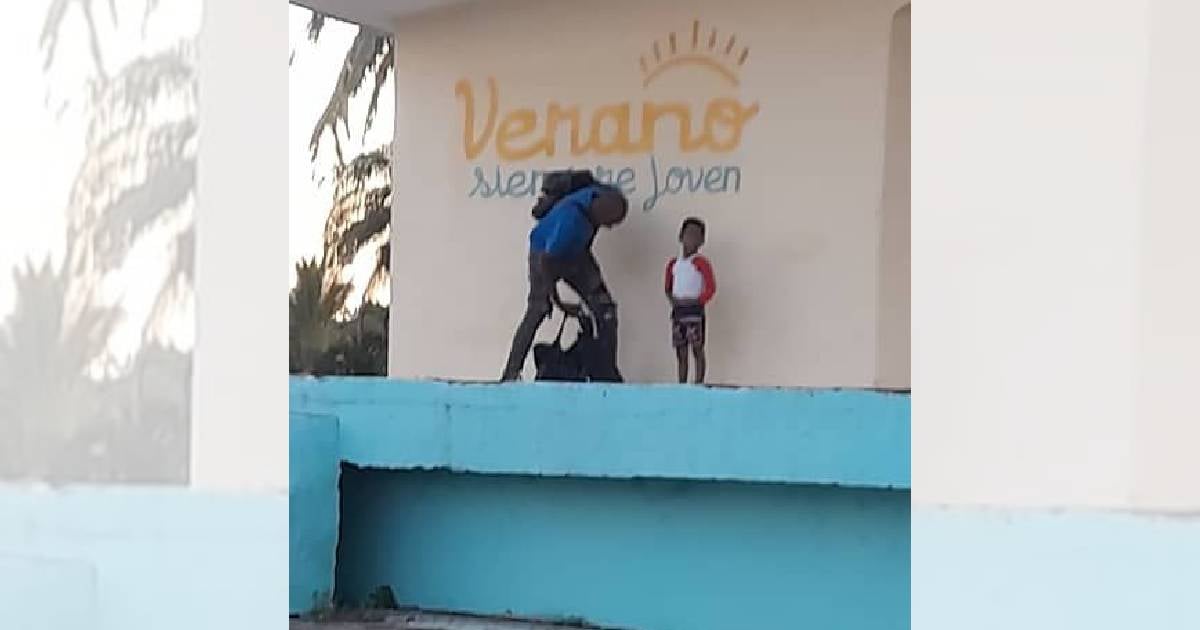
During the typical Sunday agricultural fair at the Plaza del Tenis in Matanzas, a startling scene unfolded as an entire family was found sleeping on the ground beneath a makeshift platform. Covered with little more than rags and cardboard, this image starkly contrasts with the Cuban government's claims of social protection. A follower shared the account on Facebook's La Tijera page, detailing her early morning visit to purchase food, when she witnessed “something I never imagined seeing in Cuba.”
The scene was heart-wrenching: adults—two elderly men, a young man, and a woman holding a baby—were scavenging through the discarded produce left by vendors. “They were eating rotten mangoes with such desperation and hunger that it left me speechless. The child approached me asking for money. It pained me to see the adults leaving him behind, not helping him down from the platform… I had to help him myself. He was dirty, in torn clothes, with a sadness in his eyes that couldn’t be faked,” she described.
This poignant image raises a critical question: where are the social services? The observer noted that she took the accompanying picture after the family had risen to respect their dignity, but during that early hour, many witnessed their plight.
State Neglect and Social Reality
The account directly challenges the Cuban state's narratives, recalling former Minister of Labor and Social Security's claim that Cuba has no beggars, only “disguised” individuals. However, the reality in Matanzas is undeniable: unfiltered poverty, visible suffering, and official neglect.
While the Cuban government uses euphemisms like “homeless” and “vulnerable” to downplay the issue, a growing number of elderly, sick, and marginalized people struggle to survive outdoors in Matanzas and other provinces. They lack effective policies or genuine will from the government to address what’s been swept under the carpet. Even the official press has acknowledged this, showcasing a forgotten layer of society where people who have lost almost everything—home, family, mental health, work—struggle to survive by scavenging.
Official Reports and Public Outcry
The provincial newspaper Girón highlighted this grim reality on August 1st, revealing the dire conditions faced by dozens of “homeless” individuals at the Social Protection Center in Jagüey Grande. The report “Inhabitants of the Dust (II): The Land that Was Never Promised” portrays the place as more of a “cemetery of living men” than a shelter.
Within its crumbling walls, untended mattresses, and bleak corridors, people with physical disabilities, mental disorders, and elderly without family endure, many left there without visits, regular medical care, or social assistance. On July 14, the then-Minister of Labor and Social Security, Marta Elena Feitó Cabrera, sparked outrage by denying the existence of beggars in Cuba. Her comments blaming citizens for their poverty led to widespread indignation on social media, independent media, and among the public.
Shortly after, the Communist Party's Political Bureau and the Council of State accepted her resignation following a “joint analysis” with government leadership. Days later, the government acknowledged that over 310,000 residents are living in poverty or social vulnerability amid a deep economic crisis.
Government Response and Ongoing Challenges
The Council of Ministers' Agreement 10056/2025 categorizes “homelessness” as a “multifaceted human behavior disorder” involving “home instability, lack of self-care and economic autonomy, familial neglect, and absence of a favorable life project.” However, the measure fails to address how to reverse homelessness, instead focusing on managing its visibility. As one user commented on Cubadebate, “Eradicating homelessness is one thing; eradicating beggars is another.”
The regime attributes the increase in street homelessness to family neglect and the tightening of the U.S. embargo. In late April, another report by Girón exposed one of Cuba’s most painful realities: the extreme precarity faced by thousands of retirees who, after decades of work, find themselves forced to live on the streets.
Understanding Poverty and Homelessness in Cuba
What did the observer witness at the Matanzas fair?
The observer saw a family sleeping on the ground under a platform at the fair, scavenging for food among discarded produce, and a child asking for money, all amid visible poverty and neglect.
How does the Cuban government describe homelessness?
The Cuban government refers to homelessness as a “multifaceted human behavior disorder,” citing factors like home instability and lack of familial support, rather than addressing the structural causes of poverty.
What was the public reaction to the Minister’s statements on poverty?
The Minister’s denial of beggars in Cuba and blaming citizens for their poverty led to a backlash on social media and independent media, culminating in her resignation after a governmental review.
What is the current situation for retirees in Cuba?
Many retirees in Cuba live in extreme precarity, forced to survive on the streets despite decades of work, highlighting the severe economic and social challenges they face.