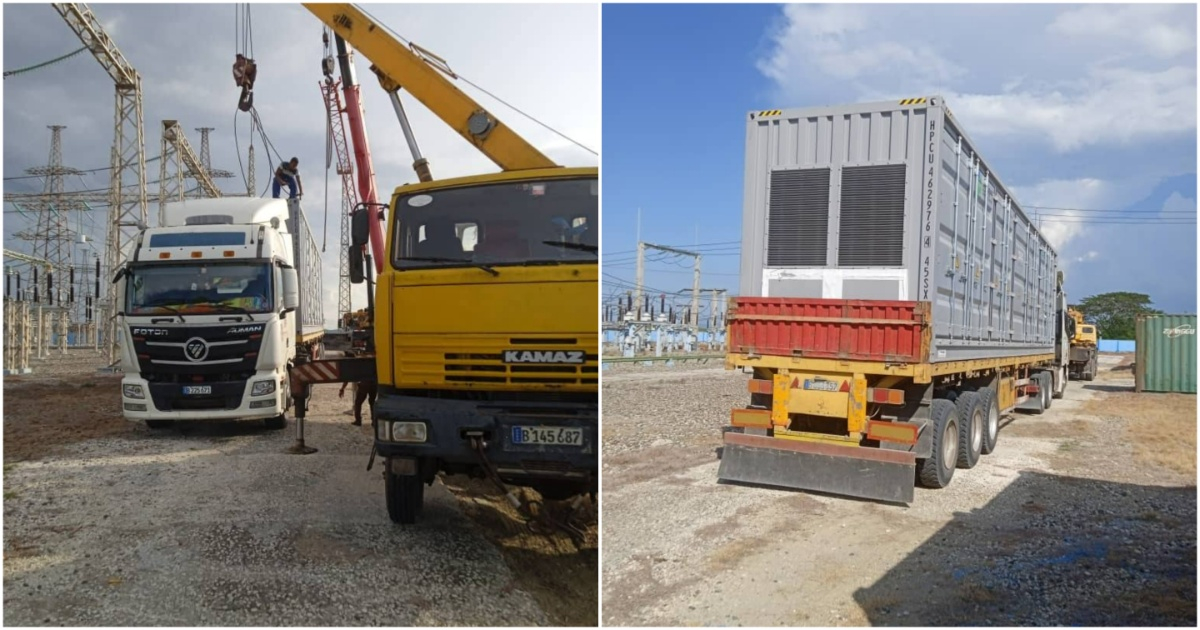
On Saturday, Cuba initiated the installation of solar energy storage batteries at four electrical substations, marking a significant step in addressing its energy challenges. These Battery Energy Storage Systems (BESS), also referred to as "concentrator units," are being placed at Cueto 220, Bayamo 220, Cotorro 220, and Habana 220 substations. The deployment was reported by state journalist José Miguel Solís on Facebook, accompanied by images of the installation process.
Each battery system has the capacity to store 50 MW, primarily harnessing renewable sources like solar energy. Solís explained that in solar projects, BESS units store surplus energy generated during daylight, to be used when production is low, such as at night, or when demand surges. This initiative aims to provide a more consistent and reliable power supply by optimizing solar energy utilization.
Solís emphasized that the system encompasses not just the batteries but also includes inverters and management systems that regulate charging and discharging, ensuring both efficiency and safety. "BESS systems play a crucial role in integrating renewable energies into the power grid by alleviating the inherent intermittency of solar and wind power, thus enhancing the stability and resilience of energy supply," he concluded.
This development addresses a major critique of the Cuban government's solar energy strategy: the prior absence of battery storage. With the island facing a severe energy crisis, the Cuban regime has turned to the rapid deployment of solar parks as a potential solution. Last month, Energy and Mines Minister Vicente de la O Levy stated, "The only way to solve the energy crisis is by continuing to install renewable energy sources."
Cuba's electrical system has deteriorated significantly due to poor maintenance of thermal power plants, lack of funding, and reduced domestic and imported fuel generation. In this scenario, renewable sources—particularly solar parks—emerge as the most viable and swift alternative. According to the minister, modernizing a thermal plant takes at least two years, whereas a solar park can be set up in just three months. "Neither the money nor the time justifies clinging to outdated methods," asserted de la O Levy, a sentiment echoed by the Cuban Presidency's official account on social media.
Despite official optimism, numerous hurdles remain. The initial investment required to expand the renewable energy matrix is steep, and Cuba lacks access to fluid credit lines or consistent suppliers due to sanctions and its own financial instability. The country also faces technological and logistical challenges in effectively integrating solar energy into its outdated and vulnerable national grid.
Persistent Power Outages Amid Infrastructure Changes
While some hoped the return of the Guiteras thermal power plant might alleviate blackouts, the Ministry of Energy and Mines announced the disconnection of the Turkish power barge docked in Havana's port on Saturday. "Today, the 240 MW barge in Havana will be disconnected for commercial reasons," explained the electricity director. Measures are being taken to ensure this disconnection does not exacerbate current power issues, reported state journalist Lázaro Manuel Alonso on Facebook.
Thus, even with the reintegration of the Antonio Guiteras Thermal Power Plant, one of the country's most crucial energy units, power outages will persist with no significant changes across Cuba. According to a report from the Unión Eléctrica (UNE) on Saturday, the nation experienced disruptions for 24 hours the previous day, continuing into the early hours today.
As of seven a.m. on Friday, the National Electric System (SEN) had an energy availability of just 1,895 MW against a demand of 3,245 MW, indicating a capacity shortfall of 1,325 MW. During peak hours, availability is expected to increase slightly to 2,022 MW, while maximum demand is estimated at 3,700 MW. This scenario could lead to a deficit of 1,674 MW and potential power disruptions affecting up to 1,744 MW, prolonging blackouts nationwide.
Understanding Cuba's Energy Crisis and Solutions
Why is Cuba focusing on solar energy and battery storage?
Cuba is investing in solar energy and battery storage to address its severe energy crisis, reduce dependency on fossil fuels, and improve the reliability and stability of its power supply.
What challenges does Cuba face in expanding renewable energy?
Cuba faces challenges such as high initial investment costs, limited access to credit and suppliers due to sanctions, and technological and logistical hurdles in integrating solar energy into its outdated national grid.
How do Battery Energy Storage Systems (BESS) benefit Cuba's power grid?
BESS units store excess energy generated from renewable sources during low-demand periods, providing a stable energy supply when production is low or demand is high, thus enhancing grid stability.