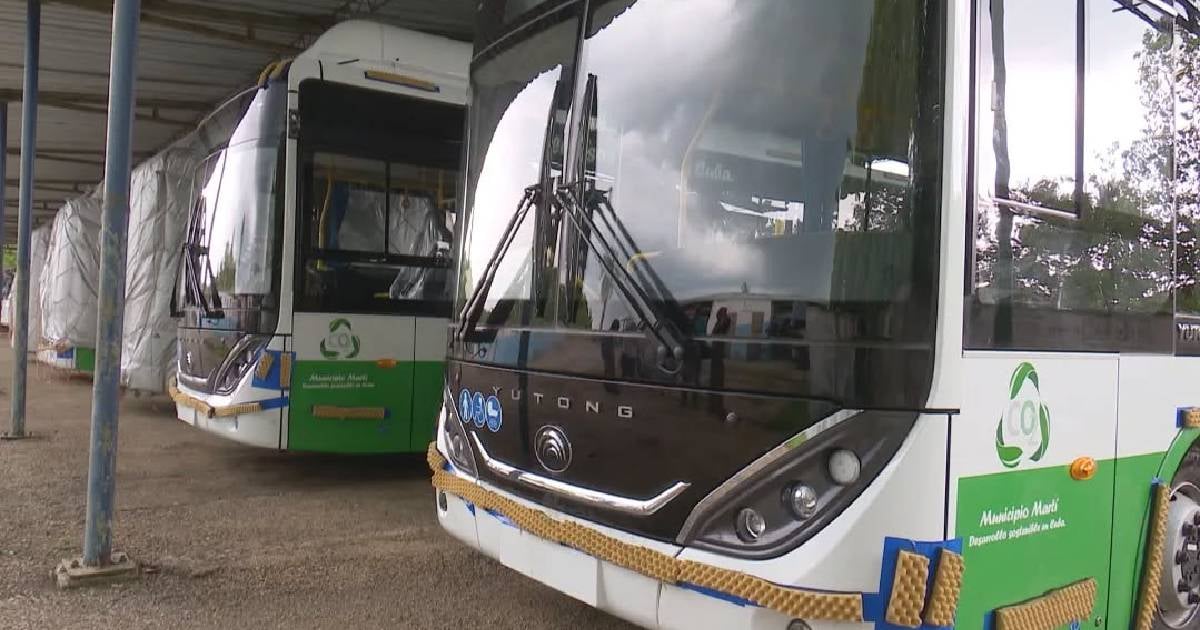
In a bid to embrace energy sovereignty and carbon-neutral transportation, the local government in Martí, Matanzas province, has announced the impending rollout of five buses powered by biomethane. These Chinese-manufactured Yutong buses will serve all community councils with routes connecting significant locations such as hospitals in Colón, Cárdenas, and Matanzas, according to Geovanny Castanedo Larena, the municipality's mayor, in an interview with the provincial TV Yumurí channel.
Despite the announcement, specifics regarding the buses’ operational schedules, frequency, and conditions remain undisclosed. The biogas refinery, intended to process gas from local pig farms, is still not operational. While a 14-kilometer gas pipeline has been installed and construction of the system’s infrastructure progresses, final operations are pending the installation of a critical upper membrane.
Biodigesters equipped with membranes will produce the fuel, yet details about production capacity, supply stability, or long-term maintenance strategies were not provided. The initiative could potentially benefit over 22,000 residents in the municipality.
This project is part of the international "Global Action for Climate Change" initiative, managed in Cuba by the Ministry of Economy and Planning, with support from the United Nations Development Program (UNDP) and funding from the European Union, which contributed five million euros out of a total of 33 million pesos.
Simultaneously, local authorities claim to be paving over 13 kilometers of road as part of this investment, addressing 17 proposals from the Economic Plan, though it's unclear if these improvements align with the planned bus routes or are separate efforts.
Despite official optimism, skepticism remains high due to past initiatives that stalled due to lack of resources, maintenance, or technical support. Residents are left wondering how long these buses will operate before ending up sidelined like many previous promises.
Cuban authorities assert that the nation will become a global leader in clean energy, aiming for a swift transition, although citizens continue to endure a severe electricity crisis with frequent blackouts. Cuba heavily relies on imported fuel, with around 50% of its petroleum coming from abroad, necessitating a shift to more efficient technologies.
During a broadcast in March on the "Mesa Redonda" program, Ramsés Monte Calzadilla, director of Policy and Strategy at the Ministry of Energy and Mines (Minem), suggested that incorporating electric vehicles could enhance efficiency four to five times compared to current combustion vehicles, significantly reducing fuel consumption. He noted, for instance, that a conventional vehicle achieves 10 kilometers per liter, whereas an electric vehicle with the same energy could cover 40 to 50 kilometers per liter equivalent.
He also highlighted successful local implementations, like the electric vehicles used by Aguas de La Habana since 2018, which maintain a technical availability rate above 90%. Additionally, the introduction of industrial heat pumps to replace conventional boilers has substantially improved energy efficiency and reduced fuel consumption in industrial and tourism sectors.
Facing a worsening energy crisis, the Cuban government is accelerating the establishment of solar parks as a primary solution. In this context, Cuba and Japan have launched a collaborative project to boost renewable energy on the island amid the severe decline of its electrical infrastructure and the persistent blackouts affecting millions of Cuban families.
Key Questions about Cuba's Biomethane Bus Initiative
What is the source of biomethane for the new buses in Cuba?
The biomethane will be produced from biogas generated by local pig farms and refined at a dedicated plant, which is still under development.
Who is funding Cuba's biomethane bus project?
The project is funded by the European Union as part of the "Global Action for Climate Change" initiative, with a contribution of five million euros.
How does Cuba plan to achieve energy sovereignty?
Cuba aims to achieve energy sovereignty by transitioning to renewable energy sources, such as solar power and biomethane, and reducing dependency on imported fuel.