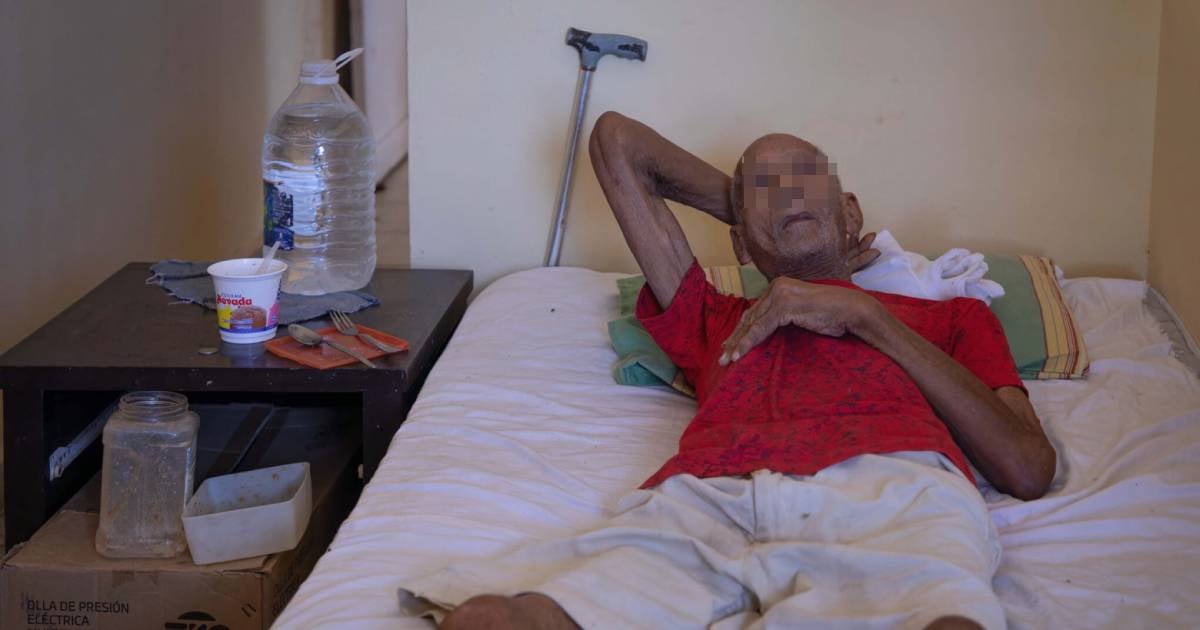
A recent journalistic investigation has exposed the dire circumstances faced by dozens of homeless individuals at the Social Protection Center in Jagüey Grande, located in Cuba's Matanzas province. Titled "Dust Dwellers (II): The Land That Never Was Promised," journalists Humberto Fuentes Rodríguez and Guillermo Carmona Rodríguez from Girón newspaper document the living conditions in this facility, which, according to gathered testimonies, resembles "a cemetery for the living" more than a shelter.
The AG-37 building, where the center is housed, was once a rural school and part of a citrus plan hospital. Today, amidst peeling walls, unkempt mattresses, and bleak corridors, individuals with physical disabilities, mental disorders, and elderly without family survive, often without visits, regular medical care, or legal and social assistance.
Elioel Peña, who has been managing the place since the pandemic, states that there is no permanent medical staff, no assigned hygiene kits, and no consistent institutional support. The center operates independently, lacking effective administrative backing. The only sporadic aid comes from the Municipal Health Directorate, which provides salaries and food, albeit with limitations. On some days, even a main meal isn't assured.
The testimonies collected in the report reveal that residents suffer from untreated illnesses, emotional scars, and shattered lives. Many have exceeded the legally mandated 90-day stay, with some remaining since the pandemic began, unaware of the reasons for their confinement. One resident, known as "El Máquina," who has psychiatric issues and was once part of the national Basque pelota preselection, has been waiting two years for housing solutions. Others, like Alexis, Lesme, and Rolando Ezequiel, share makeshift rooms amid broken promises, water bottles, and overwhelming silence.
The sole documented institutional gesture was a governmental visit in May, which, according to the incident logbook, involved no interaction with the patients. Just a few kilometers away in Cárdenas, the contrast is stark. Its Social Protection Center, established in 2022, operates with structure, cleanliness, medical care, specialized staff, and inter-institutional support.
The report highlights that Cárdenas fulfills the "ideal" role of such institutions: serving as a hub for transitioning, classifying, and reintegrating vulnerable individuals. The difference seems to lie in the political will and daily commitment of local authorities, as well as a clearly defined chain of responsibilities.
The investigation recalls that since 2022, there have been promises to create a center in Matanzas city, the provincial capital. Despite budget allocations in several fiscal years, the project never materialized. By 2025, it wasn't even included in the economic plan, the report notes. As millions of pesos go unspent, dozens remain confined in Jagüey Grande under inhumane conditions, while senior regime officials attempt to hide the truth. A minister even resigned after denying the existence of homeless individuals on the island.
The current hope is limited to two debated locations: one occupied by illegal families and another under a military-controlled agro-industrial company. The words of Rolando Ezequiel, one of the residents, encapsulate the collective sentiment: “You can't trust what you see or hear. Everything is an illusion.” The report concludes with an urgent call for institutional responsibility: constructing a center in the provincial capital is not a luxury but an imperative necessity.
Understanding the Crisis at Jagüey Grande Shelter
What are the main issues faced by residents at the Jagüey Grande shelter?
Residents at the shelter face severe neglect, lack of medical care, inadequate facilities, and poor living conditions. Many have been there far beyond the legal limit without any clear housing solutions.
How does the situation in Jagüey Grande compare to Cárdenas?
While the shelter in Jagüey Grande suffers from neglect and mismanagement, the center in Cárdenas functions effectively with proper structure, medical care, and inter-institutional support, highlighting a stark contrast in local governance and commitment.