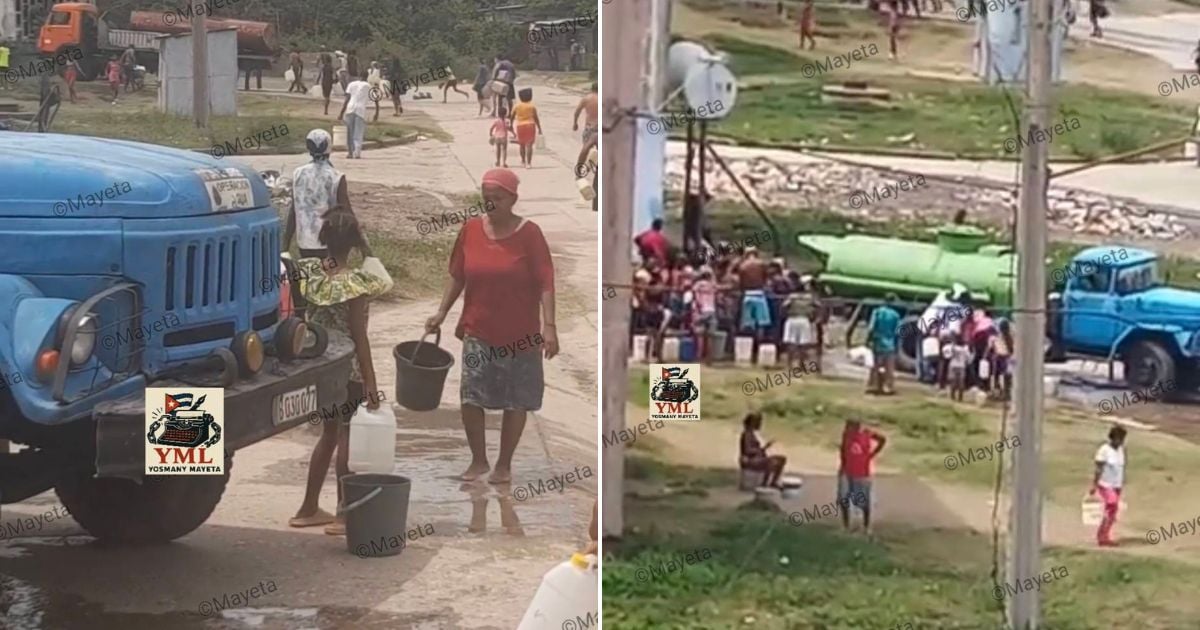
The city of Santiago de Cuba is grappling with one of its worst water crises in recent memory. Key reservoirs are operating at under 20% capacity, while the majority of the population relies on a failing infrastructure that can barely sustain water delivery amid a prolonged drought affecting the southeastern part of the province since early 2025. The city center is the hardest hit, with reservoirs at only 17.8% capacity. However, overall, the 16 reservoirs in the area managed by the National Institute of Hydraulic Resources are at 65% capacity, according to hydraulic sector officials.
The core issue lies in the fact that 89% of the total 470 million cubic meters of water are stored in distant reservoirs such as Carlos Manuel de Céspedes (Contramaestre) and Protesta de Baraguá (Mella), making it challenging to transport water to the provincial capital, as reported by the official newspaper Sierra Maestra. Reservoirs like Gilbert, Charco Mono, and Gota Blanca—exhausted since April—are nearly dry, holding less than 20% of their capacity. Only Parada maintains somewhat stable levels, necessitating water to be pumped from the Céspedes reservoir via the Mogote Transfer to prevent Gilbert from completely drying up.
Despite these efforts, the system falls short for a city heavily reliant on the deteriorating Quintero system. Ludmila Rodríguez Barroso, director of Aguas Santiago, acknowledged that 80% of the city depends on Quintero, which is plagued by leaks, faulty valves, and rampant theft of over 4,000 water meters.
Efforts to ease the situation include investments in pumping stations, refinery wells, and the Boca de Cabaña desalination plant, but the outlook remains dire. The situation is worsened by a dwindling fleet of water trucks, with only 12 out of 30 operational at the Water and Sewer Company, forcing reliance on support from other agencies to serve vulnerable communities. However, this response remains inadequate given the scale of the crisis.
With distribution cycles growing longer, entire areas are without stable service, and temporary measures fail to address the root of the problem, leaving residents of Santiago in despair and neglect. The water shortage continues to worsen daily, and official promises feel as empty as the reservoirs.
In Santiago de Cuba, the country's second-largest city, many areas have gone over two months without receiving essential water supplies. Recently, Rodríguez admitted, "There is no water, and there is no forecast" for when the service might stabilize. She noted that only one of the five pipelines in the Quintero system is operational, limiting water intake to just 900-1,000 liters per second, far below what's needed for a stable distribution cycle.
Neighborhoods such as Altamira, Van Van, Versailles, El Caney, Boniato, and El Cristo are among the most affected. Some areas have gone over 60 days without piped service, relying solely on water trucks. In several communities within San Luis municipality, accessing water is as challenging as "crossing Niagara Falls on a bicycle" due to drought, collapsed infrastructure, and illegal charges for water trucks, forcing thousands to survive without full access to a basic human right.
Cuba's water crisis continues to worsen, with alarming conditions in multiple provinces. The presence of live animals in the water reaching homes in Sancti Spíritus has sparked outrage on social media, where residents report finding larvae, worms, snails, and even fish coming from pipes supposedly meant for potable water. In Guantánamo, the main reservoir is nearly dry, leaving the population without assured water supply and creating an emergency scenario amid the summer.
In the capital, water scarcity is exacerbated by electrical instability, directly affecting pumping and distribution in the most populous neighborhoods. Thousands of homes in Matanzas lack stable supply due to simultaneous water pump failures, while authorities attempt to manage the situation with partial repairs and truck deliveries.
Nationally, the figures are stark: more than half a million Cubans are affected by the drought, with provinces like Las Tunas and Holguín facing prolonged supply outages.
Understanding Cuba's Water Crisis
Why is Santiago de Cuba facing such a severe water crisis?
Santiago de Cuba is facing a severe water crisis due to a combination of prolonged drought, failing infrastructure, and distant reservoirs that make it challenging to transport water to the city.
What measures are being taken to address Santiago de Cuba's water shortage?
Efforts to address the water shortage include investments in pumping stations, refinery wells, and the Boca de Cabaña desalination plant, along with support from water trucks, although these have proven insufficient.
How are residents coping with the water crisis in Santiago de Cuba?
Residents of Santiago de Cuba are struggling with prolonged periods without water, relying on water trucks, and facing a dire situation worsened by inadequate infrastructure and support.