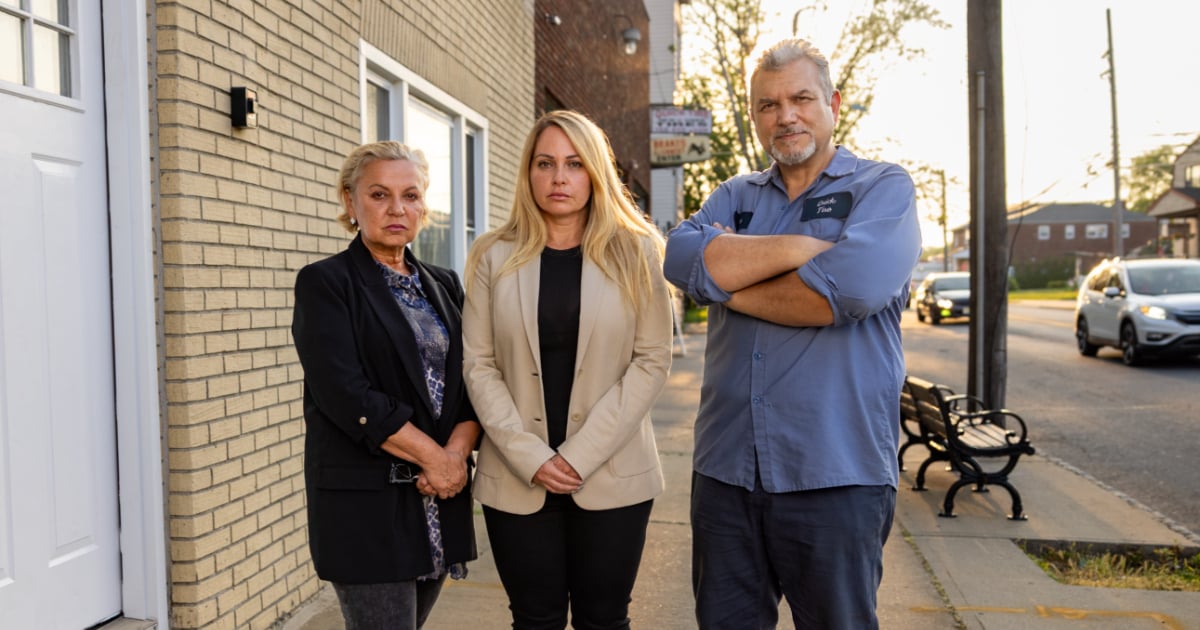
Residents of Perth Amboy, New Jersey, Honey Meerzon and Luis Romero, find themselves entangled in a legal battle with the city over attempts to acquire their properties through eminent domain. Both individuals highlight their family histories of escaping communist regimes in the Soviet Union and Cuba.
Meerzon, whose family fled the USSR in the 1970s, purchased a multifamily home in 2016, which now houses four families. “My family came here seeking a better life. I earned a master’s degree, and invested in this property, only to now face losing it to someone with connections,” she expressed to Townhall.
Romero, owner of Quick Tire & Auto since 1976, recounted how his father left Cuba post-Fidel Castro’s rise, fearing forced recruitment for the Angolan war. “I’ve always been grateful to the U.S. as my home. I never imagined they could legally take away my property like this,” he stated.
City's Justification and Legal Challenge
The city of Perth Amboy labeled the properties as “blighted” to integrate them into a 44-acre urban development scheme. The Institute for Justice (IJ) filed a lawsuit arguing that the report supporting this classification cited trivial reasons like “two pieces of cardboard at the entrance” and “a stray cat.” Romero mentioned additional claims of his shop being “too close to the sidewalk,” a common feature in the area.
Despite no citations for urban code violations and offers to modify their buildings to meet project standards, the property owners say their proposals were rejected. Public hearings saw 80 to 100 neighbors opposing the measure, but the city council approved it with only one dissenting vote.
Eminent Domain and Constitutional Rights
The IJ contends that these properties do not meet the legal criteria for being considered blighted under state law. In a post on social media platform X, the organization stated, "They have worked tirelessly to build successful businesses and hope to leave a legacy for future generations. Now, the city of Perth Amboy, New Jersey, seeks to take their properties, citing trivial reasons like minor litter and a stray cat. If Honey and Luis's properties aren't safe from #EminentDomain, no one's is."
In the U.S., eminent domain allows the government to acquire private property for public use with just compensation, as mandated by the Fifth Amendment. Unlike expropriations in communist regimes, the U.S. Constitution prohibits takings without compensation and requires public purpose justification, along with the right to appeal.
However, following the Kelo v. City of New London (2005) decision, local governments can apply eminent domain for private projects if they assert a “public purpose.” New Jersey revised its laws after this ruling but still allows expropriation in areas deemed “blighted,” a term that attorney Bobbi Taylor (IJ) argues “has expanded to mean almost anything.”
Understanding Eminent Domain in New Jersey
What prompted the legal dispute involving Meerzon and Romero?
Meerzon and Romero are contesting the city's attempt to seize their properties under eminent domain, arguing that the classification of their properties as "blighted" is unjustified.
What does eminent domain entail in the United States?
Eminent domain in the U.S. allows the government to acquire private property for public use with fair compensation, as protected by the Fifth Amendment.
How did the Kelo v. City of New London case affect eminent domain laws?
The Kelo decision expanded the scope of eminent domain, allowing local governments to claim private properties for private projects if they argue a public purpose is served.