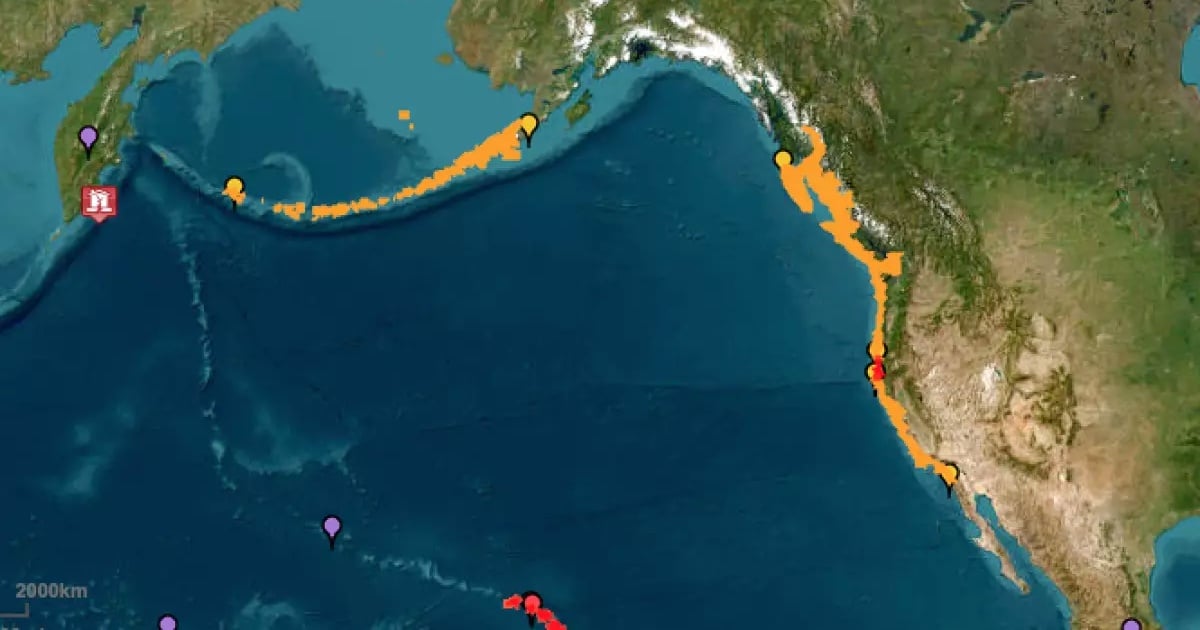
In the early hours of Wednesday, tsunami waves made landfall along the U.S. West Coast, following a powerful 8.8 magnitude earthquake that jolted Russia's Kamchatka Peninsula. This seismic event triggered tsunami alerts across the entire Pacific region.
"A significant earthquake in the Pacific Ocean has prompted a Tsunami Alert for Hawaii residents. A Tsunami Watch is in effect for Alaska and the U.S. Pacific coast, while Japan is also on alert. Stay informed by visiting official sources. STAY SAFE AND SECURE!" tweeted former President Donald Trump.
The National Weather Service (NWS) reported that the initial waves, some exceeding 3.5 feet (1.07 meters in Crescent City), reached Northern California shores shortly before 1:00 a.m. local time. Affected areas include Crescent City and Humboldt Bay, among other parts of California's coastline.
Authorities in Crescent City have urged residents to remain vigilant and stay away from the water. The wave activity extended southward, reaching San Francisco at 1:12 a.m., where rapid tide fluctuations were observed.
"We are now witnessing tidal oscillations ranging from 2 to 2.5 feet within just 15 minutes," the NWS reported on social media platform X. "Such conditions can create extremely hazardous currents on beaches and in harbors," they added.
The warning is clear: keep a distance from the water. Officials emphasize that although the first waves have already hit, additional surges may occur in the following hours. Crescent City, home to fewer than 6,000 people and located just 15 miles from the Oregon border, has been identified as the area most at risk of flooding. The city was placed under a tsunami alert from early Tuesday night.
The alert extends along the entire West Coast, from Southern California to Oregon and Washington. In Arena Cove, waves reached 1.6 feet; in Monterey, 1.4 feet; and in Crescent City, smaller waves were also recorded in addition to those over a meter, according to CNN reports.
Russia's Most Powerful Quake in 14 Years
The earthquake that triggered this series of alerts struck at 7:24 p.m. ET (Eastern Time), with a depth of just 8.2 miles off the coast of Petropavlovsk-Kamchatsky, in Russia's far east. It marks the strongest quake globally in the past 14 years, with significant impacts felt throughout the Kamchatka region.
In the area, several individuals sustained injuries while hurrying to evacuate buildings; one patient leaped from a hospital window, and a medical team had to secure a patient undergoing surgery during the tremors. The Russian Institute of Oceanology reported that tsunami waves along parts of the Russian coast reached heights between 33 and 49 feet (10 to 15 meters).
In Severo-Kurilsk, waves exceeded 19 feet, causing power outages and sweeping fishing vessels out to sea. A kindergarten in Petropavlovsk-Kamchatsky suffered damage, and several buildings were closed for inspection and repairs.
Japan and Hawaii Also on High Alert
The quake's magnitude activated emergency protocols across the Northern Pacific, including Japan, where over 2 million people in more than 220 prefectures were ordered to evacuate, from Hokkaido to Okinawa. Japan's Chief Cabinet Secretary Yoshimasa Hayashi warned that "waves could remain elevated for at least a day."
In Hawaii, authorities issued a tsunami alert on Tuesday afternoon. Residents were advised to move to higher ground, while tourists in hotels were directed to upper floors. Air traffic was suspended at several airports, including Hilo, to facilitate evacuations. Although the waves were ultimately smaller than feared, a wave of 5.7 feet was detected in Kahului (Maui). By 10:45 p.m. local time, authorities downgraded the alert to an advisory, allowing people to return to their homes.
Understanding Tsunami Alerts
This event also serves as a reminder to understand the various alert phases issued by the National Weather Service:
Tsunami Watch: Indicates a potential distant threat. Requires staying attentive to updates.
Tsunami Advisory: Suggests that dangerous water activity, such as strong currents or unusual tides, is likely or occurring. Advises moving away from beaches and harbors.
Tsunami Warning: Signals the imminent presence of hazardous waves capable of causing severe damage. Requires immediate evacuation to higher ground.
Frequently Asked Questions About Tsunami Alerts
What should I do during a tsunami warning?
During a tsunami warning, it is crucial to evacuate immediately to higher ground and stay informed through official channels. Avoid coastlines and wait for the all-clear from authorities before returning.
How are tsunami waves detected?
Tsunami waves are detected using a network of sea-level monitoring stations and seismic sensors. These tools help scientists predict the size, speed, and arrival time of the waves.