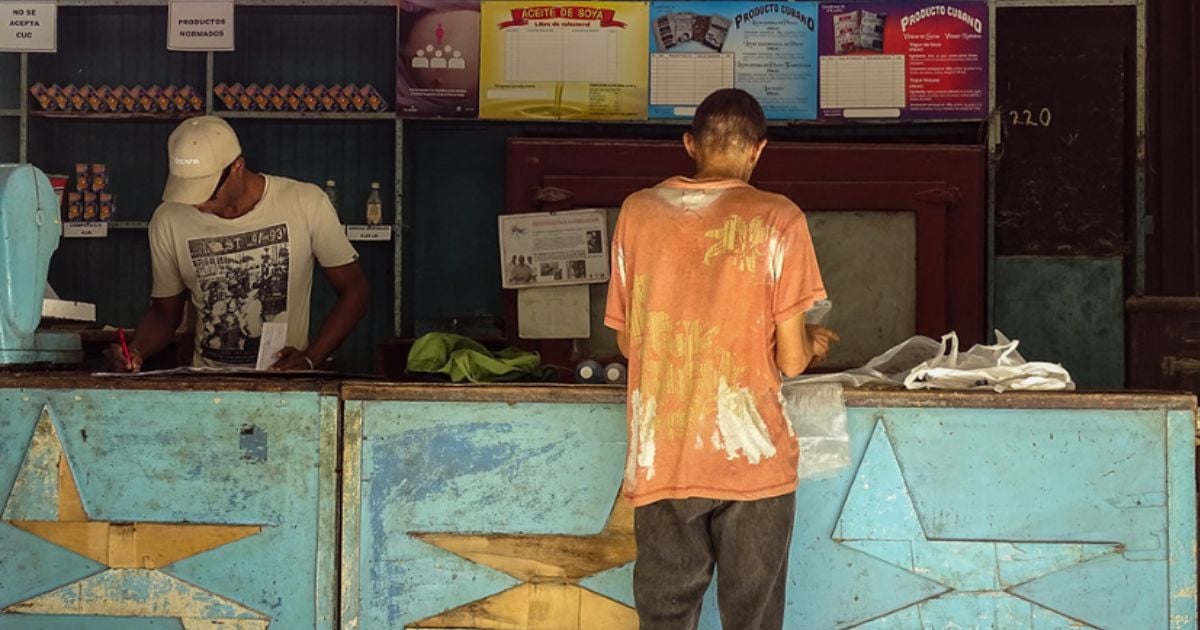
When her friend found out that their local store had been robbed the previous night, her immediate reaction was to grab her head in disbelief. She then cried, punched the wall, and blamed herself for not collecting the last few pounds of rice she was entitled to sooner. For her, it was a harsh realization that the small amount of rice available through the government store was now lost for good.
According to a report from the state-run newspaper Sierra Maestra, titled "The Store is Everyone's Business," the Commerce Company has no resources to replace the stolen goods from these outlets. Essentially, this means that residents need to quickly retrieve their rationed food because if it's stolen, the government won't replenish it. This situation has sparked anxiety among the populace, who fear losing their food supplies if they don’t act swiftly.
The economic crisis in Cuba has led to an uptick in thefts at these stores, attributed to both unscrupulous individuals and a lack of security measures in many distribution centers. The official media's call to action is explicit: families must pick up their allocations as soon as they become available, as they'll be safer at home. The same article suggests that communities should organize to safeguard these spaces and encourages the use of the Plan Jaba seal, which allows workers to authorize others to collect their goods on their behalf.
These "suggestions" unveil an uncomfortable truth: the government is unable to ensure the safety of its own facilities, instead relying on "neighborly support" to protect the increasingly scarce and insufficient food supplies distributed through rationing. This is compounded by a severe energy crisis that leaves the population vulnerable to violence.
Responsibility, according to the regime’s spokesperson, doesn’t just lie with the commerce workers. Neighbors, Committees for the Defense of the Revolution (CDR), political organizations, and those living or passing nearby are also expected to help safeguard the limited food supplies. The newspaper emphasized that what’s inside these stores is critical for many families, and losing it in such times could be a daily tragedy, highlighting the emotional manipulation often used by the regime.
The increasing number of store thefts in Cuba highlights the lack of control and security in the state distribution system. Recently, a worker was brutally assaulted during a robbery at a store in Havana, sparking outrage over the violence against staff. Soon after, two managers were caught stealing from the stores they managed, further illustrating the internal decay and state personnel involvement in these crimes.
This alarming situation has left citizens fearing both external thieves and the very people tasked with protecting the goods. Recent data reveal that over 160 state store robberies have been reported in just the first part of 2025. This official figure marks a concerning escalation and has been interpreted as a sign of the distribution model's collapse amid the country's deep economic crisis.
The Minister of Domestic Trade herself publicly acknowledged the seriousness of the issue, attributing it to both a lack of resources and organizational and security deficiencies. Her statement, rather than offering tangible solutions, confirmed that the State cannot guarantee the protection of the rationed food supplies it distributes.
Understanding the Crisis in Cuban State Stores
What is causing the increase in thefts at Cuban state stores?
The increase in thefts is attributed to unscrupulous individuals exploiting the lack of security at distribution centers, compounded by the country's severe economic crisis.
How is the government responding to the store robberies?
The government is urging residents to quickly collect their rationed food supplies and is relying on community involvement to safeguard the stores, rather than implementing effective security measures.
What are the implications of the current situation for Cuban citizens?
Citizens face the risk of losing their vital food supplies due to thefts, while also dealing with the fear of violence in an unstable environment. This adds significant stress to their daily lives.