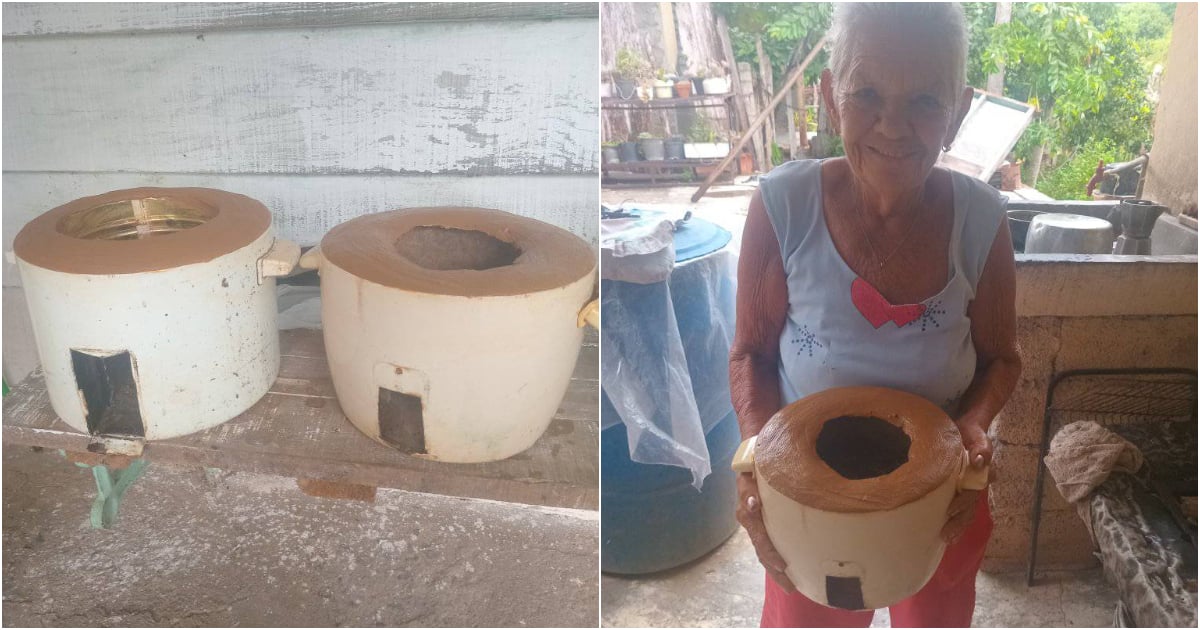
Facing the relentless power outages and energy crisis plaguing Cuba, a resourceful young man from Cumanayagua in the province of Cienfuegos has devised a clever solution. By transforming broken rice cookers and empty cans into charcoal stoves, he highlights the island's regression in the face of ongoing hardships.
Kevin David Altuna Bravo took to Facebook, specifically the Revolico Cumanayagua & Cienfuegos Cuba group, to showcase what he calls a "leisure time enterprise." He repurposes discarded materials, such as rice cookers tossed in backyards and used cans, to create small stoves that facilitate cooking during the extended blackouts.
Altuna Bravo clarified that not all the stoves displayed in his post are for his personal use. He has also crafted them for elderly neighbors in his community, aiming to ease their cooking tasks during power cuts. "I assure you it's a great idea," he wrote, emphasizing that these stoves can prepare meals quickly with minimal charcoal.
The post's comments reveal a mix of admiration and critique. While some praise his creativity, others question the need to revert to outdated technologies for survival. "After over 60 years of communism, we still have to invent ways to survive," lamented one user. Another remarked sarcastically, "This country is going back to the days of Christopher Columbus."
Others chimed in with similar methods, like using old Russian washing machine shells filled with clay to create durable stoves, underscoring an economy of patchwork where improvisation becomes a necessity to meet basic needs.
Far from being a quaint anecdote or a showcase of ingenuity, Altuna Bravo's post serves as a stark reminder of Cuba's daily struggles, where grassroots innovation replaces the deficiencies caused by the island's ongoing multi-systemic crisis. The shortage of materials and spare parts has forced Cubans to hone their creativity and resourcefulness.
Recently, a Cuban user on TikTok (@odalys6508) gained attention on social media by demonstrating how she brews coffee using a homemade contraption involving an electrical resistor, serum tubes, and a lot of creativity. What might seem like a joke is, in fact, her solution to ensure she doesn't miss her daily coffee fix.
The energy crisis and frequent blackouts in Cuba have also led residents to invent a peculiar "rechargeable fan," crafted by hand. Made from cardboard and sticks, the structure is situated outside a window and anchored to the ground, channeling wind into the home to cool the room.
In a small home factory in Cuba, a local entrepreneur has found an endless source of resources in trash. What many consider waste, he sees as raw materials reborn as useful household items.
A family living on La Clarita farm in Santiago de Cuba has turned scarcity into an opportunity to live harmoniously with nature. Inspired by permaculture and circular economy principles, they've designed an aerodynamic ecological bathroom that requires no water, generates no waste, and optimizes natural resources.
The design includes a hand-washing system where water is directly reused by plants planted at the base of the bathroom. It is indeed a survival solution.
Similarly, the water crisis has driven a Cuban woman to connect a washing machine with a hose directly to a river, a desperate attempt to maintain hygiene at home and an extreme solution to the scarcity.
Addressing Cuba's Energy and Resource Challenges
What inspired Kevin David Altuna Bravo to create charcoal stoves?
Kevin David Altuna Bravo was motivated by the ongoing power outages and energy crisis in Cuba, leading him to repurpose broken rice cookers and cans into charcoal stoves as a practical cooking solution.
How are Cubans coping with the energy crisis?
Cubans are coping with the energy crisis by utilizing their creativity and resourcefulness, inventing homemade solutions like charcoal stoves, rechargeable fans, and even designing ecological bathrooms to manage daily challenges.
What is the significance of Altuna Bravo's innovation?
Altuna Bravo's innovation serves as a testament to the daily struggles and resilience of Cubans, highlighting the necessity for grassroots solutions in response to the island's systemic crises and material shortages.